
Have you ever wondered how does cruise control work while driving on the highway? With the push of a button, your car can maintain a steady speed without keeping your foot on the accelerator. This feature makes long-distance driving more comfortable and can even improve fuel efficiency under the right conditions.
Cruise control has become a standard feature in many modern vehicles, and newer systems are more advanced than ever. While the basic idea is simple, several electronic components work together to keep your vehicle traveling at the speed you choose.
In this guide, you’ll learn how does cruise control work in a car, how different systems operate, when to use them, and what their advantages and limitations are.
What Is Cruise Control?
Cruise control is an electronic driving assistance system that automatically maintains a selected vehicle speed without requiring constant pressure on the accelerator pedal.
Once activated, the system continuously monitors your vehicle’s speed. If the car begins to slow down while climbing a hill, cruise control increases engine power. If the vehicle starts going too fast downhill, it reduces throttle input or, in some vehicles, works with the transmission or braking system to help maintain speed.
The result is smoother driving, reduced driver fatigue, and more consistent highway travel.
How Does Cruise Control Work?
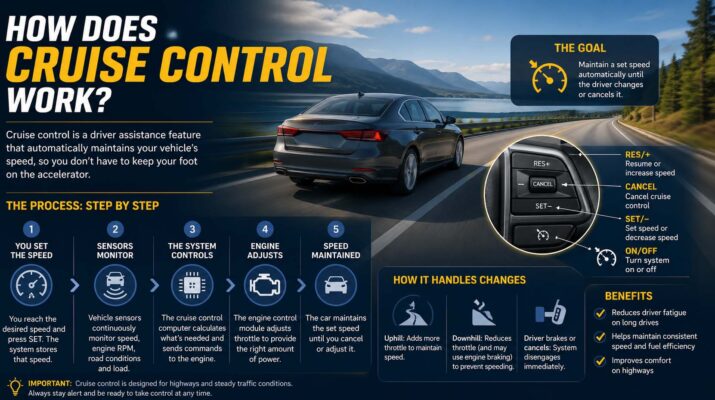
Understanding how does cruise control work becomes much easier when you look at the system step by step.
When you activate cruise control:
- You accelerate to your desired speed.
- You press the Cruise or Set button.
- The vehicle stores the selected speed in the electronic control unit (ECU).
- The ECU compares the actual speed with the selected speed.
- If necessary, it automatically adjusts the throttle opening to keep the vehicle at the chosen speed.
The process happens many times every second, allowing the vehicle to react smoothly to changing road conditions.
Unlike older mechanical systems, modern cruise control relies on electronic sensors and computer-controlled throttle systems for greater accuracy.
The Main Components That Make Cruise Control Work
Several parts work together behind the scenes.
Speed Sensors
Speed sensors measure how fast the wheels and vehicle are moving.
These sensors constantly send information to the vehicle’s computer so it knows whether speed needs to increase or decrease.
Electronic Control Unit (ECU)
The ECU acts as the system’s brain.
It receives information from multiple sensors, calculates the necessary adjustments, and sends commands to other vehicle components.
Electronic Throttle Control
Instead of relying on a cable connected to the accelerator pedal, most modern vehicles use an electronic throttle body.
The ECU controls the throttle opening electronically to maintain the selected speed.
Although today’s systems are highly computerized, understanding older fuel delivery systems—such as the parts of a carburetor—helps explain how engine speed was managed before electronic throttle control became common.
Driver Controls
Drivers interact with cruise control using steering wheel or dashboard buttons.
Common controls include:
- On/Off
- Set
- Resume
- Cancel
- Increase speed (+)
- Decrease speed (−)
These buttons allow quick adjustments without taking your hands far from the steering wheel.
Cruise Control Workflow
Here’s a simplified overview of how the system operates.
| Step | What Happens |
|---|---|
| Driver sets speed | Desired speed is stored in the ECU |
| Sensors monitor speed | Vehicle speed is checked continuously |
| ECU compares data | Actual speed is compared with target speed |
| Throttle adjusts | Engine power increases or decreases |
| Speed remains steady | Vehicle maintains selected speed |
This process repeats continuously while cruise control remains active.
How Does Cruise Control Work in a Car During Different Driving Conditions?
The system constantly adapts to changes in road conditions.
Driving Uphill
As the vehicle climbs a hill, gravity naturally slows it down.
Cruise control detects the speed drop and opens the throttle slightly to maintain the selected speed.
Driving Downhill
Going downhill has the opposite effect.
The vehicle may naturally accelerate, so cruise control reduces throttle input. Some newer vehicles can also use transmission control or gentle braking assistance to prevent excessive speed increases.
Driving Into Strong Wind
Headwinds increase aerodynamic resistance.
Cruise control compensates by increasing engine power until the selected speed is restored.
Conventional Cruise Control vs. Adaptive Cruise Control
Not all cruise control systems work the same way.
| Feature | Conventional Cruise Control | Adaptive Cruise Control |
|---|---|---|
| Maintains selected speed | Yes | Yes |
| Detects vehicles ahead | No | Yes |
| Automatically slows down | No | Yes |
| Automatically speeds back up | No | Yes |
| Uses radar or cameras | No | Yes |
Adaptive systems add another layer of automation by monitoring surrounding traffic.
We’ll explain how does adaptive cruise control work later in this guide.
Benefits of Using Cruise Control
Cruise control offers several practical advantages, especially during highway driving.
Reduces Driver Fatigue
Keeping your foot on the accelerator for long periods can become tiring.
Cruise control allows drivers to relax their right foot while maintaining a steady speed.
Helps Maintain Speed Limits
Because the vehicle automatically holds a consistent speed, drivers are less likely to unintentionally exceed the speed limit on open roads.
Can Improve Fuel Efficiency
Smooth acceleration generally uses less fuel than frequent speed changes.
For that reason, cruise control may improve fuel economy on relatively flat highways where traffic flows consistently.
Engine efficiency also depends on the vehicle’s design and power output. Understanding What Is a KW can help drivers better understand how engine performance is measured alongside fuel consumption.
Creates a More Comfortable Highway Drive
Long-distance travel becomes more enjoyable when drivers don’t need to constantly adjust the accelerator.
Many people find highway trips less stressful when cruise control handles minor speed adjustments.
Limitations of Standard Cruise Control
Although cruise control is useful, it isn’t suitable for every driving situation.
Some limitations include:
- It cannot detect slower vehicles ahead.
- Heavy traffic requires frequent driver intervention.
- Sharp curves may require manual speed adjustment.
- Wet, icy, or snowy roads reduce safety.
- Steep hills can affect speed consistency in some vehicles.
Drivers should always remain alert and keep both hands on the steering wheel, even when cruise control is active.
Modern vehicles combine many electronic systems to improve driving efficiency. Likewise, understanding topics such as alternator vs generator provides useful insight into how different vehicle components produce and manage electrical power that supports onboard electronics and control systems.
How Does Adaptive Cruise Control Work?
One of the biggest advancements in driving technology is adaptive cruise control. While standard cruise control only maintains a chosen speed, adaptive systems also monitor the traffic ahead.
So, how does adaptive cruise control work?
Adaptive cruise control uses sensors such as radar, cameras, or a combination of both to detect vehicles in front of your car. The system continuously measures the distance and relative speed of nearby traffic.
If another vehicle moves into your lane and is traveling more slowly, the system automatically reduces your speed to maintain a safe following distance. Once the road clears, the vehicle gradually accelerates back to your preset speed.
Although adaptive cruise control makes highway driving more convenient, drivers must remain attentive and ready to take control at any time.
When Should You Use Cruise Control?
Cruise control works best under predictable driving conditions.
Ideal situations include:
- Long highway trips
- Light traffic
- Straight roads
- Dry weather
- Consistent speed limits
Using cruise control in these situations helps reduce unnecessary speed changes and allows for a more relaxed driving experience.
When You Should Avoid Cruise Control
There are also times when cruise control is not the safest option.
Avoid using it when:
- Roads are wet, icy, or snow-covered.
- Traffic is heavy or constantly changing.
- Driving through construction zones.
- Traveling on winding mountain roads.
- Visibility is poor because of heavy rain, fog, or snow.
Maintaining full manual control gives you quicker reaction times when road conditions become unpredictable.
Common Cruise Control Problems
Like any vehicle system, cruise control can occasionally stop working.
Some common causes include:
Faulty Brake Switch
Pressing the brake pedal immediately cancels cruise control.
If the brake switch fails, the vehicle may think the brakes are always being applied, preventing cruise control from activating.
Blown Fuse
Many cruise control systems are protected by dedicated electrical fuses.
A blown fuse may disable the feature until it is replaced.
Damaged Speed Sensor
The ECU depends on accurate speed information.
If a speed sensor fails, the system may deactivate itself as a safety precaution.
Steering Wheel Button Failure
Worn or damaged control buttons can prevent the system from turning on or storing a desired speed.
Check Engine Light
Some vehicles automatically disable cruise control whenever the engine management system detects certain faults.
If the check engine light appears along with cruise control problems, a diagnostic scan is often the quickest way to identify the issue.
Simple Troubleshooting Checklist
Before scheduling a repair, check a few basic items.
| Problem | Possible Cause | What to Do |
|---|---|---|
| Cruise control won’t turn on | Master switch is off | Verify the system is switched on |
| System turns off immediately | Brake pedal switch issue | Have the brake switch inspected |
| Speed won’t stay constant | Speed sensor malfunction | Schedule vehicle diagnostics |
| Cruise indicator flashes | Electronic fault | Read diagnostic trouble codes |
| Feature unavailable | Warning lights active | Resolve engine or ABS faults first |
If these steps don’t solve the problem, consult your owner’s manual or have the vehicle inspected by a qualified technician.
Safety Tips for Using Cruise Control
Cruise control is designed to assist the driver—not replace them.
For safer driving:
- Keep both hands on the steering wheel.
- Stay alert to surrounding traffic.
- Watch for changing speed limits.
- Be prepared to brake at any moment.
- Leave plenty of space between vehicles.
- Turn off cruise control before entering busy city traffic.
Even adaptive systems have limitations and cannot predict every driving situation.
Common Myths About Cruise Control
Myth: Cruise Control Drives the Car for You
False.
Standard cruise control only controls vehicle speed. Steering, braking, and lane positioning remain the driver’s responsibility.
Myth: Cruise Control Always Saves Fuel
Not always.
It can improve fuel economy on flat highways with steady traffic, but hilly roads or constant speed changes may reduce that benefit.
Myth: Adaptive Cruise Control Is Fully Autonomous
No.
Adaptive cruise control is a driver-assistance feature. It does not replace an attentive driver or make the vehicle self-driving.
Myth: Cruise Control Works in Every Weather Condition
Incorrect.
Most manufacturers recommend turning off cruise control during rain, snow, ice, or other slippery conditions because tire traction may change unexpectedly.
Cruise Control and Different Vehicle Types
Cruise control is available on many kinds of vehicles, although the technology may vary.
For example, many passenger cars, SUVs, pickup trucks, and motorcycles offer some form of cruise control. Engine type generally doesn’t affect how the electronic system works, whether the vehicle uses a 2 stroke vs 4 stroke engine in specialized applications or a modern four-stroke engine found in most road vehicles.
Marine engines use different control systems altogether, which is one reason discussions about inboard vs outboard propulsion focus on boating rather than automotive technology.
Frequently Asked Questions
How does cruise control work in a car?
Cruise control stores your chosen speed in the vehicle’s electronic control unit. Speed sensors constantly monitor the vehicle, while the ECU adjusts the electronic throttle to maintain that speed.
Does cruise control use more fuel?
Usually not. On level highways with steady traffic, cruise control can help improve fuel efficiency by avoiding unnecessary acceleration.
Can I brake while using cruise control?
Yes. Pressing the brake pedal immediately cancels cruise control, allowing you to regain full manual control.
Is cruise control safe?
Yes, when used appropriately. It should only be used in suitable driving conditions and never as a substitute for attentive driving.
What’s the difference between cruise control and adaptive cruise control?
Standard cruise control maintains a selected speed. Adaptive cruise control also monitors vehicles ahead and automatically adjusts speed to maintain a safe following distance.
Key Takeaways
Understanding how does cruise control work helps drivers use this feature more confidently and safely. By combining speed sensors, an electronic control unit, and throttle control, cruise control keeps your vehicle traveling at a consistent speed with minimal driver input.
For most highway journeys, it can reduce fatigue, improve driving comfort, and even support better fuel efficiency under the right conditions. Still, it is not designed for every road or weather situation. Drivers should remain attentive, monitor traffic, and be ready to take control whenever conditions change.
Whether your vehicle uses traditional cruise control or a newer adaptive system, learning its capabilities and limitations will help you get the most from this convenient driving technology while keeping safety the top priority.