
Have you ever wondered how a solar panel system, car battery, or portable power station can run ordinary household appliances? The answer often involves an inverter. But what does an inverter do, and why is it useful in modern electrical systems?
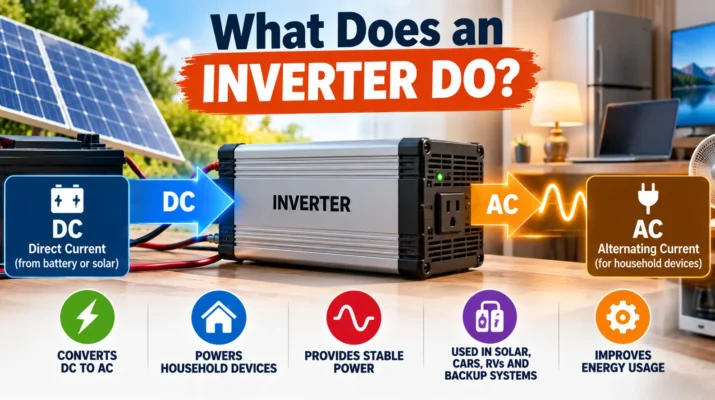
An inverter is an electronic device that converts direct current (DC) electricity into alternating current (AC) electricity. This conversion allows energy stored in batteries or supplied by DC sources to power compatible devices that require AC electricity.
For example, an can help run a laptop charger, television, or small appliance using energy stored in a battery.
However, inverters are not all the same. Their power capacity, output waveform, efficiency, and safety features can vary significantly.
This guide explains how inverters work, their main types, practical applications, advantages, limitations, and important considerations when choosing one.
What Does an Inverter Do in an Electrical System?
The main function of an inverter is to change DC electricity into AC electricity.
DC electricity flows in one direction. Batteries and many solar panels provide this type of electrical power.
Meanwhile, AC electricity periodically changes direction and is commonly used in household electrical systems.
Therefore, an inverter acts as a bridge between a DC power source and equipment designed to operate on AC power.
A Simple Inverter Example
Imagine you have a 12-volt battery and want to power a compatible 120-volt AC appliance.
The battery supplies DC electricity, while the appliance expects AC electricity.
An appropriately rated converts the battery’s DC input into the required AC output.
However, the inverter must support the correct input voltage, output voltage, frequency, and power demand.
For readers comparing electrical equipment, understanding inverter vs converter can clarify why these devices are not always interchangeable.
Although both change electrical characteristics, their specific functions depend on their design.
How Does an Inverter Work?
Inverters also play an essential role in renewable energy systems. For example, the U.S. Department of Energy explains how solar inverters convert DC electricity from solar panels into AC electricity and help integrate solar power with the electrical grid. As a result, these devices support both everyday electricity use and modern solar energy systems.
An inverter uses electronic switching components to transform DC power into an alternating electrical waveform.
Although the internal circuitry can be complex, the basic process is straightforward.
Step 1: Receive DC Electricity
First, the receives electricity from a DC source.
Common sources include batteries, solar panels through suitable power electronics, and vehicle electrical systems.
The input voltage must fall within the inverter’s supported operating range.
Otherwise, the equipment may shut down or become damaged.
Step 2: Switch the Electrical Current
Next, semiconductor switches rapidly control the flow of electricity.
These components create a changing electrical output from the DC supply.
Modern inverters commonly use switching techniques such as pulse-width modulation to control their output.
Step 3: Produce Usable AC Power
Finally, the inverter’s circuitry produces AC electricity at the required voltage and frequency.
Depending on the design, filtering components may help smooth the waveform.
For example, many household appliances require a nominal 120V or 230V AC supply, depending on the country.
However, the output must match the connected equipment’s specifications.
What Are the Main Types of Power Inverters?
Different inverter designs serve different purposes.
Therefore, choosing the right type depends on the devices you want to power and the electrical system you’re using.
Pure Sine Wave Inverters
Pure sine wave inverters produce an AC waveform designed to closely resemble conventional utility electricity.
As a result, they are generally suitable for a broad range of compatible appliances, including sensitive electronics.
Common applications include computers, televisions, medical equipment where approved by the manufacturer, and household appliances.
However, pure sine wave models may cost more than simpler alternatives.
Modified Sine Wave Inverters
Modified sine wave inverters produce a stepped waveform rather than a smooth sine wave.
They can operate certain basic electrical devices.
However, some equipment may run inefficiently, produce additional noise, overheat, or fail to operate correctly.
Therefore, always confirm device compatibility before choosing this type.
Solar Inverters
Solar inverters convert DC electricity generated by photovoltaic panels into AC electricity.
In grid-connected installations, they also synchronize their output with the electrical grid.
Some systems use string inverters, while others use microinverters or hybrid designs.
Meanwhile, hybrid inverters may manage solar generation, batteries, and other power sources, depending on their capabilities.
What Does an Inverter Do in an RV?
If you enjoy camping or road trips, you may wonder: what does an inverter do in an RV?
An RV converts DC electricity from the recreational vehicle’s battery system into AC electricity.
This allows compatible household-style appliances to operate when suitable external AC power is unavailable.
For example, an RV inverter may power:
- Laptop chargers
- Televisions
- Small kitchen appliances
- Phone chargers
- Selected entertainment equipment
However, available power depends on the inverter’s rating and the battery system’s capacity.
What Does an RV Inverter Do Compared With a Converter?
An RV inverter converts battery DC electricity into AC electricity.
In contrast, an RV converter typically changes incoming AC electricity into DC electricity to supply DC loads and charge batteries.
For example, when connected to campground shore power, a converter or charger may replenish the RV battery.
Meanwhile, an can supply AC electricity from the battery when shore power is unavailable.
If you’re unfamiliar with related electrical terminology, learning what is a voltage converter can help explain how voltage conversion differs from DC-to-AC inversion.
Can an RV Inverter Run an Air Conditioner?
Some RV inverter systems can operate air conditioners.
However, air conditioners often require substantial running power and may have high startup demands.
Therefore, the inverter, battery bank, wiring, and supporting equipment must all be appropriately sized.
A small inverter connected to a standard vehicle battery is generally unsuitable for running a large RV air conditioner.
What Does an Inverter Generator Do?
Another common question is: what does an inverter generator do?
An inverter generator produces electrical power using an engine-driven generator and electronic power conversion.
Unlike a simple standalone battery inverter, it generates electricity from fuel.
Typically, the generator’s electrical output is converted and electronically regulated to produce the required AC supply.
Inverter Generator vs. Conventional Generator
| Feature | Inverter Generator | Conventional Generator |
|---|---|---|
| Power production | Engine and electronic power conversion | Engine-driven alternator |
| Output regulation | Electronically controlled | Depends on generator design |
| Engine speed | Often adjusts to demand | Commonly runs near a fixed speed |
| Noise | Often quieter at light loads | Varies by model and load |
| Typical applications | Camping, portable electronics, small appliances | Home backup, tools, larger loads |
However, performance varies by manufacturer and model.
For example, not every inverter generator is quieter or more fuel-efficient than every conventional generator.
If you’re comparing the equipment used to generate electricity, the topic alternator vs generator provides useful background on how mechanical energy becomes electrical power.
Where Are Inverters Commonly Used?
Inverters appear in more electrical systems than many people realize.
Although their designs differ, they help control or convert electrical power for specific applications.
Solar Power and Battery Storage
Solar installations commonly use inverters to convert panel-generated DC electricity into usable AC electricity.
Meanwhile, battery storage systems may use bidirectional inverter technology to manage charging and discharging.
However, not every solar inverter can provide backup electricity during a grid outage.
Backup capability depends on the system design and approved equipment.
Uninterruptible Power Supplies
An uninterruptible power supply, or UPS, may use an inverter to supply AC power from stored battery energy.
For example, a UPS can provide temporary electricity to a computer during a power interruption.
However, backup duration depends on the battery capacity and connected load.
Electric Motors and Variable-Speed Drives
Inverters are also used to control certain electric motors.
For example, variable-frequency drives adjust the frequency and voltage supplied to compatible AC motors.
As a result, motor speed can be controlled according to the application.
In industrial settings, understanding single phase vs three phase helps explain why electrical supply arrangements matter when selecting motor drives.
How to Choose the Right Inverter
Before purchasing an inverter, consider your power requirements and intended application.
Calculate Your Power Needs
First, identify the wattage of every device you plan to operate.
For example, a 100-watt appliance and a 60-watt device require approximately 160 watts of combined running power.
However, some motors and compressors need substantially more power during startup.
Therefore, choose an inverter with adequate continuous and surge capacity.
When comparing electrical ratings, understanding what is a kw can help you interpret specifications expressed in watts and kilowatts.
Check Input and Output Specifications
Next, confirm that the inverter supports your battery voltage.
Common battery systems include 12V, 24V, and 48V configurations.
Also, verify the required AC output voltage and frequency.
For example, equipment designed for 230V AC should not be connected to an incompatible 120V output.
Consider Efficiency and Battery Capacity
Inverters consume some energy during conversion.
Therefore, the battery supplies more power than the connected appliance actually receives.
For example, a 100-watt load operating through an inverter with 90% efficiency requires approximately 111 watts from the DC source, excluding other system losses.
Consequently, inverter efficiency and battery capacity affect runtime.
Advantages and Disadvantages of Inverters
Inverters offer several practical benefits, but they also have limitations.
Main Advantages
- Allow compatible AC appliances to operate from DC sources
- Support solar energy and battery storage applications
- Provide flexible electricity options for RVs and camping
- Enable backup power when combined with suitable batteries
- Support efficient motor control in certain applications
Potential Disadvantages
- Lose some energy during conversion
- Require proper electrical sizing
- May produce heat during operation
- Can drain batteries quickly under heavy loads
- May require professional installation for larger systems
Therefore, the best inverter depends on your electrical needs rather than simply choosing the highest advertised wattage.
Common Inverter Problems and Troubleshooting
Although modern inverters often include protective features, problems can still occur.
Inverter Turns Off Unexpectedly
First, check whether the connected load exceeds the inverter’s rating.
Next, inspect the battery charge level and confirm that the DC input voltage is within the supported range.
Some inverters automatically shut down when they detect overloads, overheating, or low battery voltage.
Inverter Produces No AC Output
Check the power switch, status indicators, and error messages.
Also, confirm that the connected appliance works with another suitable power source.
However, never open an inverter enclosure or touch exposed electrical connections unless you’re qualified to service the equipment.
Inverter Overheats
Poor ventilation, excessive loads, and high surrounding temperatures can contribute to overheating.
Therefore, follow the manufacturer’s clearance and installation requirements.
If overheating continues, disconnect the equipment safely and seek professional assistance.
Frequently Asked Questions About Inverters
What Does an Inverter Do?
An inverter converts DC electricity into AC electricity.
This allows compatible appliances to use electricity from batteries, solar systems, and other DC sources.
Does an Inverter Store Electricity?
No. An inverter converts electrical power but does not normally store energy itself.
Instead, batteries or other storage devices supply the electricity.
Can an Inverter Work Without a Battery?
Yes, some inverter systems operate without batteries.
For example, many grid-connected solar inverters convert electricity directly from solar panels.
However, operating requirements depend on the specific design.
Does an Inverter Use Electricity When Nothing Is Connected?
Many inverters consume a small amount of electricity while switched on, even without an active load.
This is often called idle or standby consumption.
However, the amount varies by model and operating mode.
How Long Can an Inverter Run?
Runtime depends on the available energy source, inverter efficiency, and connected load.
For battery-powered systems, larger usable battery capacity generally provides longer runtime.
Understanding Inverters Before Choosing One
An inverter makes DC electricity usable for compatible AC-powered equipment.
Whether you’re planning an RV electrical system, exploring solar energy, or choosing backup power equipment, understanding inverter operation helps you select suitable technology.
Start by checking your power requirements, battery voltage, appliance compatibility, and expected runtime.
Then, compare inverter types, safety features, and manufacturer specifications.
With the right equipment and proper installation, an inverter can provide a practical way to use stored or generated electricity across many everyday applications.