
Electrical power systems are essential for homes, businesses, factories, and industrial facilities. One of the most common questions people ask is single phase vs three phase—what’s the difference, and which one is better?
While both systems deliver electrical energy, they differ in efficiency, power capacity, wiring, and typical applications. Understanding these differences helps homeowners, electricians, engineers, and business owners choose the right electrical supply for their needs.
This guide explains single-phase and three-phase power, compares their advantages and disadvantages, discusses motor applications, and provides troubleshooting tips. If you’re new to electrical systems, learning series vs parallel can also make it easier to understand how electricity flows through different circuit arrangements.
What Is Single-Phase Power?
Single-phase power is the most common electrical supply used in residential homes.
It consists of:
- One alternating current (AC) voltage wave
- One live (hot) conductor
- One neutral conductor
- A ground wire for safety
Single-phase systems are suitable for everyday appliances such as:
- Lights
- Televisions
- Refrigerators
- Washing machines
- Computers
- Air conditioners
Because the power supply fluctuates during each AC cycle, single-phase systems are generally used for lower power requirements.
What Is Three-Phase Power?
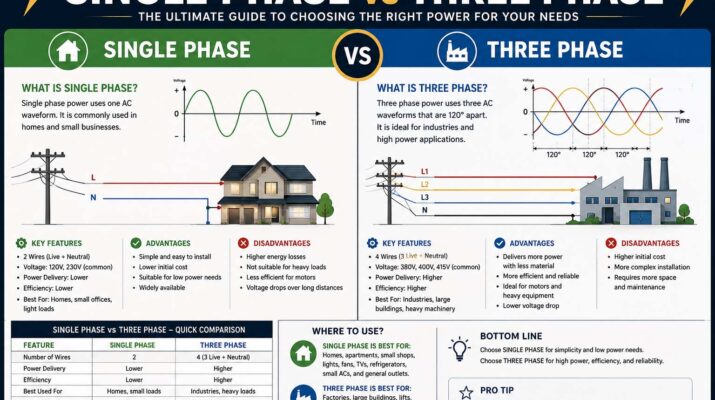
Three-phase power uses three alternating current waves that are evenly spaced 120 degrees apart.
This configuration provides:
- More consistent power delivery
- Higher efficiency
- Greater power capacity
- Smoother operation for large equipment
Three-phase systems are commonly found in:
- Factories
- Commercial buildings
- Data centers
- Manufacturing plants
- Large HVAC systems
Single Phase vs Three Phase Power
The main difference in single phase vs three phase power is how electricity is delivered.
Single-phase systems provide one AC waveform, while three-phase systems deliver three synchronized waveforms.
This results in smoother and more continuous energy delivery with three-phase power. Understanding alternator vs generator also helps explain how different machines generate electrical output for various systems and applications.
Comparison Table
| Feature | Single Phase | Three Phase |
|---|---|---|
| Number of AC Waves | 1 | 3 |
| Typical Use | Homes | Commercial & Industrial |
| Power Delivery | Pulsating | Continuous |
| Efficiency | Lower | Higher |
| Equipment Size | Small to Medium | Medium to Large |
| Installation Cost | Lower | Higher |
Three Phase vs Single Phase
When comparing three phase vs single phase, several important differences become clear.
Efficiency
Three-phase systems transfer more power using the same conductor size.
Reliability
Power delivery is smoother because at least one phase is always producing power.
Capacity
Three-phase power supports much larger electrical loads.
Cost
Single-phase installations are generally less expensive for residential applications.
Single vs Three Phase: Which One Is Better?
The answer depends entirely on your needs.
Choose Single Phase If:
- You own a home.
- You use standard household appliances.
- Your electrical demand is relatively low.
- You want a lower installation cost.
Choose Three Phase If:
- You operate industrial machinery.
- Your business uses large motors.
- You need continuous high-power equipment.
- Energy efficiency is a priority.
Single Phase vs Three Phase Motor
Another common comparison is single phase vs three phase motor.
Single-Phase Motors
Single-phase motors are commonly used in:
- Ceiling fans
- Water pumps
- Household appliances
- Small air compressors
Advantages:
- Lower purchase cost
- Easier installation
- Suitable for residential use
Limitations:
- Lower starting torque
- Less efficient
- Reduced power capacity
Three-Phase Motors
Three-phase motors are used in:
- Conveyor systems
- Industrial pumps
- Manufacturing equipment
- Large compressors
- HVAC systems
Advantages:
- Higher efficiency
- Greater starting torque
- Smoother operation
- Longer service life under heavy workloads
How to Identify Your Electrical Supply
If you’re unsure whether your building has single-phase or three-phase power, follow these steps.
Step 1: Check the Electrical Panel
Many panels indicate the service type.
Step 2: Review Utility Documentation
Your electricity provider often lists the supply type on installation documents.
Step 3: Count Incoming Conductors
A qualified electrician can safely identify the wiring configuration.
Never inspect live electrical wiring unless you are trained to do so.
Common Applications
Single-Phase Applications
Examples include:
- Residential homes
- Apartments
- Small offices
- Home workshops
Three-Phase Applications
Examples include:
- Warehouses
- Manufacturing facilities
- Hospitals
- Shopping centers
- Large office buildings
Industrial electrical systems require reliable transmission infrastructure. Understanding why are there balls on power lines provides additional insight into the visibility and safety measures used around high-voltage electrical networks.
Troubleshooting Common Electrical Problems
Motor Won’t Start
Possible causes:
- Incorrect voltage
- Loose wiring
- Failed capacitor (single-phase motors)
- Faulty overload protection
A solenoid is another electrical component that may fail to operate correctly when it receives insufficient or improper voltage.
Equipment Runs Slowly
Possible causes:
- Low voltage
- Overloaded circuit
- Motor wear
Circuit Breaker Trips Frequently
Possible causes:
- Overloaded electrical system
- Short circuit
- Damaged equipment
Uneven Motor Performance
For three-phase systems:
- One phase may be missing.
- Voltage imbalance could exist.
These issues should be inspected by a qualified electrician.
Advantages and Disadvantages
Single Phase Advantages
- Lower installation cost
- Simple wiring
- Easy maintenance
- Ideal for homes
Single Phase Disadvantages
- Lower efficiency
- Limited power output
- Less suitable for large motors
Three Phase Advantages
- Higher efficiency
- Continuous power delivery
- Supports heavy equipment
- Better motor performance
Three Phase Disadvantages
- Higher installation cost
- More complex wiring
- Usually unnecessary for most homes
Understanding what is continuity is also useful when comparing electrical systems, since an uninterrupted circuit path directly affects current flow, equipment performance, and electrical safety.
Safety Tips
When working around electrical systems:
- Turn off power before maintenance.
- Use properly rated equipment.
- Never overload circuits.
- Hire licensed electricians for installations.
- Inspect wiring regularly.
Frequently Asked Questions
What is the difference between single-phase and three-phase power?
Single-phase power uses one AC waveform, while three-phase power uses three synchronized waveforms for smoother and more efficient energy delivery.
Is three phase better than single phase?
For industrial and commercial applications, three-phase power is generally more efficient. For most homes, single-phase power is sufficient.
What is single phase vs three phase power?
The difference lies in how electrical energy is supplied. Three-phase systems provide continuous power, while single-phase systems deliver one alternating waveform.
Which motor is better: single phase or three phase?
Three-phase motors are generally more efficient and powerful, while single-phase motors are suitable for smaller residential applications.
Can a home have three-phase power?
Yes. Some larger homes or properties with heavy electrical demands may have three-phase service, although most residential properties use single-phase power.
Can single-phase equipment operate on three-phase power?
In some situations, yes, but it may require appropriate transformers, converters, or dedicated equipment. Always consult a qualified electrician before making modifications.
Conclusion
Understanding single phase vs three phase helps homeowners, businesses, and engineers select the right electrical system for their specific needs. Single-phase power remains the standard choice for residential properties because it is simple, affordable, and well suited to everyday appliances. In contrast, three phase vs single phase comparisons show that three-phase systems excel in commercial and industrial environments where efficiency, higher power capacity, and reliable motor performance are essential.