
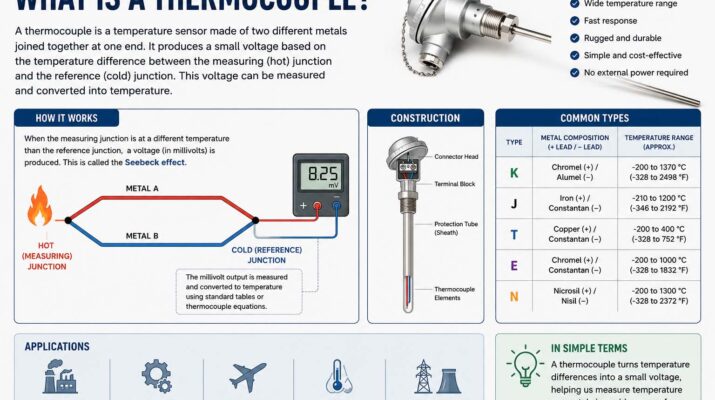
Temperature measurement is essential in many industries, appliances, and technological systems. Whether you work with industrial equipment, heating systems, or electronic devices, understanding what is a thermocouple can help you better understand how temperature monitoring works.
A is a temperature sensor made from two different metal wires joined together at one end.
What Is a Thermocouple and How Does It Work?
Many beginners ask, what is a thermocouple?
A works based on a scientific principle known as the Seebeck Effect.
The process is simple:
- Two different metals are joined together.
- A small voltage is generated.
- The measuring device interprets the voltage.
- The voltage is converted into a temperature reading.
The greater the temperature difference, the larger the electrical signal produced.
This allows thermocouples to accurately monitor temperatures in many environments.
Main Components of a Thermocouple
A standard contains several basic parts.
Measuring Junction
The point where the two metal wires meet.
This junction detects temperature changes.
Wires
Two different metals create the voltage signal required for measurement.
Reference Junction
Provides a known temperature reference for accurate calculations.
Measurement Device
A controller, meter, or monitoring system converts the voltage into a readable temperature value.
What Is a Thermocouple Used For?
One of the most common questions is what is a thermocouple used for.
Thermocouples are used in countless applications because of their versatility.
Industrial Manufacturing
Used for monitoring:
- Furnaces
- Boilers
- Kilns
- Ovens
- Heat treatment equipment
HVAC Systems
Heating and cooling systems rely on thermocouples for safe operation.
Automotive Applications
Used in:
- Engine testing
- Exhaust monitoring
- Performance tuning
Food Processing
Temperature monitoring helps maintain food quality and safety.
Scientific Research
Laboratories use thermocouples for precise temperature measurement during experiments.
Common Thermocouple Types
Several designs exist, each optimized for specific applications.
Type K Thermocouple
The most widely used option.
Made from:
- Chromel
- Alumel
Advantages:
- Wide temperature range
- Affordable
- Reliable
Type J
Made from:
- Iron
- Constantan
Commonly used in older industrial systems.
Type T
Offers excellent performance at lower temperatures.
Often used in laboratory applications.
Type E
Provides higher voltage output compared to many other types.
What Is a K Type Thermocouple?
A popular question is what is a K type thermocouple.
A K-type is the most commonly used thermocouple in industrial and commercial applications.
Key benefits include:
- Temperature range approximately -200°C to 1260°C
- Good accuracy
- Excellent durability
- Cost-effective design
Applications include:
- Industrial furnaces
- Manufacturing equipment
- Laboratory testing
- Food processing systems
Because of its versatility, the K-type thermocouple has become the industry standard in many environments.
What Is a Thermocouple on a Water Heater?
Homeowners often ask what is a thermocouple on a water heater.
In gas water heaters, the serves as a safety device.
Its primary role is to:
- Detect whether the pilot flame is lit
- Generate a small electrical signal
- Keep the gas valve open when the flame is present
If the flame goes out:
- The stops generating voltage.
- The gas valve closes automatically.
- Gas flow stops for safety.
This helps prevent dangerous gas leaks.
Advantages of Thermocouples
Thermocouples remain popular for several reasons.
Wide Temperature Range
Many models operate effectively from extremely low to extremely high temperatures.
Durability
They can withstand harsh industrial environments.
Fast Response Time
Temperature changes are detected quickly.
Cost-Effective
Thermocouples are often less expensive than other sensor technologies.
Simple Design
Their straightforward construction improves reliability.
Thermocouple vs RTD Comparison
Temperature sensors are available in several forms.
The most common alternative is the RTD (Resistance Temperature Detector).
| Feature | Thermocouple | RTD |
|---|---|---|
| Cost | Lower | Higher |
| Temperature Range | Very Wide | Moderate |
| Durability | Excellent | Good |
| Accuracy | Good | Higher |
| Response Speed | Fast | Moderate |
| Industrial Use | Very Common | Common |
Thermocouples are typically preferred for extreme temperature environments, while RTDs are often selected when higher precision is required.
How to Test a Thermocouple
If you suspect a problem, testing can help identify the issue.
Step 1: Turn Off Equipment
Always follow safety procedures.
Step 2: Inspect the Sensor
Look for:
- Corrosion
- Burn damage
- Loose connections
- Physical wear
Step 3: Use a Multimeter
Measure the voltage output while heating the thermocouple tip.
Step 4: Compare Results
Compare measured output with manufacturer specifications.
Abnormal readings may indicate failure.
Common Thermocouple Problems
Like any component, thermocouples can develop issues over time.
Corrosion
Harsh environments can damage sensor materials.
Loose Connections
Poor electrical connections may create inaccurate readings.
Mechanical Damage
Vibration or impact can affect performance.
Sensor Aging
Long-term exposure to high temperatures may reduce accuracy.
Thermocouple Troubleshooting Guide
Problem: No Temperature Reading
Possible causes:
- Broken wire
- Failed sensor
- Loose connection
Problem: Inaccurate Readings
Possible causes:
- Calibration issues
- Damaged junction
- Electrical interference
Problem: Water Heater Pilot Won’t Stay Lit
Possible causes:
- Dirty
- Faulty
- Misaligned pilot flame
Tips for Maintaining Thermocouples
Inspect Regularly
Check for physical damage and corrosion.
Keep Connections Secure
Loose wiring can create unreliable readings.
Avoid Mechanical Stress
Protect sensors from excessive vibration.
Follow Manufacturer Guidelines
Proper installation improves performance and lifespan.
FAQ
What is a thermocouple?
A is a temperature sensor made from two different metals that generate a voltage when exposed to temperature differences.
What is a thermocouple used for?
Thermocouples are used in industrial equipment, HVAC systems, water heaters, laboratories, and manufacturing processes.
What is a K type thermocouple?
A K-type thermocouple is a popular temperature sensor known for its wide operating range and reliability.
It is a safety device that detects the pilot flame and controls gas flow.
How long do thermocouples last?
Lifespan varies by application, but many thermocouples operate reliably for several years.
Can a thermocouple be repaired?
Minor issues such as loose connections may be fixed, but damaged thermocouples are usually replaced.
Conclusion
Understanding what is a thermocouple is important for anyone working with temperature measurement systems, industrial equipment, or household appliances. Thermocouples offer a reliable, affordable, and versatile solution for monitoring temperatures across a wide range of applications.