
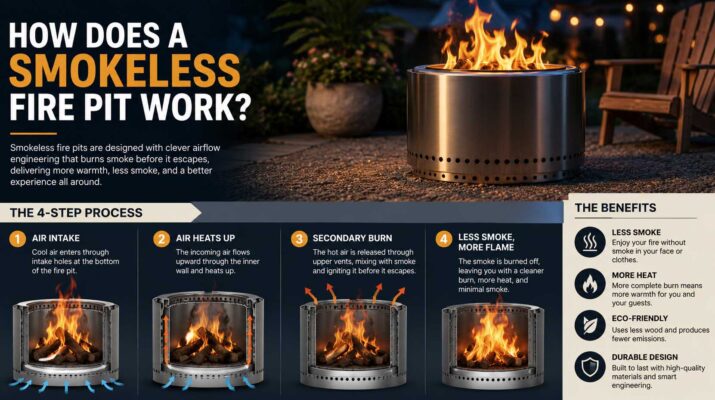
If you’ve ever sat around a modern fire pit and wondered how does a smokeless fire pit work, you’re not alone. At first glance, it looks like an ordinary fire pit, yet it produces far less visible smoke while creating a hotter, cleaner-burning fire.
The secret isn’t magic or hidden electronics. Instead, smokeless fire pits rely on smart engineering, controlled airflow, and a process called secondary combustion. By burning smoke particles before they escape into the air, these fire pits improve efficiency and make outdoor fires more enjoyable.
This guide explains how smokeless fire pits work, the science behind their design, their advantages and limitations, and how to use one for the best results.
What Is a Smokeless Fire Pit?
A smokeless fire pit is a specially designed outdoor fire pit that reduces visible smoke by improving combustion.
Traditional fire pits allow much of the smoke created during burning to escape directly into the air. A smokeless design introduces extra oxygen into the upper part of the fire, allowing many smoke particles and gases to ignite before leaving the fire pit.
The result is:
- Less smoke
- More heat
- Cleaner combustion
- Reduced ash buildup
- Better fuel efficiency
Although no wood-burning fire pit is completely smoke-free, high-quality smokeless models can dramatically reduce the amount of smoke compared with conventional designs.
How Does a Smokeless Fire Pit Work?
The answer to how does a smokeless fire pit work? starts with airflow.
Here’s the basic process:
- Cool air enters through vents near the bottom.
- Part of the air feeds the main fire.
- The remaining air travels upward between the inner and outer walls.
- As it rises, the air becomes extremely hot.
- Heated oxygen exits through holes near the upper rim.
- This hot oxygen ignites smoke and unburned gases before they leave the fire pit.
This second burn is called secondary combustion, and it is the main reason these fire pits produce significantly less smoke.
How Does a Smokeless Fire Pit Work Diagram (Text Description)
Imagine looking at the fire pit from the side.
Top Flame
↑
Secondary combustion zone
↑
Upper air holes release heated oxygen
↑
Double-wall air chamber
↑
Fresh air rises between the walls
↑
Lower intake vents pull in outside air
↑
Fire grate supports burning wood
↑
Ash pan collects ash below
This airflow cycle continues automatically while the fire burns.
Because heated oxygen mixes with smoke before it escapes, many particles burn a second time instead of drifting into the air.
The Science Behind Smokeless Fire Pits
Understanding how does a smokeless fire pit actually work? becomes easier when you know a little about combustion.
Wood contains:
- Cellulose
- Lignin
- Moisture
- Natural oils
- Organic gases
When wood burns, it doesn’t simply disappear.
Heat causes the wood to release combustible gases. If these gases don’t receive enough oxygen, they become visible smoke.
Smokeless fire pits solve this problem by supplying additional heated oxygen exactly where these gases collect.
Instead of escaping, many of those gases ignite again, creating cleaner flames.
How Does a Smokeless Fire Pit Work Physics?
The how does a smokeless fire pit work physics explanation involves several basic scientific principles.
Convection
Hot air naturally rises.
As flames heat the fire pit, air between the double walls also warms and rises upward.
Oxygen Supply
Combustion requires oxygen.
Fresh air entering through lower vents continuously feeds the fire while supplying heated oxygen for the secondary burn.
Secondary Combustion
When smoke particles meet very hot oxygen, they ignite again.
This creates:
- Brighter flames
- Higher temperatures
- Reduced smoke
- More complete combustion
Heat Reflection
Many smokeless fire pits use polished stainless steel interiors that reflect heat back toward the flames, helping maintain higher combustion temperatures.
Main Components of a Smokeless Fire Pit
Although designs vary by manufacturer, most include similar parts.
| Component | Purpose |
|---|---|
| Lower air vents | Draw fresh air into the fire pit |
| Double-wall chamber | Preheats incoming air |
| Upper vent holes | Release heated oxygen for secondary combustion |
| Fire grate | Allows airflow beneath the wood |
| Ash pan | Collects ash while improving airflow |
| Burn chamber | Holds the firewood |
Every component works together to improve combustion efficiency.
Materials Used in Smokeless Fire Pits
Most premium fire pits are made from stainless steel because it withstands repeated heating and cooling.
Some models use cast iron for certain components.
If you’re comparing construction materials, understanding wrought iron vs cast iron can help explain why manufacturers choose different metals based on durability, weight, corrosion resistance, and heat retention.
Material quality directly affects the lifespan of the fire pit.
Advantages of Smokeless Fire Pits
Smokeless fire pits have become popular for several reasons.
Less Smoke
This is the biggest advantage.
People can sit closer to the fire without constantly moving away from smoke.
Better Heat Output
More complete combustion converts additional fuel into usable heat instead of smoke.
Cleaner Burning
Efficient combustion leaves behind less soot and ash.
Easier Cleanup
Because more wood burns completely, cleaning the ash pan usually takes only a few minutes.
Improved Outdoor Experience
Less smoke means clothing, hair, and furniture absorb fewer smoky odors.
Are Smokeless Fire Pits Completely Smoke-Free?
No.
This is one of the biggest misconceptions.
Even the best smokeless fire pit can produce smoke under certain conditions.
Common causes include:
- Wet firewood
- Poor airflow
- Overloading the fire pit
- Restricted air vents
- Starting a cold fire
- Burning leaves or debris
Once the fire reaches operating temperature, smoke usually decreases significantly.
Best Fuel for a Smokeless Fire Pit
Dry hardwood performs best.
Recommended woods include:
- Oak
- Maple
- Hickory
- Ash
- Beech
Avoid:
- Green wood
- Damp logs
- Painted lumber
- Pressure-treated wood
- Household trash
- Cardboard
Dry wood produces fewer smoke particles before secondary combustion even begins.
How to Use a Smokeless Fire Pit
Following the correct steps helps maximize performance.
Step 1: Place the Fire Pit Safely
Choose a flat, fire-resistant surface away from buildings and low-hanging branches.
Step 2: Use Dry Firewood
Seasoned hardwood creates hotter fires with less smoke.
Step 3: Build a Small Starter Fire
Start with tinder and kindling before adding larger logs.
Step 4: Avoid Blocking Air Vents
Keep lower intake vents completely open.
Good airflow is essential for secondary combustion.
Step 5: Let the Fire Heat Up
The smokeless effect becomes stronger after the fire pit reaches high operating temperatures.
Patience during the first several minutes often makes a noticeable difference.
Common Problems and Troubleshooting
| Problem | Possible Cause | Solution |
|---|---|---|
| Excessive smoke | Wet wood | Use seasoned hardwood |
| Weak flames | Poor airflow | Clear blocked vents |
| Fire won’t stay lit | Small fuel load | Add properly sized logs |
| Excess ash | Low combustion temperature | Allow the fire to burn hotter |
| Smoke after adding logs | Cold wood | Add smaller amounts gradually |
Most performance issues relate to fuel quality rather than the fire pit itself.
How Smokeless Fire Pits Compare to Traditional Fire Pits
| Feature | Smokeless Fire Pit | Traditional Fire Pit |
|---|---|---|
| Smoke | Very low | Moderate to heavy |
| Fuel efficiency | Higher | Lower |
| Heat output | More concentrated | More variable |
| Cleanup | Easier | More ash |
| Airflow design | Engineered | Basic |
| Secondary combustion | Yes | No |
While traditional fire pits remain popular, smokeless designs offer a more comfortable experience for many users.
Safety Tips
Even though these fire pits reduce smoke, they still produce very high temperatures.
Always remember to:
- Keep children and pets at a safe distance.
- Never use indoors.
- Empty ashes only after they are fully extinguished.
- Keep a fire extinguisher or water source nearby.
- Follow local fire regulations.
If you’re using accessories that monitor cooking or fire temperatures, learning what is a thermocouple can help you understand how many modern temperature sensors accurately measure high heat.
Common Myths About Smokeless Fire Pits
Myth: They produce zero smoke.
Reality: All wood fires create some smoke. Smokeless designs simply burn much of it before it escapes.
Myth: They don’t get hot.
Reality: Many smokeless fire pits actually burn hotter than traditional models because combustion is more efficient.
Myth: Any wood works equally well.
Reality: Dry hardwood consistently produces the best performance.
Myth: They require electricity.
Reality: Most smokeless fire pits operate entirely through natural airflow without fans or electrical components.
Frequently Asked Questions
How does a smokeless fire pit actually work?
It uses double-wall construction and secondary combustion. Fresh air enters through lower vents, heats as it travels upward, and ignites smoke particles before they exit the fire pit.
Does a smokeless fire pit eliminate all smoke?
No. It greatly reduces smoke, especially after reaching full operating temperature, but no wood-burning fire pit is completely smoke-free.
Why does my smokeless fire pit still smoke?
Wet wood, blocked air vents, or adding too much fuel at once can reduce combustion efficiency and increase smoke.
Do smokeless fire pits produce more heat?
Yes. Because they burn fuel more completely, they often produce hotter, more efficient fires than traditional fire pits.
Are smokeless fire pits worth buying?
For people who frequently enjoy backyard fires, camping, or outdoor gatherings, a smokeless fire pit can provide a cleaner, more comfortable experience with less smoke and easier maintenance.
Enjoy Cleaner Fires with the Right Setup
Once you understand how does a smokeless fire pit work, it’s easy to see why these fire pits have become so popular. Their smart airflow system and secondary combustion technology allow more of the smoke-producing gases to burn instead of escaping into the air. The result is a hotter fire, less visible smoke, and a more enjoyable outdoor experience.
To get the best performance, use dry hardwood, keep the air vents clear, and give the fire enough time to reach full temperature. With proper use and regular maintenance, a quality smokeless fire pit can provide years of efficient, cleaner-burning fires for relaxing evenings, backyard gatherings, and outdoor adventures.