
The power just went out, your phone is at 12% and the fridge is slowly warming up. Naturally, you start shopping for backup power, and almost right away you hit the same question: inverter vs generator, which one should you buy? In short, both make electricity from fuel, but they do it in different ways, so they suit very different jobs.
Below, you’ll see how each one works, how they compare on noise, fuel use, power quality and price, and which one fits your needs.
Inverter vs Generator: The Quick Answer
If you need quiet, clean power for camping, tailgating or charging electronics, an inverter generator is usually the better pick. On the other hand, if you need lots of raw wattage for a whole-home backup, power tools or a job site, a conventional generator often gives you more power for less money.
Quick note on wording: when people search “generator vs inverter,” they usually mean an inverter generator versus a regular one. So that’s the comparison this guide focuses on.
How a Conventional Generator Works
Basically, a regular portable generator has a gas engine connected to an alternator. As the engine spins, the alternator creates AC power that goes straight to the outlets.
However, there’s a catch. To keep the power at the right frequency (60 Hz in the U.S.), the engine has to run at a steady, high speed, usually around 3,600 RPM. As a result, it stays loud and burns fuel at nearly the same rate, even when you’re only running a lamp.
If you’re curious how the alternator fits into all this, our guide on alternator vs generator explains the difference between the two terms in plain English.
How an Inverter Generator Works
By contrast, an inverter generator takes a few extra steps. First, its engine and alternator produce raw AC power. Next, built-in electronics convert that power to DC. Finally, an inverter turns the DC back into smooth, stable AC.
Because the electronics control the output, the engine doesn’t need to run at a fixed speed. Instead, it speeds up or slows down to match your load. That’s why inverter generators are quieter and more fuel-efficient at light loads.
For a closer look at that final conversion step, check out our explainer on what does an inverter do, which breaks down how DC becomes usable household AC.
Inverter Generator vs Regular Generator: Side-by-Side
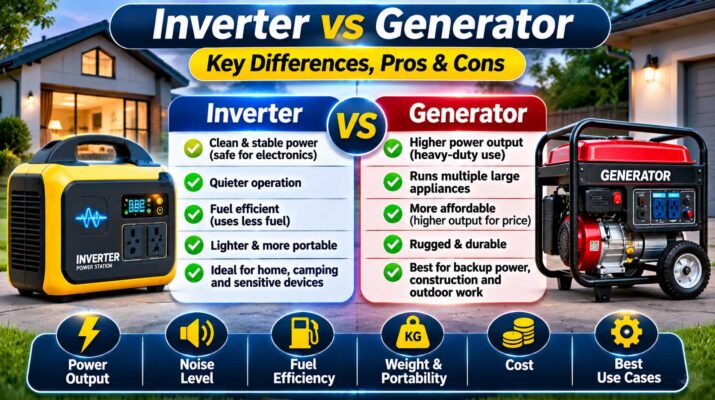
To make the comparison easy, here’s a quick-reference table. Keep in mind that exact numbers vary by brand and model.
| Feature | Inverter Generator | Conventional Generator |
|---|---|---|
| Power quality | Very clean, stable output | Less stable, more “noisy” power |
| Noise level | Usually quiet | Usually loud |
| Fuel efficiency | Better at light loads | Lower, since engine runs at full speed |
| Typical wattage | Often around 1,000–4,000 watts | Often 3,000 watts and up |
| Weight and size | Lighter, more compact | Heavier, bulkier |
| Price per watt | Higher | Lower |
| Parallel capability | Common | Less common |
| Best for | Camping, RVs, electronics | Home backup, job sites, heavy tools |
Key Differences Explained
Now let’s unpack what those differences actually mean for you.
Power Quality
Generally, inverter generators produce power with low total harmonic distortion (THD). In fact, many models list THD under 3%. So they’re safer for laptops, phones, TVs and devices with sensitive circuits.
Meanwhile, conventional generators produce rougher power. While that’s fine for drills, saws and lights, it can be less ideal for delicate electronics.
Noise
Thanks to their variable engine speed and enclosed design, inverter generators are much quieter. For example, many sound like a normal conversation from a short distance. On the flip side, open-frame generators can be loud enough to annoy neighbors or campground hosts.
Fuel Efficiency
Since an inverter generator throttles down when demand is low, it sips fuel during light use. As a result, a small tank can last surprisingly long overnight. By contrast, a conventional unit burns fuel at a steadier rate no matter what you plug in.
Power Output and Price
Here’s where conventional generators shine. Generally, they deliver more watts per dollar. So if you need to run a well pump, central AC or several large appliances, a big conventional generator is usually the more affordable route.
Also, most portable generators supply single-phase power, which is what homes use. If you’re wiring into a shop or commercial space, understanding single phase vs three phase will help you avoid buying the wrong type.
Size and Portability
Finally, inverter models are usually smaller and lighter. Because of this, they’re easy to toss in a truck bed or RV storage bay. Meanwhile, larger conventional units often need wheels and a second person to move.
When an Inverter Generator Makes More Sense
Typically, an inverter generator is the right choice if you:
- Go camping, RVing or tailgating
- Need to power laptops, phones, CPAP machines or TVs
- Care about noise, especially in campgrounds or neighborhoods
- Want lower fuel use for light, long-running loads
- Like the option to pair two units together for more power
In other words, think of inverter generators as the “clean and quiet” option.
When a Conventional Generator Is the Better Pick
On the other hand, choose a conventional generator if you:
- Need high wattage for whole-home or large-appliance backup
- Run power tools on job sites
- Want 240-volt outlets for a transfer switch
- Have a tighter budget per watt
- Don’t mind extra noise and weight
Put simply, conventional generators are the “big and budget-friendly” choice.
Maintenance and Safety Basics
No matter which type you buy, regular care keeps it running. For starters, change the oil on schedule, use fresh fuel and run the generator every month or so. Most modern portable generators use four-stroke engines, and if you want to know why, our breakdown of 2 stroke vs 4 stroke explains how each engine type handles fuel and oil.
Above all, never run any generator indoors. According to the U.S. Consumer Product Safety Commission, portable generators should only be used outside and kept at least 20 feet from doors, windows and vents. Also, install battery-powered carbon monoxide alarms inside your home.
Similarly, never plug a generator straight into a wall outlet. Instead, use heavy-duty extension cords or have an electrician install a transfer switch.
FAQs
Is an inverter generator the same as a power inverter?
No. Actually, a power inverter has no engine at all; it simply turns battery DC power into AC. Meanwhile, an inverter generator burns fuel to make its own electricity. If those terms still feel fuzzy, our guide to inverter vs converter clears up how these devices differ.
Can an inverter generator power a house?
Partly. Usually, a mid-size inverter generator can run essentials like a fridge, lights and a few outlets. However, for central AC or a whole-home setup, you’ll typically need a large conventional unit or a standby generator.
Are inverter generators worth the extra cost?
For many people, yes. Especially if you value quiet operation, clean power and fuel savings, the higher price often pays off over time.
Picking Your Power
To sum up, start by listing what you need to run and adding up the watts. Then, think about where you’ll use it and how much noise matters.
If the answer is “electronics, camping and quiet nights,” go with an inverter generator. But if it’s “big appliances and heavy tools,” a conventional generator will likely serve you better.