
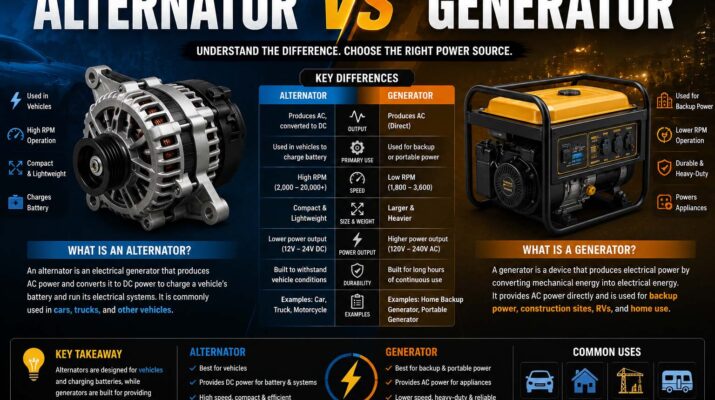
If you’ve ever wondered whether an alternator and a generator are the same thing, you’re not alone. Both devices convert mechanical energy into electrical energy, but they work differently and are designed for different jobs.
The easiest way to think about alternator vs generator is this:
An alternator is commonly used in modern vehicles to produce electricity while the engine is running.
A generator is a broader term for any machine that converts mechanical energy into electrical energy and is often used for backup power, construction sites, or industrial applications.
Understanding the differences helps you choose the right equipment, troubleshoot electrical problems, and better understand how vehicles and power systems operate. If you’re new to the topic, learning series vs parallel provides a solid foundation for understanding how electricity flows through different circuit arrangements.
Quick Comparison
| Feature | Alternator | Generator |
|---|---|---|
| Main Use | Modern vehicles | Backup and portable power |
| Output | AC internally, converted to DC for vehicles | AC or DC depending on design |
| Efficiency | Higher | Lower in many traditional designs |
| Battery Charging | Excellent | Possible, depending on type |
| Maintenance | Usually lower | Often higher |
| Typical Speed | Performs well at higher RPM | Can generate power across wider speed ranges |
What Is an Alternator?
An alternator is an electrical device driven by an engine belt that generates electricity.
Its primary job is to:
- Charge the vehicle battery
- Supply power to electrical systems
- Maintain battery voltage while driving
Nearly every modern gasoline and diesel vehicle uses an alternator.
Without it, the battery would quickly lose charge, eventually preventing the engine from starting.
What Is a Generator?
A generator also converts mechanical energy into electricity.
Unlike an automotive alternator, generators are available in many forms.
Examples include:
- Portable generators
- Standby home generators
- Industrial generators
- Diesel generators
- Gasoline generators
- Wind-powered generators
- Hydroelectric generators
Their purpose is to provide electrical power wherever it is needed.
How Do They Work?
Although both machines use electromagnetic induction, their designs differ.
Alternator Operation
The engine turns a belt connected to the alternator pulley.
Inside the alternator:
- The rotor spins.
- A magnetic field rotates.
- The stator produces alternating current (AC).
- Diodes convert AC into direct current (DC).
- The battery receives charging current.
Modern vehicle electronics rely on this continuous power supply.
Generator Operation
Generators follow a similar principle.
Mechanical energy rotates internal components.
Depending on the design, the generator produces:
- AC electricity
- DC electricity
Portable home generators usually produce AC power suitable for household appliances. Learning what is a solenoid also helps explain how electric current and magnetic fields can produce controlled movement in electrical devices.
Alternator vs Generator Explained
The biggest difference in alternator vs generator is how they generate and deliver electricity.
Alternators produce AC internally and convert it into DC before supplying power to the vehicle.
Generators may produce either AC or DC depending on their construction.
Alternators are optimized for charging batteries efficiently.
Generators are designed to provide usable electrical power directly to external equipment.
Generator vs Alternator: Major Differences
Many people search for generator vs alternator because the terms are sometimes used interchangeably.
Here are the biggest differences.
Electrical Output
Alternators:
- Produce AC internally
- Convert to DC using diodes
Generators:
- May produce AC
- May produce DC
Understanding single phase vs three phase also helps explain how alternating current is distributed for residential, commercial, and industrial applications.
Efficiency
Alternators generally achieve better efficiency during normal vehicle operation.
Their design minimizes unnecessary energy loss.
Durability
Modern alternators usually require less maintenance because they use slip rings instead of large commutators.
Traditional DC generators contain brushes and commutators that experience greater wear.
Weight
Alternators are often:
- Smaller
- Lighter
- More compact
These advantages make them ideal for automobiles.
Car Generator vs Alternator
Many people ask about car generator vs alternator because older vehicles sometimes used generators instead of alternators.
Older Vehicles
Cars built decades ago commonly used DC generators.
These systems:
- Produced less power
- Charged batteries less efficiently
- Required more maintenance
Modern Vehicles
Nearly every modern passenger vehicle now uses an alternator because it:
- Produces more electricity
- Charges better at idle
- Supports modern electronics
- Requires less maintenance
Today’s vehicles have much greater electrical demands than older models.
Features like infotainment systems, LED lighting, heated seats, cameras, and driver-assistance systems all depend on reliable electrical power.
Generator vs Alternator Car Applications
The phrase generator vs alternator car usually refers to which device powers a vehicle.
Modern passenger cars almost always use alternators.
Generators may still appear in:
- Vintage automobiles
- Antique tractors
- Older motorcycles
- Historic military vehicles
Collectors often restore these systems to maintain originality.
Advantages of Alternators
Alternators offer several benefits.
Higher Efficiency
Alternators convert mechanical energy into electrical energy very efficiently.
Better Low-Speed Charging
Many alternators continue charging effectively even while the vehicle idles.
This helps prevent battery discharge during city driving.
Lower Maintenance
Alternators contain fewer components subject to wear than traditional DC generators.
Compact Design
Smaller size makes installation easier.
Manufacturers can also reduce vehicle weight.
Advantages of Generators
Generators remain valuable in many situations.
Portable Power
Portable generators provide electricity during:
- Power outages
- Camping
- Construction projects
- Outdoor events
Independent Electricity
Generators can operate wherever fuel or another mechanical energy source is available.
Large Power Output
Industrial generators can produce electricity for:
- Factories
- Hospitals
- Data centers
- Emergency systems
Large power stations also rely on extensive transmission infrastructure. Understanding why are there balls on power lines helps explain how visibility and safety are managed when electricity is transmitted over long distances.
Disadvantages of Alternators
Alternators also have limitations.
- Depend on the engine running
- Cannot provide long-term backup power alone
- Internal components eventually wear out
- Voltage regulators may fail
Disadvantages of Generators
Generators may have their own drawbacks.
- Higher maintenance for some designs
- Larger size
- Fuel consumption
- Noise
- Emissions (for gasoline or diesel models)
Portable generators also require safe outdoor operation to avoid carbon monoxide exposure.
Alternator vs Generator Diagram
Many readers search for an alternator vs generator diagram to understand the flow of electricity.
A simplified workflow looks like this:
Alternator
Engine → Belt → Rotor Spins → Magnetic Field → AC Produced → Diodes → DC Output → Battery → Vehicle Electronics
Generator
Engine or Motor → Rotor Spins → Electrical Current Generated → AC or DC Output → External Devices
Although the paths are similar, alternators include a rectification stage that converts AC into DC for automotive systems. Understanding what is RPM also helps explain how engine speed supplies the mechanical rotation needed by alternators and engine-driven generators.
Common Signs of Alternator Problems
A failing alternator may cause:
- Battery warning light
- Dim headlights
- Slow engine cranking
- Dead battery
- Flickering dashboard lights
- Electrical accessories failing
Testing battery voltage with a multimeter often helps diagnose charging problems.
Common Generator Problems
Generators may experience:
- Hard starting
- Low output voltage
- Fuel problems
- Dirty spark plugs
- Worn brushes
- Overloaded circuits
Regular maintenance greatly improves reliability.
Maintenance Tips
Proper maintenance extends equipment life.
Alternator
- Inspect drive belt.
- Check battery terminals.
- Keep electrical connections clean.
- Replace worn bearings if necessary.
Generator
- Change engine oil regularly.
- Replace air filters.
- Test periodically.
- Store with fresh fuel or fuel stabilizer.
- Follow the manufacturer’s maintenance schedule.
Which One Should You Choose?
The answer depends entirely on your needs.
Choose an Alternator if You Need:
- Reliable vehicle charging
- Efficient automotive electrical power
- Compact design
Choose a Generator if You Need:
- Backup electricity
- Portable power
- Off-grid operation
- Emergency household power
Neither device replaces the other because they serve different purposes.
Real-World Examples
Passenger Car
Uses an alternator to charge the battery and power electrical systems while the engine is running.
Emergency Home Backup
Uses a portable or standby generator during utility outages.
Construction Site
Portable generators power tools where electrical service is unavailable.
Hospital
Large standby generators provide emergency electricity if the power grid fails.
Frequently Asked Questions
What is the difference between alternator vs generator?
An alternator primarily charges a vehicle battery and powers automotive electronics, while a generator provides electrical power for a wide variety of applications, including homes, businesses, and job sites.
Which is better, generator vs alternator?
Neither is universally better. Alternators are ideal for vehicles, while generators are designed for supplying electrical power independently.
What is the difference between car generator vs alternator?
Older cars often used generators, while modern vehicles almost always use alternators because they are more efficient and produce better charging performance.
Can an alternator replace a generator?
Not usually. Alternators depend on an engine and charging system, while generators are designed to provide standalone electrical power.
What is an alternator vs generator diagram?
A diagram shows how mechanical energy becomes electrical energy. Alternators include diodes that convert AC into DC before supplying vehicle electrical systems.
Why Do Modern Cars Use Alternators Instead of Generators?
Alternators provide higher efficiency, better charging at idle, lower maintenance requirements, and enough electrical output to support today’s advanced vehicle electronics.
Choosing the Right Power Solution
Understanding alternator vs generator becomes much easier once you know their primary roles. Alternators keep modern vehicles running by charging the battery and powering electrical systems, while generators provide independent electricity for homes, businesses, construction sites, and emergency situations. Both rely on the same basic principle of converting mechanical energy into electrical energy, but their designs and intended uses are different. Choosing the right one depends on where and how you need reliable electrical power.