
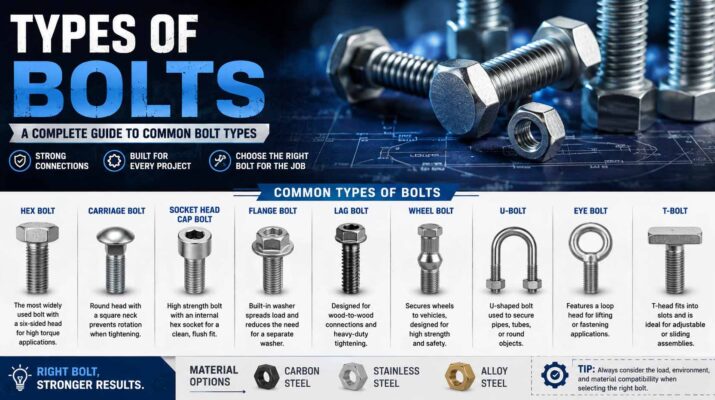
Bolts may look like simple pieces of hardware, yet choosing the wrong one can weaken an entire assembly. The many types of bolts are designed for different loads, materials, environments, and installation methods. Some secure steel structures, while others fasten machinery, automotive components, wood, concrete, or equipment that needs regular maintenance.
Although bolts are often discussed alongside screws, they aren’t always interchangeable. A typical bolt passes through a hole and works with a nut, whereas many screws create or engage threads directly in the material.
Understanding these differences makes it much easier to select a safe and practical fastener.
What Is a Bolt?
A bolt is a threaded mechanical fastener used to join two or more components. In a common bolted joint, the bolt passes through aligned holes before a nut is tightened onto its threaded end.
As the nut tightens, the bolt develops tension and clamps the components together. Therefore, the connection depends on more than simply preventing the parts from falling apart. Proper clamping force helps the joint handle movement, vibration, shear forces, and external loads.
Bolts appear everywhere from household equipment to vehicles, industrial systems, bridges, electronics enclosures, and heavy machinery.
However, bolts are only one mechanical fastening option. For example, learning about the types of rivets is useful when comparing removable bolted joints with permanent fastening methods.
How Bolted Connections Work
A basic bolted joint normally includes a bolt, mating components, and a nut. Washers may also sit beneath the bolt head or nut.
When you tighten the nut, the bolt stretches slightly. At the same time, the connected components experience compression. This creates a clamping force that holds the joint together.
However, correct tightening matters. Too little torque can allow the connection to loosen, especially under vibration. In contrast, excessive torque may stretch the bolt beyond its safe range, strip the threads, or damage the components.
Engineers therefore consider bolt diameter, material, thread pitch, strength grade, preload, operating temperature, vibration, and expected loads when designing critical connections.
Common Types of Bolts and Their Uses
Different applications need different bolt designs. Although many specialized fasteners exist, the following styles cover a large share of everyday engineering, automotive, construction, and mechanical applications.
Hex Bolts
Hex bolts are among the most recognizable fasteners. As their name suggests, they have a six-sided head that accepts a wrench or socket.
Because the head provides a strong gripping surface, installers can apply considerable torque. As a result, hex bolts appear in machinery, structural assemblies, automotive components, equipment frames, and general construction.
They come in partially and fully threaded versions. Meanwhile, manufacturers offer many materials and strength grades for different operating conditions.
Carriage Bolts
A carriage bolt has a smooth, rounded head and usually features a square section directly underneath it.
Once inserted into a suitable hole, that square neck helps prevent the bolt from rotating while the nut is tightened. Therefore, carriage bolts work particularly well with wood.
You will often find them in wooden structures, outdoor furniture, fencing, decks, and applications where a smooth exposed head is desirable.
Flange Bolts
Flange bolts include a widened flange beneath the head. This flange spreads the clamping load across a larger surface.
Consequently, a separate washer may not always be necessary. Some versions also have serrations underneath the flange to resist loosening.
Automotive manufacturers frequently use flange bolts in engines, frames, transmissions, and other mechanical assemblies.
Anchor Bolts
Anchor bolts connect structural components or equipment to concrete.
Depending on the design, they may be installed before concrete cures or fitted into existing concrete afterward. Common applications include securing structural columns, machinery, railings, equipment bases, and building frames.
Because concrete connections can carry substantial loads, correct hole preparation, embedment depth, bolt size, and installation method all matter.
Eye Bolts
An eye bolt replaces a conventional bolt head with a circular loop or “eye.”
The eye creates an attachment point for ropes, cables, chains, or other hardware. Therefore, eye bolts often appear in lifting, tensioning, anchoring, and securing applications.
However, not every eye bolt is rated for lifting. If a load will be suspended, always use hardware with an appropriate working-load rating and follow the manufacturer’s loading direction requirements.
U-Bolts
As the name suggests, a U-bolt has a curved U-shaped body with threaded ends.
Its shape allows it to wrap around pipes, tubes, poles, or cylindrical components. For that reason, U-bolts commonly secure exhaust systems, piping, suspension components, and utility hardware.
In many machines, fasteners must also work alongside moving mechanical components. Understanding the broader types of machines can help explain why fastening requirements change so much between static structures and equipment exposed to repeated movement.
J-Bolts
J-bolts have a hooked end that resembles the letter J.
The curved portion can provide an anchor point inside concrete or connect components where a straight bolt would not work well. Consequently, J-bolts appear in construction, structural anchoring, and specialized mounting applications.
Shoulder Bolts
A shoulder bolt includes an unthreaded cylindrical section between its head and threaded portion.
Unlike an ordinary bolt, this smooth shoulder can serve as a precise bearing surface or pivot. Therefore, shoulder bolts appear in mechanical linkages, pulleys, moving assemblies, dies, fixtures, and equipment.
Their dimensions need careful selection because the shoulder diameter and length directly affect alignment and movement.
T-Bolts
T-bolts have heads shaped to fit inside tracks, channels, or T-slots.
Once installed, the head stays captured in the slot while the threaded section accepts a nut. As a result, T-bolts make adjustable mounting relatively easy.
They are particularly useful with machine tables, aluminum extrusion systems, workholding equipment, and modular frames.
Quick Comparison of Different Types of Bolts
| Bolt Type | Distinctive Feature | Common Uses |
|---|---|---|
| Hex bolt | Six-sided head | Machinery, construction, vehicles |
| Carriage bolt | Rounded head and square neck | Wood, furniture, fencing |
| Flange bolt | Integrated flange | Automotive and machinery |
| Anchor bolt | Designed for concrete anchoring | Structures and equipment bases |
| Eye bolt | Circular eye | Securing, tensioning, rated lifting |
| U-bolt | U-shaped body | Pipes, exhausts, suspension |
| J-bolt | Hooked end | Anchoring and construction |
| Shoulder bolt | Precision smooth shoulder | Pivots and moving mechanisms |
| T-bolt | T-shaped captured head | Tracks, slots and machine tables |
Although this table covers common designs, manufacturers produce many specialized variations for aerospace, electronics, energy, manufacturing, and other industries.
Types of Nuts and Bolts
Bolts usually work as part of a fastening system rather than independently. Therefore, understanding the types of nuts and bolts together can prevent compatibility problems.
Hex nuts are among the most common choices. Lock nuts, meanwhile, are designed to resist unintended loosening. Wing nuts allow convenient hand adjustment, while cap nuts cover exposed threaded ends.
The thread specification must match as well. A metric bolt, for example, requires a nut with the corresponding metric diameter and thread pitch.
Similarly, an imperial bolt needs compatible inch-based threads.
Never assume that two components fit correctly just because they initially turn together. A thread mismatch can damage both parts and create an unreliable connection.
Types of Screws and Bolts: What’s the Difference?
The distinction between types of screws and bolts can sometimes appear unclear because both fasteners use threads.
Generally, a bolt is intended to work with a nut or an existing threaded component. A screw, on the other hand, often threads directly into a prepared hole or creates threads as it enters a material.
For instance, wood screws are designed to bite into wood fibers. Machine screws, however, can enter tapped holes and may look quite similar to small bolts.
The installation method often matters more than appearance when identifying the correct fastener.
Bolt Materials and Strength
The shape of a bolt tells only part of the story. Material selection has a major effect on strength, corrosion resistance, temperature tolerance, weight, and service life.
Steel Bolts
Steel offers a useful balance of strength, availability, and cost. Therefore, it remains one of the most widely used bolt materials.
However, steel can corrode when exposed to moisture. Manufacturers often apply zinc plating, galvanizing, or other protective finishes when extra corrosion resistance is needed.
Stainless Steel Bolts
Stainless steel provides better corrosion resistance than ordinary carbon steel in many environments.
As a result, stainless fasteners are popular for outdoor equipment, marine environments, food-processing equipment, and installations regularly exposed to moisture.
Alloy Steel Bolts
Alloy steel bolts can provide high tensile strength for demanding mechanical and structural applications.
For comparison, material-focused topics such as what is damascus steel show how changing alloy composition and material processing can significantly influence the properties of a metal product.
Other Bolt Materials
Manufacturers can also produce bolts from brass, bronze, aluminum, titanium, and specialized alloys.
The best choice depends on the environment and load rather than appearance alone. Similarly, comparisons such as wrought iron vs cast iron demonstrate why manufacturing method and material properties matter when selecting metal components for engineering applications.
Bolt Grades, Sizes, and Thread Pitch
Choosing among different types of bolts also requires understanding their specifications.
Bolt diameter indicates the nominal width of the threaded body. Length generally describes the distance from beneath the head to the end, although measurement conventions can differ for certain head styles.
Thread pitch describes the spacing between threads. Metric fasteners typically express pitch as the distance between adjacent threads, while inch-based systems commonly use threads per inch.
Strength markings matter too.
For example, metric bolts may carry property-class markings such as 8.8, 10.9, or 12.9. SAE fasteners use a different grading system. Therefore, never replace a critical high-strength bolt with a visually similar lower-grade fastener.
How to Choose the Right Types of Bolts
Start by identifying what the fastener needs to accomplish.
First, consider the materials being joined. Wood, steel, aluminum, plastic, and concrete can require very different fasteners.
Next, estimate the loads involved. A decorative bracket has very different requirements from a suspension component or structural connection.
Then consider the operating environment. Moisture, salt, chemicals, extreme temperatures, and outdoor exposure can influence material and coating choices.
Movement matters as well. Machinery exposed to vibration may need suitable locking hardware or a carefully engineered preload. Mechanical systems containing components such as types of springs can also create changing loads that a fastened joint must repeatedly withstand.
Finally, verify these key specifications before installation:
- Bolt type and head style
- Diameter and length
- Thread standard and pitch
- Material and protective coating
- Strength grade or property class
- Compatible nut and washer
- Required tightening torque
- Environmental exposure
- Expected static or dynamic load
For safety-critical assemblies, always follow the equipment manufacturer’s specifications rather than choosing a bolt only by physical size.
Common Bolt Problems and How to Prevent Them
Even the correct bolt can fail when installed improperly.
Loose Bolts
Vibration, insufficient preload, settling surfaces, or incorrect hardware can cause a connection to loosen.
Instead of simply tightening the fastener as hard as possible, use the specified torque and appropriate locking method when required.
Stripped Threads
Threads may strip when a bolt is cross-threaded, overtightened, damaged, or paired with the wrong nut.
Start threading by hand whenever practical. This makes misalignment easier to detect before significant force is applied.
Corrosion
Rust can weaken fasteners and make later removal difficult.
Therefore, select a suitable material or protective coating for wet, salty, chemically aggressive, or outdoor environments.
Broken Bolts
Bolts may fracture because of overload, fatigue, excessive tightening, corrosion, or an unsuitable strength grade.
Replacing a failed bolt with an identical-looking fastener may not solve the underlying problem. Instead, identify why the original bolt failed.
FAQs About Types of Bolts
What Are the Most Common Types of Bolts? A Complete Guide to Bolt Types and Uses
Common examples include hex bolts, carriage bolts, flange bolts, anchor bolts, U-bolts, eye bolts, shoulder bolts, and T-bolts. However, the most suitable style depends on the material, load, and installation method.
What Type of Bolt Is Best for Wood? A Complete Guide to Choosing the Right Fastener
Carriage bolts work well for many wood assemblies because their square neck helps prevent rotation. However, the correct choice still depends on the structure and expected load.
What bolt is commonly used for concrete?
Anchor bolts and concrete-specific anchoring systems are designed for these applications. However, installation requirements vary considerably between anchor designs.
Are Stainless Steel Bolts Stronger or Weaker Than Regular Steel Bolts?
Not automatically. Stainless steel generally offers excellent corrosion resistance, but mechanical strength depends on the specific stainless grade and fastener specification. Some alloy or high-strength carbon steel bolts can carry greater loads.
Can I replace a bolt with the same size?
Size alone isn’t enough. The replacement should also match the required thread pitch, strength grade, material, head design, and corrosion resistance.
Making the Right Fastener Choice
The many types of bolts exist because one fastener cannot handle every mechanical connection equally well. Hex bolts offer a versatile solution for general assemblies, while carriage bolts suit many wood projects, anchor bolts secure components to concrete, and shoulder bolts support precise moving mechanisms.
Before buying or replacing a bolt, check its dimensions, thread specification, material, strength grade, environment, and expected load. A few minutes spent checking those details can prevent damaged threads, loose joints, premature corrosion, and potentially serious mechanical failures.
When the connection carries structural, automotive, lifting, or other safety-critical loads, use the exact fastener specification required by the manufacturer or engineering design rather than relying on appearance alone.