
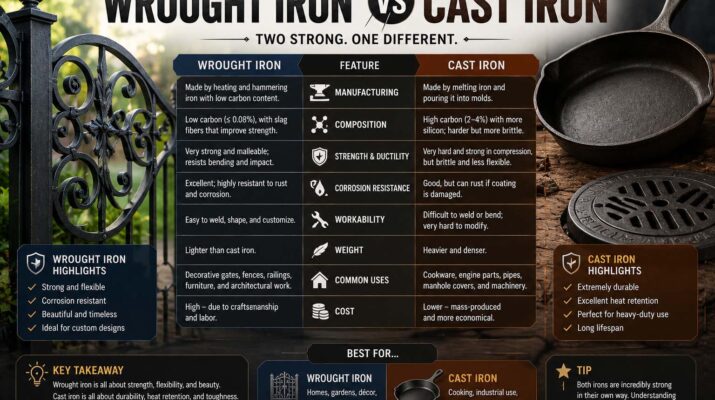
If you’ve ever shopped for outdoor furniture, cookware, gates, or decorative metalwork, you’ve probably come across the terms wrought iron vs cast iron. They sound similar, but they are very different materials with unique properties.
The biggest difference is how they’re made. Wrought iron is heated and shaped through forging or rolling, while cast iron is melted and poured into molds.
This manufacturing difference affects everything from strength and durability to appearance, maintenance, and cost.
Whether you’re choosing materials for a construction project, comparing cookware, or simply curious about metalworking, this guide explains wrought iron vs cast iron in simple terms. Understanding what is Damascus steel can also help you appreciate how different manufacturing methods produce metals with unique mechanical properties.
Quick Comparison
| Feature | Wrought Iron | Cast Iron |
|---|---|---|
| Manufacturing | Forged and shaped | Melted and cast into molds |
| Carbon Content | Very low | High |
| Strength | Tough and ductile | Strong in compression but brittle |
| Flexibility | High | Low |
| Weldability | Good | Difficult |
| Decorative Designs | Hand-forged details | Intricate molded shapes |
| Repairability | Easier | More difficult |
What Is Wrought Iron?
Historically, wrought iron also contained small amounts of slag, giving it a fibrous internal structure that improved toughness.
Unlike cast iron, wrought iron is shaped by heating and working the metal using tools such as hammers, rollers, or presses.
Common applications include:
- Decorative fences
- Gates
- Railings
- Garden furniture
- Balconies
- Historic architectural details
Its ability to bend without breaking makes it ideal for ornamental work.
What Is Cast Iron?
Cast iron contains a much higher carbon content than wrought iron.
Manufacturers create cast iron by melting the metal and pouring it into molds.
Once cooled, the finished part closely matches the mold’s shape.
Cast iron is widely used for:
- Engine blocks
- Machine bases
- Pipes
- Cookware
- Industrial equipment
- Fireplace inserts
Its excellent casting properties enable manufacturers to create intricate shapes and detailed components with high efficiency, making it a popular choice for large-scale production.
Wrought Iron vs Cast Iron Explained
The biggest difference between wrought iron vs cast iron is their structure.
Wrought iron is:
- Tough
- Flexible
- Easily shaped
Cast iron is:
- Hard
- Rigid
- Excellent for casting
- More brittle
Although both are iron-based materials, they perform differently under stress.
Carbon Content
Carbon plays a major role in metal properties.
Wrought Iron
Usually contains less than 0.1% carbon.
Lower carbon content improves:
- Ductility
- Toughness
- Workability
Cast Iron
Typically contains between 2% and 4% carbon.
Higher carbon levels increase:
- Hardness
- Castability
- Compressive strength
At the same time, higher carbon reduces flexibility.
Strength Comparison
People often assume harder means stronger.
The answer depends on the type of force involved.
Wrought Iron
Excellent for:
- Bending
- Impact resistance
- Tensile loading
It tends to deform before breaking. A free body diagram can help illustrate the pulling forces acting on a material when engineers evaluate its strength.
Cast Iron
Excellent for:
- Compression
- Heavy stationary loads
- Vibration damping
However, cast iron is more likely to crack under sudden impact.
Cast Iron vs Wrought Iron
The comparison cast iron vs wrought iron often depends on the intended application.
Choose wrought iron if you need:
- Flexibility
- Decorative metalwork
- Welding
- Forging
Choose cast iron if you need:
- Complex molded shapes
- Excellent wear resistance
- Stable heavy components
- Cost-effective mass production
Neither material is universally better.
Manufacturing Process
The production methods explain many of the differences.
Wrought Iron Manufacturing
General process:
- Heat the metal.
- Shape it using mechanical force.
- Bend or forge into the desired form.
- Finish the surface.
This creates strong, continuous grain flow.
Cast Iron Manufacturing
General process:
- Melt iron.
- Pour into a mold.
- Cool and solidify.
- Remove from the mold.
- Machine if necessary.
This method allows manufacturers to create detailed shapes with minimal additional forming.
Appearance
The materials also look different.
Wrought Iron
Often features:
- Curved scrollwork
- Hand-forged texture
- Elegant decorative details
It’s commonly associated with traditional architecture.
Cast Iron
Usually has:
- Smooth cast surfaces
- Symmetrical details
- Complex molded patterns
You’ll often find cast iron in vintage furniture and architectural ornaments.
Corrosion Resistance
Neither material is completely rust-proof.
Both require protection outdoors.
Common protective methods include:
- Paint
- Powder coating
- Galvanizing (where appropriate)
- Regular maintenance
Proper coatings greatly increase service life. Learning what is the strongest metal can also provide useful insight into how different metals compare in strength, durability, and resistance to environmental conditions.
Maintenance
Maintenance depends on the environment.
Wrought Iron
Inspect regularly for:
- Rust
- Paint damage
- Loose joints
Touch-up painting helps prevent corrosion.
Cast Iron
Check for:
- Cracks
- Rust
- Surface wear
Seasoning is commonly recommended for cast iron cookware to help protect the surface and improve cooking performance.
Common Applications
Wrought Iron Uses
Popular examples include:
- Decorative gates
- Window grilles
- Stair railings
- Outdoor fencing
- Garden benches
- Historic restoration
Its combination of strength and beauty makes it a favorite for ornamental work.
Cast Iron Uses
Common products include:
- Frying pans
- Engine components
- Pipe fittings
- Machine frames
- Industrial pumps
- Brake components
Its casting ability makes it ideal for manufacturing complex parts.
Wrought vs Cast Iron
The phrase wrought vs cast iron usually refers to choosing between forged and cast products.
| Application | Better Choice |
|---|---|
| Decorative fencing | Wrought iron |
| Cookware | Cast iron |
| Heavy machinery | Cast iron |
| Ornamental railings | Wrought iron |
| Complex industrial parts | Cast iron |
| Handcrafted metalwork | Wrought iron |
Cast vs Wrought Iron
When comparing cast vs wrought iron, consider these questions:
Do you need flexibility?
Choose wrought iron.
Need detailed molded parts?
Choose cast iron.
Will the part experience repeated impact?
Wrought iron generally handles impact better.
Will it remain stationary under heavy loads?
Cast iron often performs well in those conditions.
Cast Aluminum vs Wrought Iron
Another common comparison is cast aluminum vs wrought iron, especially for outdoor furniture.
Cast Aluminum
Advantages:
- Lightweight
- Naturally corrosion resistant
- Easy to move
- Low maintenance
Wrought Iron
Advantages:
- Heavier
- Extremely sturdy
- Elegant appearance
- Wind resistant because of its weight
Outdoor furniture buyers often choose based on climate and portability.
If frequent movement is important, cast aluminum may be more practical.
If maximum stability matters, wrought iron remains a popular option.
Advantages and Disadvantages
Wrought Iron
Advantages
- Tough
- Durable
- Attractive
- Repairable
- Easy to forge
Disadvantages
- Heavier than many alternatives
- Can rust without maintenance
- Higher labor costs
Cast Iron
Advantages
- Excellent casting properties
- High compressive strength
- Good wear resistance
- Cost-effective production
Disadvantages
- Brittle
- Difficult to weld
- Can crack under impact
- Requires rust protection. Reviewing the physical change definition can also help readers distinguish surface or shape changes from chemical changes such as rust formation.
Common Myths
Myth: They’re the same material.
False.
Their carbon content and manufacturing methods differ significantly.
Myth: Cast iron is always stronger.
Not exactly.
Cast iron excels under compression, while wrought iron performs better under impact and bending.
Myth: Wrought iron never rusts.
False.
Both materials can rust if protective coatings fail.
Choosing the Right Material
Ask yourself these questions.
Is appearance the priority?
Choose wrought iron.
Does the part need detailed molding?
Choose cast iron.
Will the component experience impact?
Wrought iron usually performs better.
Is the product cookware?
Cast iron is the common choice because of its excellent heat retention.
When selecting materials for construction or fabrication projects, it is also helpful to understand what do engineers do, since material selection requires balancing strength, corrosion resistance, weight, and cost.
Frequently Asked Questions
What is the difference between wrought iron vs cast iron?
Wrought iron is forged with very low carbon content, making it tough and flexible. Cast iron contains more carbon and is created by pouring molten metal into molds, making it harder but more brittle.
Which Is Stronger: Cast Iron or Wrought Iron?
It depends on the application. Wrought iron generally handles bending and impact better, while cast iron performs well under compressive loads.
What is cast iron vs wrought iron?
This comparison looks at two different iron materials with distinct manufacturing methods, mechanical properties, and common uses.
What is wrought vs cast iron?
Wrought iron is shaped through forging or rolling, while cast iron is formed by pouring molten metal into molds.
How does cast aluminum vs wrought iron compare?
Cast aluminum is lighter and naturally corrosion resistant, while wrought iron is heavier, stronger for decorative structures, and often chosen for classic architectural designs.
Which lasts longer outdoors?
Both materials can last for decades with proper coatings, routine inspections, and regular maintenance to control rust.
Choosing the Best Iron for Your Project
Understanding wrought iron vs cast iron makes it much easier to choose the right material for your needs. Wrought iron stands out for its toughness, flexibility, and timeless decorative appeal, while cast iron shines in applications that require complex shapes, excellent wear resistance, and strong compressive performance. By matching the material to the job, considering maintenance needs, and understanding each metal’s strengths, you can make a more informed decision for construction, manufacturing, cookware, or home improvement projects.