
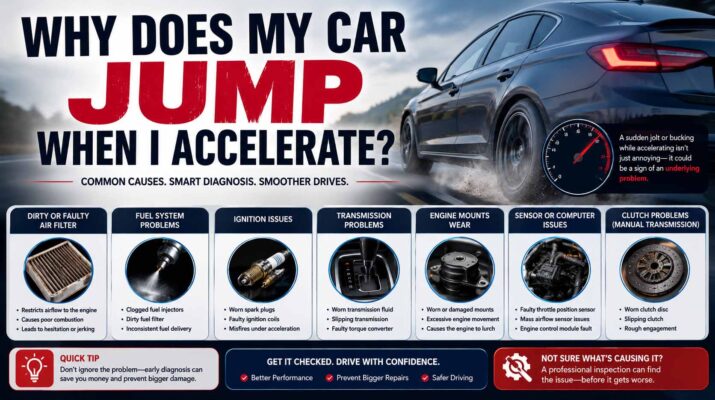
If you’ve ever pressed the gas pedal and wondered, “why does my car jump when I accelerate,” you’re not alone. A car that jerks, lurches, or jumps during acceleration is usually telling you something isn’t working correctly. The issue might be as simple as worn spark plugs or as serious as a transmission problem.
The good news is that many causes can be identified early before they become expensive repairs. Knowing what symptoms to watch for can help you decide whether you need immediate service or a simple maintenance visit.
This guide explains the most common reasons a car jumps during acceleration, how to diagnose the problem, and what you can do next.
Why Does My Car Jump When I Accelerate?
A smooth acceleration depends on several systems working together.
These include:
- Engine
- Fuel system
- Ignition system
- Transmission
- Suspension
- Drivetrain
- Electronic sensors
If any one of these develops a fault, your vehicle may hesitate or jerk when power is applied.
The jumping may occur:
- From a stop
- At highway speeds
- While climbing hills
- During gear changes
- Only when the engine is cold
Paying attention to exactly when it happens helps narrow down the cause.
Quick Troubleshooting Table
| Symptom | Possible Cause | Urgency |
|---|---|---|
| Jerks during acceleration | Dirty fuel injectors | Moderate |
| Hesitates before speeding up | Faulty spark plugs | Moderate |
| Jumps during shifting | Transmission issue | High |
| Vibrates while accelerating | Worn engine mounts | Moderate |
| Jerks uphill | Fuel delivery problem | High |
| Check Engine light with jerking | Sensor or ignition fault | High |
Engine Misfires
One of the most common reasons a vehicle jumps during acceleration is an engine misfire.
A misfire occurs when one or more cylinders fail to burn fuel properly.
Common causes include:
- Worn spark plugs
- Bad ignition coils
- Damaged spark plug wires
- Faulty injectors
Besides jerking, you may notice:
- Rough idle
- Reduced fuel economy
- Engine vibration
- Check Engine light
Misfires should be repaired promptly because prolonged driving can damage the catalytic converter.
Fuel System Problems
Your engine needs a consistent fuel supply.
If fuel delivery becomes uneven, acceleration can become rough.
Possible causes include:
- Dirty fuel injectors
- Clogged fuel filter
- Weak fuel pump
- Low fuel pressure
The engine may hesitate briefly before suddenly catching up, making the car feel like it jumps forward.
Transmission Problems
Automatic and manual transmissions can both create jerking during acceleration.
Automatic Transmission
Common problems include:
- Low transmission fluid
- Worn clutch packs
- Failing torque converter
- Faulty shift solenoids
Symptoms often appear during gear changes.
Manual Transmission
Manual vehicles may jerk because of:
- Worn clutch
- Improper clutch engagement
- Damaged flywheel
If you’re unfamiliar with manual drivetrains, learning how does a clutch work makes it easier to understand why worn clutch components can cause sudden jerking when accelerating.
Dirty or Faulty Mass Airflow Sensor
If it sends incorrect information, the engine computer may inject too much or too little fuel.
Common symptoms include:
- Rough acceleration
- Poor fuel economy
- Hesitation
- Stalling
Fortunately, cleaning or replacing the sensor is often straightforward.
Throttle Body Issues
Modern cars use an electronically controlled throttle body.
Carbon deposits can prevent smooth airflow.
Signs include:
- Delayed acceleration
- Rough idle
- Sudden surging
- Poor throttle response
Cleaning the throttle body often restores smooth performance.
Worn Engine or Transmission Mounts
Engine mounts absorb vibration and keep the engine stable.
When mounts wear out, the engine shifts excessively under load.
Instead of a smooth launch, you’ll feel a noticeable jolt.
Other symptoms include:
- Clunking noises
- Excessive vibration
- Engine movement during acceleration
Suspension Problems
Although engine problems cause most acceleration jerks, worn suspension parts can sometimes make the vehicle feel like it jumps.
For example, damaged bushings or worn dampers may exaggerate weight transfer during acceleration.
If your vehicle feels unstable over bumps as well, comparing the difference between shocks and struts can help you understand how worn suspension components affect ride quality.
Faulty Sensors
Modern vehicles rely on dozens of sensors.
A faulty sensor can confuse the engine computer.
Common examples include:
- Throttle Position Sensor
- Crankshaft Position Sensor
- Camshaft Position Sensor
- Oxygen Sensor
These faults often trigger the Check Engine light.
Fuel Quality Problems
Poor-quality fuel sometimes causes hesitation.
Water contamination or incorrect octane fuel may lead to:
- Engine knocking
- Rough acceleration
- Misfires
- Power loss
If symptoms begin immediately after refueling, consider the possibility of contaminated gasoline.
Air Intake Restrictions
Your engine also needs clean airflow.
Potential restrictions include:
- Dirty air filter
- Blocked intake duct
- Vacuum leaks
Restricted airflow upsets the fuel-air mixture, reducing smooth acceleration.
Replacing an old air filter is inexpensive and should be part of regular maintenance.
Carburetor Problems in Older Vehicles
Older vehicles equipped with carburetors may experience jerking if fuel isn’t mixed correctly.
Understanding the what is the function of a carburetor helps explain why proper fuel-air mixing remains essential for smooth engine performance.
Likewise, learning about the parts of a carburetor can help owners of classic vehicles recognize components that may require cleaning or adjustment over time.
How to Diagnose the Problem
You don’t always need to guess.
Follow this checklist.
Step 1: Watch for Warning Lights
A Check Engine light provides valuable clues.
Scan the vehicle with an OBD-II scanner.
Step 2: Notice When It Happens
Ask yourself:
- Only when cold?
- Only uphill?
- During shifting?
- At highway speed?
- From a complete stop?
Patterns help identify the system involved.
Step 3: Listen Carefully
Do you hear:
- Clicking
- Clunking
- Knocking
- Grinding
Unusual sounds often point toward mechanical problems.
Step 4: Check Maintenance History
Consider whether it’s time for:
- Spark plugs
- Air filter
- Fuel filter
- Transmission service
Routine maintenance prevents many acceleration issues.
Can Low RPM Cause Jerking?
Sometimes.
Driving at very low engine speed while demanding heavy acceleration can make a vehicle hesitate.
If you’re unsure how engine speed affects performance, understanding what is rpm helps explain why engines perform best within specific operating ranges.
However, consistent jerking at normal RPM usually indicates a mechanical or electronic issue rather than driving technique.
Is It Safe to Keep Driving?
It depends.
Usually Safe for Short Trips
Minor hesitation caused by:
- Dirty air filter
- Aging spark plugs
- Slight injector deposits
may allow cautious driving until repairs are scheduled.
Stop Driving Immediately If
- Check Engine light flashes
- Engine loses power
- Loud knocking develops
- Smoke appears
- Transmission slips badly
Continuing to drive could cause much more expensive damage.
Typical Repair Costs
Costs vary depending on the vehicle, labor rates, and replacement parts.
| Repair | Typical Cost Range |
|---|---|
| Spark plug replacement | Low to Moderate |
| Ignition coil replacement | Moderate |
| Fuel injector cleaning | Low to Moderate |
| Fuel pump replacement | Moderate to High |
| Transmission repair | High |
| Engine mount replacement | Moderate |
| Sensor replacement | Low to Moderate |
Obtaining multiple repair estimates is often worthwhile for major repairs.
Preventing Future Acceleration Problems
Many issues can be avoided with regular maintenance.
Good habits include:
- Replace spark plugs at recommended intervals.
- Change air filters regularly.
- Use quality fuel.
- Follow transmission service schedules.
- Address warning lights promptly.
- Replace worn engine mounts when needed.
- Keep fuel injectors clean.
Preventive maintenance almost always costs less than repairing neglected problems.
Common Mistakes Drivers Make
Ignoring Small Jerks
Minor hesitation often becomes worse over time.
Early diagnosis usually saves money.
Replacing Parts Without Testing
Guessing can become expensive.
Proper diagnostic testing helps identify the underlying cause of a problem, ensuring that any treatment or repairs are based on an accurate diagnosis.
Waiting for Complete Failure
A small ignition issue today can become catalytic converter damage tomorrow.
Skipping Regular Maintenance
Old spark plugs and clogged filters remain among the simplest causes of rough acceleration.
FAQs
Why does my car jump when I accelerate from a stop?
Common causes include engine misfires, dirty fuel injectors, transmission issues, or worn engine mounts.
Why does my automatic car jerk while accelerating?
Low transmission fluid, worn internal transmission components, or faulty sensors frequently cause jerking in automatic vehicles.
Can bad spark plugs cause jumping?
Yes.
Worn spark plugs are one of the most common reasons engines hesitate or jerk during acceleration.
Does low transmission fluid cause jerking?
Yes.
Insufficient fluid can reduce hydraulic pressure, leading to rough or delayed gear changes.
Can dirty fuel injectors cause hesitation?
Absolutely.
Uneven fuel delivery often creates hesitation, surging, or rough acceleration.
Should I keep driving if my car jerks?
If the Check Engine light flashes or the vehicle loses significant power, stop driving and have it inspected immediately.
Final Thoughts
If you’re asking, “why does my car jump when I accelerate,” don’t ignore the warning signs. While the problem could be something simple like worn spark plugs or a dirty throttle body, it may also point to transmission, fuel system, or ignition issues that become more expensive if left untreated.
Pay attention to when the jerking occurs, look for warning lights, why does my car jump when I accelerate and arrange a professional inspection if the symptoms persist. Catching the problem early can improve performance, restore smooth acceleration, and help you avoid larger repair bills later.