
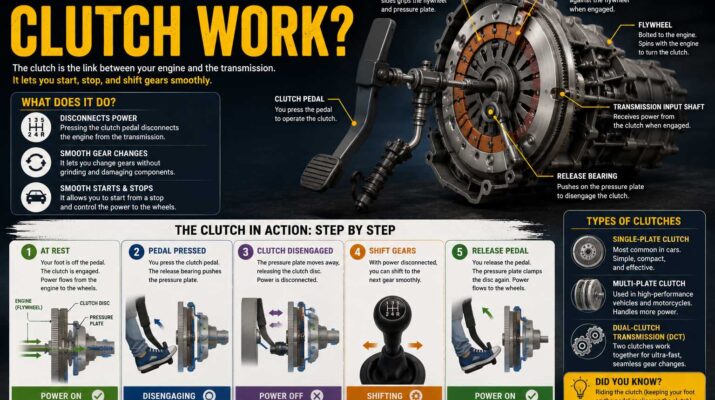
If you’ve ever driven a manual car or wondered what happens when you press the clutch pedal, you’re probably asking, how does a clutch work? The answer is surprisingly simple: a clutch temporarily disconnects the engine from the transmission, allowing you to change gears smoothly without damaging the drivetrain.
Although the clutch is hidden between the engine and transmission, it plays a vital role every time you start moving, shift gears, or stop your vehicle. Understanding how it works can help you become a better driver, recognize early signs of wear, and appreciate the engineering behind both manual and automatic transmissions.
What Is a Clutch?
A clutch is a mechanical device that connects and disconnects the engine’s rotating power from the transmission.
When the clutch is engaged, engine power flows to the wheels. When it’s disengaged, the engine continues running while the transmission is temporarily disconnected, allowing gears to change without grinding.
Manual transmission vehicles require the driver to operate the clutch pedal, while many automatic systems perform the same task electronically or hydraulically.
How Does a Clutch Work?
The basic principle behind a clutch is friction.
Several components work together to either transfer engine power or interrupt it for a gear change.
Step 1: The Engine Produces Rotational Power
As the engine runs, the crankshaft spins a heavy metal disc called the flywheel.
The flywheel stores rotational energy and provides a smooth surface for the clutch disc to press against.
Engine speed is commonly measured in what is rpm, and matching engine RPM with vehicle speed helps produce smooth gear changes.
Step 2: The Clutch Is Engaged
When your foot is off the clutch pedal:
- The pressure plate firmly presses the clutch disc against the flywheel.
- Friction locks the two surfaces together.
- Engine power transfers through the transmission.
- The wheels receive torque.
At this point, the vehicle moves normally.
Step 3: You Press the Clutch Pedal
When you press the clutch pedal:
- A release mechanism pushes against the pressure plate.
- The pressure plate releases the clutch disc.
- The clutch disc separates from the flywheel.
- Engine power temporarily stops flowing to the transmission.
Because the transmission is disconnected, you can safely shift gears.
Step 4: You Release the Pedal
As you slowly lift your foot:
- The pressure plate squeezes the clutch disc back against the flywheel.
- Friction gradually reconnects the engine and transmission.
- Power smoothly reaches the wheels again.
Releasing the pedal too quickly can cause the vehicle to jerk or stall.
Main Parts of a Clutch System
Understanding each component makes the entire process much easier to visualize.
| Component | Purpose |
|---|---|
| Flywheel | Connects to the engine and provides a friction surface |
| Clutch Disc | Transfers engine power through friction |
| Pressure Plate | Holds the clutch disc tightly against the flywheel |
| Release Bearing | Pushes on the pressure plate during disengagement |
| Clutch Fork | Moves the release bearing |
| Clutch Pedal | Allows the driver to operate the system |
| Input Shaft | Transfers power into the transmission |
Every part must work together for smooth shifting.
Manual vs Automatic Clutch Systems
Not every vehicle uses the same type of clutch.
Manual Transmission
In a manual car:
- The driver controls the clutch pedal.
- Gear changes require coordination.
- The clutch engages and disengages with each shift.
This design offers excellent driver control and mechanical simplicity.
Automatic Transmission
Traditional automatic transmissions also contain clutch packs.
Instead of a pedal, hydraulic pressure and electronic controls engage multiple internal clutches automatically.
The driver never operates these directly.
How Does a Dual Clutch Transmission Work?
A dual clutch transmission (DCT) uses two separate clutches instead of one.
Typically:
- One clutch controls odd-numbered gears.
- The other controls even-numbered gears.
While one gear is driving the vehicle, the next gear is already preselected.
As a result, shifts happen extremely quickly with very little interruption in power delivery.
Many modern sports cars and performance vehicles use dual-clutch transmissions because they combine fast shifts with excellent fuel efficiency.
How Does a Centrifugal Clutch Work?
Unlike a manual clutch, a centrifugal clutch operates automatically using centrifugal force.
As engine speed increases:
- Weighted shoes move outward.
- Friction material contacts the clutch drum.
- Power begins transferring to the driven shaft.
When engine speed drops, the clutch disengages automatically.
This type of clutch is commonly found in:
- Go-karts
- Mini bikes
- Chainsaws
- Lawn equipment
- Some scooters
How Does a Rekluse Clutch Work?
A Rekluse clutch is an aftermarket automatic clutch system designed mainly for off-road motorcycles.
Instead of requiring constant clutch lever operation, it automatically engages and disengages based on engine speed.
Benefits include:
- Reduced rider fatigue
- Fewer engine stalls
- Easier low-speed control
- Better performance on technical trails
Riders can still shift gears normally while enjoying automatic clutch engagement.
How Does a Fan Clutch Work?
A fan clutch serves a completely different purpose than a transmission clutch.
A thermostatic clutch senses engine temperature.
When cooling isn’t needed:
- The fan spins slowly.
- Engine load decreases.
- Fuel efficiency improves.
When temperatures rise:
- The clutch locks.
- The fan spins faster.
- Cooling airflow increases.
This simple design helps maintain proper engine temperature without running the cooling fan at full speed all the time.
Why Friction Matters
The clutch works because friction creates a temporary mechanical connection.
Too little friction causes slipping.
Too much sudden friction creates jerky starts.
Engineers carefully select clutch materials that balance:
- Heat resistance
- Durability
- Smooth engagement
- Wear characteristics
Common friction materials include organic compounds, ceramic materials, and metallic composites.
Common Signs of a Worn Clutch
Like brake pads, clutch components wear gradually.
Watch for these warning signs:
- Clutch slipping during acceleration
- Burning smell
- Difficulty shifting gears
- Soft or spongy clutch pedal
- Grinding noises
- High clutch engagement point
- Poor acceleration despite higher engine speed
Ignoring these symptoms may eventually require a complete clutch replacement.
What Causes a Clutch to Wear Out?
Several driving habits can shorten clutch life.
Common causes include:
- Riding the clutch pedal
- Frequent stop-and-go traffic
- Aggressive launches
- Towing heavy loads
- Holding the vehicle on hills using the clutch
- Poor maintenance
Most clutches last anywhere from 60,000 to over 100,000 miles, depending on driving style and vehicle type.
Tips to Extend Clutch Life
Good driving habits make a significant difference.
Try these practices:
- Shift smoothly without rushing.
- Use the parking brake on steep hills.
- Avoid excessive slipping during takeoff.
- Don’t overload the vehicle.
- Address clutch problems early.
Small improvements in driving technique can add years to a clutch’s lifespan.
How the Clutch Works With Other Engine Components
The clutch is only one part of the vehicle’s powertrain.
For example, before power reaches the clutch, the engine creates combustion using components explained in our guide to the parts of a carburetor found on many older gasoline engines.
Likewise, understanding what is the function of a carburetor helps explain how the engine receives the proper air-fuel mixture before generating the power that the clutch transfers to the transmission.
Modern performance engines may also use forced induction. If you’re curious about increasing engine power before it reaches the drivetrain, our article on how does a turbo work explains how turbochargers compress incoming air for greater performance.
Troubleshooting Common Clutch Problems
| Problem | Possible Cause | Recommended Action |
|---|---|---|
| Slipping clutch | Worn clutch disc | Replace clutch components |
| Hard shifting | Hydraulic issue or worn clutch | Inspect hydraulic system |
| Grinding gears | Incomplete disengagement | Check clutch adjustment |
| Pedal vibration | Worn flywheel or pressure plate | Professional inspection |
| Burning smell | Excessive clutch slipping | Reduce slipping and inspect system |
If problems continue, have the clutch inspected by a qualified technician before additional drivetrain damage occurs.
Frequently Asked Questions
Does every car have a clutch?
Yes, although not every vehicle has a clutch pedal. Manual transmissions use a driver-operated clutch, while automatic transmissions rely on internal clutch packs controlled by hydraulic and electronic systems.
Can you drive with a worn clutch?
A worn clutch may still function for a while, but slipping or incomplete engagement can make driving unsafe and may damage other drivetrain components.
Is replacing a clutch expensive?
Costs vary depending on the vehicle, labor rates, and whether the flywheel also needs replacement.
What controls the clutch?
Most manual vehicles use either a cable-operated or hydraulic clutch system. Some hydraulic systems include components similar in principle to what is a solenoid in that they rely on mechanical or electronically controlled actuators elsewhere in the drivetrain, although the clutch pedal itself typically operates through hydraulic pressure.
Why does the clutch wear faster in city driving?
Frequent stopping, starting, and gear changes cause more clutch engagement cycles than steady highway driving, leading to faster wear.
Key Takeaways
A clutch may seem like a simple component, but it’s one of the most important parts of any vehicle with a manual transmission and many modern automatic systems. By using friction to connect and disconnect the engine from the transmission, it allows smooth starts, clean gear changes, and efficient power transfer to the wheels.
Whether you’re learning to drive, maintaining your car, or simply curious about automotive engineering, understanding how a clutch works makes it easier to recognize problems early and develop driving habits that help the system last for many years.