
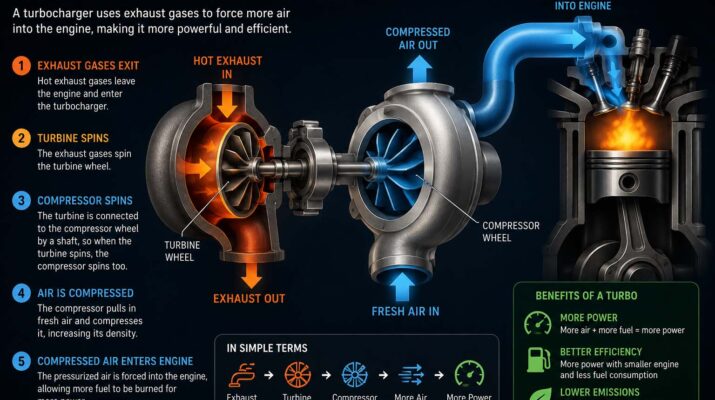
If you’ve ever wondered how does a turbo work, the basic idea is surprisingly simple. A turbocharger uses energy from the engine’s exhaust gases to compress fresh air before it enters the engine.
More compressed air means more oxygen can enter the cylinders. The engine can then add the appropriate amount of fuel and produce more power from the same engine displacement.
In simple terms, the process works like this:
Exhaust gas → turbine spins → compressor spins → air is compressed → intercooler cools the air → more air enters the engine → more power is produced.
This allows manufacturers to get impressive horsepower and torque from relatively small engines.
What Is a Turbocharger?
A turbocharger, commonly called a turbo, is a forced-induction device that uses exhaust-gas energy to compress the air entering an engine.
A naturally aspirated engine relies largely on atmospheric pressure to fill its cylinders. A turbocharged engine uses a compressor to increase the pressure and density of the intake air.
Because more oxygen becomes available for combustion, the engine can burn an appropriate additional amount of fuel and generate more power.
A turbo essentially recovers some energy from the exhaust stream that would otherwise leave through the exhaust system.
Modern turbo systems also depend on sensors and electronic controls. Understanding what is instrumentation can provide useful background on how sensors and measurement systems help monitor pressure, temperature, and other operating conditions.
For a more detailed technical explanation, Garrett Motion’s turbocharger guide explains how exhaust energy drives the turbine and compressor to supply compressed air to the engine.
How Does a Turbo Work?
A turbocharger has two main sides: the turbine side and the compressor side.
The turbine sits in the exhaust stream. The compressor sits in the engine’s intake system. A shaft connects the two wheels.
When exhaust gases spin the turbine, the connecting shaft turns the compressor. The compressor then draws in fresh air, compresses it, and sends it toward the engine.
Here is the process step by step.
1. Exhaust Gases Leave the Engine
Combustion takes place inside the engine’s cylinders.
After combustion, hot exhaust gases leave the cylinders and travel through the exhaust manifold.
Instead of allowing all of this exhaust energy to immediately continue toward the tailpipe, a turbocharged engine routes the gases through the turbine housing.
2. Exhaust Gas Spins the Turbine
The exhaust flow passes across the turbine wheel.
That flow causes the turbine to rotate extremely quickly. Turbocharger rotational speed varies considerably with turbo design and operating conditions, but it can reach well over 100,000 RPM.
The turbine converts energy from the exhaust flow into rotational energy.
3. The Compressor Spins
A shaft connects the turbine wheel to the compressor wheel.
Therefore, when exhaust gas spins the turbine, the compressor on the other side of the turbo also rotates.
The compressor draws fresh air through the engine’s air intake and air filter.
4. The Turbo Compresses the Intake Air
The rotating compressor increases the pressure of the incoming air.
This is the key reason a turbocharger can increase engine output.
Instead of relying only on atmospheric pressure, the engine receives pressurized intake air. This allows a greater mass of oxygen to enter the cylinders.
The pressure produced above atmospheric pressure is commonly referred to as boost.
5. The Intercooler Cools the Compressed Air
Compressing air increases its temperature.
Hotter air is less dense, so turbocharged engines commonly use an intercooler to remove some of that heat before the air reaches the engine.
The intercooler is part of the intake/charge-air system rather than an internal component of the turbocharger itself.
After leaving the compressor, pressurized air travels through the intercooler. The cooler, denser air then continues toward the intake manifold.
6. Compressed Air Enters the Cylinders
The cooled charge air enters the engine.
The engine-management system controls fuel delivery according to operating conditions and the amount of air entering the engine.
With more oxygen available, the engine can burn more fuel when additional power is demanded.
The result is greater torque and horsepower without necessarily increasing engine displacement.
Turbocharger Parts and What They Do
Understanding the main parts makes how a turbo works much easier to visualize.
Turbine Housing
The turbine housing receives exhaust gases from the engine and directs the flow toward the turbine wheel.
Turbine Wheel
The turbine wheel extracts energy from the exhaust flow and converts it into rotational motion.
Shaft
The shaft connects the turbine wheel to the compressor wheel.
When the turbine rotates, the shaft transfers that rotation to the compressor.
Compressor Wheel
The compressor wheel draws in fresh air and compresses it before sending it toward the engine.
Compressor Housing
The compressor housing surrounds the compressor wheel and directs pressurized air into the charge-air system.
Bearings
Turbocharger bearings support the rapidly rotating shaft.
Proper lubrication is extremely important because the turbo operates at very high rotational speeds and temperatures.
Wastegate
A wastegate helps control boost pressure.
When boost reaches the required level, the wastegate can allow some exhaust gas to bypass the turbine. This helps prevent the turbo from producing excessive boost.
Why Does a Turbo Make More Power?
An internal-combustion engine requires air and fuel to produce power.
One important limitation is how much air the engine can draw into its cylinders.
A turbocharger helps overcome that limitation by compressing the intake air.
More air mass means more oxygen is available. When the engine adds the appropriate amount of fuel, it can produce more energy during combustion.
That’s why a relatively small turbocharged engine can produce power comparable to a larger naturally aspirated engine.
Turbocharging can provide:
- Higher horsepower
- More torque
- Stronger acceleration
- Greater power from a smaller engine
- Better performance at higher elevations compared with a similar naturally aspirated engine
The exact benefits depend on engine design, turbo sizing, calibration, driving conditions, and many other factors.
Turbocharged vs Naturally Aspirated Engines
The easiest way to understand a turbo system is to compare it with a naturally aspirated engine.
Naturally Aspirated Engine
A naturally aspirated engine does not use a turbocharger or supercharger to pressurize its intake air.
Atmospheric pressure and piston movement help fill the cylinders.
This arrangement is mechanically simpler and often provides predictable throttle response.
Turbocharged Engine
A turbocharged engine uses exhaust energy to operate a compressor.
The compressor increases intake pressure, allowing the engine to take in a greater mass of air.
That can produce considerably more power from a given engine displacement.
However, turbocharging adds components, heat, lubrication requirements, and additional control systems.
What Is Boost Pressure?
Boost pressure describes intake pressure produced by the forced-induction system above atmospheric pressure.
As the turbo spins faster, the compressor can increase intake pressure.
However, more boost is not automatically better.
The engine, fuel system, cooling system, turbocharger and engine-management calibration must all be designed to operate safely at the intended pressure.
This is why modern engines carefully monitor and control turbo operation.
How Does a Wastegate Work?
The wastegate is an important boost-control device.
Without some method of controlling exhaust energy reaching the turbine, the turbo could produce more boost than the engine is designed to handle.
When the desired boost level is reached, the wastegate can redirect some exhaust flow around the turbine.
Reducing flow through the turbine helps control its speed and therefore compressor output.
Some systems use electronically controlled actuators and valves. Technologies related to what is a solenoid can help explain how electrically controlled devices are used in modern automotive systems.
Common Types of Turbochargers
Although the fundamental operating principle remains similar, manufacturers use several turbo configurations.
Single Turbo
A single-turbo system uses one turbocharger.
It is common because it can provide a practical balance of performance, packaging, complexity, and cost.
Twin Turbo
A twin-turbo engine uses two turbochargers.
However, not every twin-turbo system operates in exactly the same way.
In some engines, each turbo serves a particular group of cylinders. Other systems use sequential arrangements where turbochargers operate differently depending on engine speed and load.
The goal is usually to achieve the desired balance between response and high-output airflow.
Twin-Scroll Turbo
A twin-scroll turbo separates exhaust pulses through divided passages leading toward the turbine.
When matched with an appropriate exhaust-manifold design, this can improve turbine response and help the turbo build useful boost efficiently.
Variable Geometry Turbo
A variable geometry turbocharger, often called a VGT or VNT, changes the effective flow geometry around the turbine.
Adjustable vanes can modify how exhaust gas reaches the turbine depending on operating conditions.
This helps provide useful response at lower engine speeds while still managing exhaust flow at higher loads.
Variable geometry systems are particularly common in diesel applications.
How Does a Turbo Work on a Diesel Engine?
A diesel turbo works according to the same fundamental principle.
Exhaust gases spin a turbine, the turbine drives a compressor, and the compressor supplies pressurized air to the engine.
Turbocharging works particularly well with diesel engines because additional air can support efficient combustion and increased engine output.
Turbocharged diesel engines are widely used in passenger vehicles, pickups, commercial trucks, construction equipment, and other heavy-duty applications.
Depending on the engine and application, turbocharging can contribute to:
- Strong low-speed torque
- Increased engine output
- Improved high-altitude performance
- Better power density
- Efficient operation under heavy loads
Modern diesel turbo systems may also operate alongside complex emissions-control and engine-management systems.
What Is Turbo Lag?
Turbo lag is the delay between requesting more power and receiving the full boost response from the turbocharger.
The turbo doesn’t instantly reach its required speed.
When engine speed and load are low, there may not be enough exhaust energy to immediately accelerate the turbine and compressor to the speed required for significant boost.
After exhaust flow increases, the turbo speeds up and produces more pressure.
Factors influencing turbo lag include:
- Turbo size
- Turbine and compressor design
- Engine displacement
- Exhaust-manifold design
- Engine speed
- Engine calibration
- Boost-control strategy
Modern turbo systems can reduce lag through technologies such as smaller turbines, twin-scroll housings, variable geometry, improved exhaust design, and sophisticated electronic controls.
Does a Turbo Improve Fuel Economy?
A turbocharger can contribute to better fuel economy in some applications, but turbocharging itself does not guarantee lower fuel consumption.
One common manufacturer strategy is engine downsizing.
A smaller turbocharged engine can sometimes provide the performance of a larger naturally aspirated engine while using less fuel under lighter operating conditions.
However, when a driver frequently uses high boost and demands maximum power, fuel consumption can increase because the engine must supply enough fuel for the additional air.
Real-world economy therefore depends on engine design, vehicle weight, gearing, driving style, operating conditions, and calibration.
Turbochargers and High-Altitude Performance
Air becomes less dense as elevation increases.
Naturally aspirated engines therefore tend to lose output at higher elevations because less oxygen enters the cylinders.
A turbocharger can compensate for some of this loss by compressing the intake air.
That is one reason turbocharged engines can maintain performance better at altitude than comparable naturally aspirated engines.
Advantages of Turbochargers
Turbochargers offer several potential benefits.
More Power From Smaller Engines
Turbocharging allows manufacturers to obtain greater output without necessarily increasing engine displacement.
Strong Torque
Many turbocharged engines are designed to provide substantial torque across useful engine-speed ranges.
Better Power Density
A relatively compact engine can produce significant horsepower and torque.
Improved Altitude Performance
Forced induction helps compensate for lower air density at higher elevations.
Potential Efficiency Benefits
When combined with appropriate engine downsizing and calibration, turbocharging can contribute to improved efficiency in certain operating conditions.
Disadvantages of Turbochargers
Turbo systems also introduce trade-offs.
Potential disadvantages include:
- Additional mechanical complexity
- Higher operating temperatures
- More components that can eventually require repair
- Dependence on proper lubrication
- Potential turbo lag
- Higher replacement costs if a turbocharger fails
Whether these disadvantages are significant depends greatly on the engine design and how the vehicle is maintained.
Common Turbo Problems
Turbochargers operate in demanding conditions and can develop problems over time.
Loss of Boost or Power
A noticeable loss of performance doesn’t automatically mean the turbocharger itself has failed.
Possible causes include:
- Boost leaks
- Damaged intake hoses
- Wastegate problems
- Sensor faults
- Compressor or turbine damage
Unusual Whining or Siren-Like Noise
A change in turbo sound can indicate an air leak or mechanical wear.
A qualified technician should inspect persistent abnormal noises.
Excessive Exhaust Smoke
Smoke can have many causes, including engine-related problems and, in some cases, turbocharger oil-sealing issues.
Proper diagnosis is important before replacing components.
Oil Consumption
Turbochargers depend on engine oil for lubrication.
Oil leaks, restricted oil supply, worn components, or other engine problems can contribute to turbo-related symptoms.
Modern monitoring technologies can help identify developing equipment problems. Our guide to what is telemetry explains how operating information can be collected and monitored remotely.
How to Help a Turbo Last Longer
Good maintenance is particularly important for a turbocharged engine.
Follow the vehicle manufacturer’s maintenance schedule and consider these basic practices:
- Use the specified engine oil.
- Change the oil and filter at the recommended intervals.
- Maintain the engine air filter.
- Investigate boost or intake leaks.
- Avoid demanding maximum power from a cold engine.
- Address warning lights and abnormal turbo noises promptly.
- Follow manufacturer-specific operating recommendations.
Older turbo advice sometimes recommends idling every turbocharged vehicle before shutdown. Modern vehicles vary considerably, so the manufacturer’s instructions should take priority.
How Turbo Systems Are Electronically Controlled
Modern turbocharged engines aren’t purely mechanical systems.
The engine control unit can use information from multiple sensors to monitor factors such as pressure, temperature, airflow, throttle demand, and engine speed.
It can then adjust fuel delivery and boost-control devices accordingly.
These electronic systems require a reliable electrical supply. Our alternator vs generator comparison explains two technologies used to convert mechanical energy into electrical energy.
Turbocharger vs Supercharger
Turbochargers and superchargers are both forms of forced induction, but they obtain their driving energy differently.
A turbocharger uses energy from exhaust gases to drive its compressor.
A traditional supercharger is mechanically driven by the engine, commonly through a belt, gear system, or other mechanical connection.
Both technologies can increase the amount of air entering the engine and therefore increase potential engine output.
Frequently Asked Questions
How does a turbo work in simple terms?
A turbo uses exhaust gases to spin a turbine. The turbine is connected by a shaft to a compressor, which compresses fresh intake air. The denser air provides more oxygen, allowing the engine to produce more power when matched with the correct amount of fuel.
How does a turbocharger work?
A turbocharger converts energy in the engine’s exhaust flow into rotational energy. That rotation drives a compressor that pressurizes intake air before it reaches the engine.
Does a turbo make a car faster?
A turbo can increase horsepower and torque, which can improve acceleration and overall performance. The actual result depends on the engine, turbocharger, vehicle, transmission, and calibration.
Does a turbo run all the time?
Exhaust gas flows through the turbo whenever the engine is operating, but the turbo does not produce maximum boost continuously. Turbo speed and boost vary with engine speed, load, throttle demand, and control strategy.
Does every turbocharged engine have an intercooler?
Many modern turbocharged engines use charge-air cooling, but system designs vary. An intercooler reduces the temperature of compressed intake air before it reaches the engine.
How fast does a turbo spin?
Turbochargers can operate at extremely high rotational speeds, often well above 100,000 RPM. Exact maximum speed depends on the turbocharger and application.
What makes a turbo spool?
Increasing exhaust-gas energy accelerates the turbine. Because the turbine and compressor are connected by a shaft, compressor speed also increases. Drivers commonly refer to this acceleration toward useful boost as the turbo spooling up.
Is a turbocharger the same as a supercharger?
No. Both compress intake air, but a turbocharger is driven by exhaust energy while a traditional supercharger is mechanically driven by the engine.
How is turbocharged engine power measured?
Engine output is commonly expressed as horsepower or kilowatts, while torque describes rotational force. Boost pressure is also commonly discussed when evaluating turbo systems.
If you want to understand the power unit itself, see what is KW.
Key Takeaways
So, how does a turbo work?
A turbocharger uses exhaust energy to spin a turbine connected to a compressor. The compressor pressurizes fresh intake air, an intercooler commonly cools that compressed air, and the denser air enters the engine.
With more oxygen available, the engine can add the appropriate amount of fuel and produce greater horsepower and torque.
The complete cycle can be remembered simply:
Exhaust → turbine → compressor → compressed air → intercooler → engine → more potential power.
Turbochargers allow manufacturers to produce impressive output from relatively compact engines, but they also add heat, complexity and additional maintenance considerations. Proper engine oil, routine maintenance and correct diagnosis of boost-related problems are important for long-term reliability.