
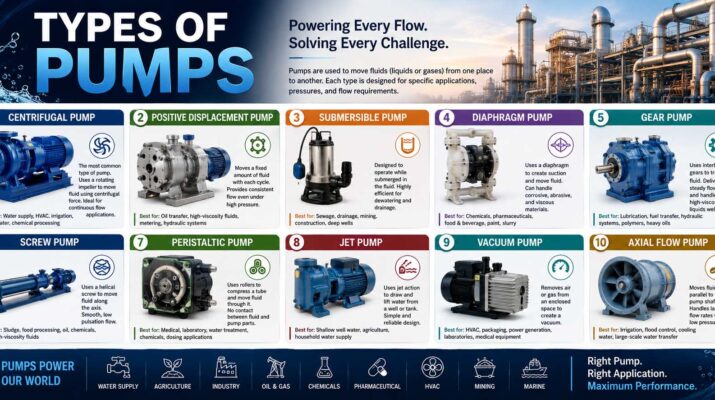
Pumps are found almost everywhere, from home plumbing and cars to factories, hospitals, and water treatment plants. Although they all do the same basic job of moving liquids or gases, they work in different ways. For this reason, understanding the types of pumps helps homeowners, students, technicians, and engineers choose the right equipment.
Some pumps move large volumes of water. In contrast, others deliver small and highly accurate amounts of fluid. As a result, design, operating principle, and intended use all decide how well a pump performs.
What Is a Pump?
A pump is a mechanical device that moves liquids or gases from one place to another by creating pressure or flow. Unlike gravity-fed systems, pumps supply the energy needed to push fluids through pipes, hoses, or machines.
You’ll find pumps in home plumbing, water supply systems, and farming. In addition, they are used in factories, medical equipment, and chemical plants. Similarly, heating and cooling systems and cars depend on them every day.
Although pumps vary widely in size and purpose, they all turn mechanical energy into fluid movement.
Main Types of Pumps
Most types of pumps fall into two main groups: centrifugal pumps and positive displacement pumps. However, each group works differently and suits different tasks. The Hydraulic Institute pump types guide also uses these two main classes.
| Category | Operating Principle | Best For |
|---|---|---|
| Centrifugal Pumps | Rotating impeller creates flow | High-volume liquid transfer |
| Positive Displacement Pumps | Trap and move fixed amounts of fluid | High-pressure, precise flow |
Once you understand these two groups, it becomes much easier to identify the special pump designs below.
Centrifugal Pumps
Centrifugal pumps are among the most widely used pumps in homes and industry. First, a spinning impeller speeds up the liquid. Then, the pump turns that speed into pressure.
These pumps work best with large amounts of thin liquids. For example, they handle clean water, cooling water, irrigation water, and process water very well.
Beginners studying pumps also benefit from learning what is rpm, because the impeller’s speed directly affects pump performance and flow rate.
On the plus side, centrifugal pumps have a simple design and give a steady, continuous flow. Moreover, they need little maintenance, cost less, and handle high flow rates.
On the other hand, they are less effective with thick fluids. In addition, they can lose prime if they are not installed properly.
Positive Displacement Pumps
Positive displacement pumps move fluid by trapping a fixed volume and forcing it through the system. Unlike centrifugal pumps, they keep a steady flow even when pressure changes.
For this reason, they are ideal for oils, chemicals, syrups, fuel, and hydraulic fluids. Because they deliver precise amounts of liquid, they are common in factories and labs.
Common Types of Positive Displacement Pumps
Several types of pumps fall under this group. In particular, three designs are the most common.
Gear Pumps
Gear pumps use rotating gears to move fluid through the pump housing. For example, they are common in hydraulic systems, lubrication equipment, and fuel transfer systems. In addition, their simple design makes them reliable for oils and other thick liquids.
Piston Pumps
Piston pumps use a piston that moves back and forth to push fluid. As a result, they create high pressure. That is why pressure washers, hydraulic machines, and industrial cleaning systems often use them.
Diaphragm Pumps
Diaphragm pumps use a flexible membrane to push fluids through the system. Therefore, they are especially useful for corrosive chemicals, slurries, wastewater, and food processing.
Because the fluid stays away from the moving parts, diaphragm pumps also lower the risk of contamination.
Submersible Pumps
Submersible pumps work while fully underwater in the liquid they move. In fact, a waterproof motor drives the impeller, so the pump pushes water up rather than pulling it from above.
For example, people use them in deep wells, boreholes, flood removal, sewage systems, and groundwater pumping. Moreover, their sealed build improves efficiency and lowers the risk of cavitation.
Peristaltic Pumps
Among the gentlest types of pumps, peristaltic pumps move liquid by squeezing a flexible tube with rotating rollers. As a result, the liquid never touches the pump’s moving parts.
For this reason, they suit medical equipment, labs, medicine factories, and food production. In addition, their gentle pumping action protects sensitive fluids from damage.
Vacuum Pumps
Unlike water pumps, vacuum pumps remove gases from sealed spaces to create a vacuum. For example, industries use them for packaging, chip making, scientific research, and fridge servicing.
In short, vacuum pumps are built for gases rather than liquids, which makes them different from most other pumps.
Comparing Popular Types of Pumps
| Pump Type | Best Application | Main Advantage |
|---|---|---|
| Centrifugal | Water supply | High flow rate |
| Gear | Oils and lubricants | Handles thick fluids |
| Piston | High-pressure systems | Excellent pressure output |
| Diaphragm | Chemicals | Leak-resistant design |
| Submersible | Wells and drainage | Operates underwater |
| Peristaltic | Medical and laboratory use | Clean fluid handling |
| Vacuum | Air removal | Creates vacuum environments |
Overall, this table gives a quick view of where each design works best.
How Pump Components Work Together
Although pump designs vary, many share the same main parts. For example, most have a motor, a shaft, bearings, and an impeller or other pumping part. In addition, they have seals, a housing, an inlet, and an outlet.
In centrifugal pumps, the impeller does most of the work. So, knowing the difference between agitator and impeller helps you avoid mixing up stirring parts with parts that actually move fluid.
Likewise, some industrial pumping systems use what is a solenoid technology to open and close valves automatically.
Choosing Between Centrifugal and Positive Displacement Pumps
Choose a centrifugal pump if you need high flow, thin liquids, continuous running, and lower upkeep costs. On the other hand, choose a positive displacement pump if you need high pressure, accurate flow, or thick liquids.
In addition, positive displacement pumps keep their output steady even when pressure changes. Above all, knowing your fluid matters just as much as knowing the pump.
Specialized Types of Pumps
Beyond factories and plumbing, many pumps are built for very specific jobs. Therefore, learning about these models helps you pick equipment that fits your needs.
Types of Insulin Pumps
The types of insulin pumps available today help people with diabetes deliver insulin throughout the day. For example, traditional tubed pumps connect to the body through thin tubing. In contrast, patch pumps are small wearable devices that stick directly to the skin.
In addition, many modern insulin pumps work with continuous glucose monitors (CGMs), which makes diabetes care more convenient.
Types of Heat Pumps UK
The types of heat pumps UK homeowners usually install are air source, ground source, and water source heat pumps. Instead of making heat directly, each one moves heat from outside into the home.
As a result, heat pumps are an energy-efficient way to heat a house. However, the best choice depends on climate, space, budget, and property design.
Types of Breast Pumps
The types of breast pumps vary by lifestyle and how often a parent pumps. For example, common options include manual pumps, single electric pumps, and double electric pumps. In addition, wearable and hospital-grade pumps are available.
Overall, each one offers a different mix of convenience, portability, and efficiency.
Types of Sump Pumps
The types of sump pumps used in homes help prevent basement flooding by removing extra groundwater. First, pedestal sump pumps keep the motor above the pit, so maintenance is easy. Second, submersible sump pumps sit inside the pit under the water, so they run more quietly and save space.
Either way, both work well when installed correctly and serviced regularly.
How to Choose Between Types of Pumps
With so many designs available, picking the right pump starts with your application. First, ask what fluid you need to move. Next, decide how much flow and pressure you need.
After that, think about whether the pump will run all day and whether the liquid contains solids. Also, check if the fluid is corrosive or rough, and whether the pump will sit indoors or outdoors.
As a result, these answers narrow your choices before you compare specific models.
Common Problems With All Types of Pumps
Even reliable types of pumps can develop problems over time. For example, a low flow rate often comes from clogged filters, blocked pipes, or worn impellers. In addition, air in the system or the wrong pump size can cut flow.
Similarly, loud noise may point to cavitation, loose mounting bolts, or worn bearings. Besides that, trapped air and damaged inner parts can make a pump noisy.
Overheating is another common issue. Usually, it comes from dry running, blocked discharge lines, or poor airflow. Furthermore, electrical faults and too much workload can cause it.
Fortunately, routine checks help you catch these issues before major damage occurs.
Basic Pump Maintenance Tips
Regular maintenance helps all types of pumps last longer and work better. First, inspect the seals for leaks and clean the intake screens. Then, check the bearings and watch vibration levels.
In addition, replace worn parts quickly and make sure the motor is lined up correctly. Finally, follow the maker’s service schedule.
In the end, small tasks done often can prevent costly breakdowns later.
Automation in Modern Pump Systems
Today, many industrial types of pumps run as part of automated control systems. For example, sensors track pressure, flow rate, temperature, tank levels, and motor performance.
As a result, controllers can start, stop, or adjust pump speed on their own. In addition, many systems use what is an actuator technology to work the valves and control fluid movement.
Meanwhile, larger plants rely on what is instrumentation to collect data, watch equipment, and improve overall performance.
Frequently Asked Questions
What are the two main types of pumps?
The two main groups are centrifugal pumps and positive displacement pumps. In fact, most special pumps belong to one of these two groups.
Which pump is best for water?
Centrifugal pumps are the usual choice for clean water because they give high flow and run well nonstop.
Which pump is best for thick liquids?
Positive displacement pumps, such as gear and diaphragm pumps, work better with thick fluids. This is because they move a fixed volume of liquid with each cycle.
Are submersible pumps more efficient?
For many well and drainage jobs, yes. Since they push water instead of pulling it, submersible pumps often run more efficiently and have fewer priming problems.
How long do pumps typically last?
Pump life depends on build quality, operating conditions, and maintenance. In addition, fluid type and installation quality play a role. Generally, well-maintained pumps run reliably for 10 to 20 years or longer.
Final Thoughts on the Types of Pumps
Understanding the different types of pumps makes it much easier to choose equipment that works well and lasts for years. Centrifugal pumps are ideal for moving large volumes of thin liquids. In contrast, positive displacement pumps shine when you need steady flow, high pressure, or thicker fluids.
Meanwhile, special pumps such as insulin pumps, breast pumps, heat pumps, and sump pumps are built for very specific jobs. So, choose them based on the task they need to do.
Before buying any pump, consider the fluid, flow rate, pressure, upkeep needs, and where it will be installed. In the end, the right choice improves reliability, lowers running costs, and keeps your system safe for the long term.