
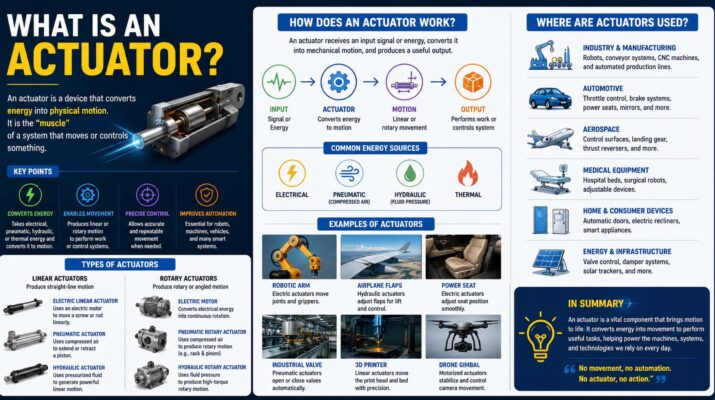
The question what is an actuator is increasingly common as automation technology expands across industries, vehicles, smart homes, and HVAC systems. Actuators are essential components that help machines move, control mechanisms, and perform automated tasks.
From car door locks to industrial robots and air conditioning systems, actuators play an important role in modern technology. In simple terms, an actuator receives energy or a control signal and produces physical movement. The National Institute of Standards and Technology (NIST) definition of an actuator describes it as a device that moves or controls a mechanism or system by converting energy into motion.
What Is an Actuator?
An actuator is a mechanical or electronic device that converts energy into controlled movement. Depending on the design, that movement can be linear, rotary, or another type of mechanical motion.
In simple terms, actuators allow machines to perform physical actions automatically. A control system sends a signal, the actuator receives energy, and the component produces movement that operates a mechanism.
For example, an actuator can open a valve, move a robotic arm, adjust an air damper, or lock a vehicle door. Therefore, actuators connect electronic or automated control systems with physical actions.
How Does an Actuator Work?
Understanding how an actuator works becomes easier when the process is divided into several steps.
First, the device receives a control signal from a switch, sensor, computer, or control system. This signal tells the actuator what action to perform.
Next, the actuator uses its available power source to create movement. Electric actuators use electrical energy and motors, while pneumatic actuators use compressed air. Similarly, hydraulic actuators use pressurized fluid to produce force.
Finally, the movement performs a specific task. For instance, an actuator may open a valve, move a robotic arm, adjust airflow, or operate a vehicle locking mechanism.
As a result, actuators allow automated systems to respond quickly and consistently. Many automated systems also rely on what is instrumentation principles to monitor and control equipment accurately.
What Is an Electric Actuator?
The phrase what is an electric actuator is commonly searched because electric actuators are widely used in homes, vehicles, medical equipment, and industrial systems.
An electric actuator typically uses an electric motor, gears, and a control mechanism to convert electrical energy into mechanical movement. Depending on the design, it can produce either linear or rotary motion.
Electric actuators are popular because they can provide precise movement and integrate easily with electronic control systems. They are commonly used in:
- Smart home automation
- Industrial machinery
- Medical devices
- Solar panel tracking systems
- Automated doors and windows
- Robotics
In addition, electric actuators can provide controlled positioning without requiring compressed air or hydraulic fluid. For that reason, they are useful in applications where clean operation, precise movement, and electronic control matter.
What Is an Actuator in a Car?
Many people search for what is an actuator in a car because modern vehicles use several types of actuators to control mechanical functions.
Automotive actuators respond to electrical signals from vehicle control systems and move or adjust specific components. As a result, they can improve convenience, comfort, safety, and vehicle performance.
Common automotive actuators include:
- Door lock actuators
- Throttle actuators
- Turbocharger actuators
- Blend door actuators for climate control
- Brake actuators in some advanced vehicle systems
For example, when you press a power-lock button, the door lock actuator moves the locking mechanism. Therefore, the driver can lock or unlock the door without manually operating the mechanism.
Modern vehicles depend heavily on electronic control. Some vehicle systems also include what is a solenoid components that work alongside actuators to control mechanical functions.
What Is an Actuator in HVAC?
The phrase what is an actuator in HVAC is important for understanding how modern heating, ventilation, and air conditioning systems control airflow and temperature.
HVAC actuators operate components such as dampers and valves. For example, an actuator can open or close an air damper according to a thermostat or building control signal. Consequently, the system can regulate airflow without requiring constant manual adjustment.
HVAC systems may use electric or pneumatic actuators depending on the equipment and control design. They commonly appear in:
- Commercial ventilation systems
- Air handling units
- Heating valves
- Cooling dampers
- Building automation systems
Therefore, actuators help HVAC equipment respond to control signals and maintain desired operating conditions.
Types of Actuators
Several major actuator categories serve different applications. The best choice depends on factors such as required force, speed, precision, available energy, and operating environment.
Electric Actuators
Electric actuators use electrical energy, usually through a motor, to create mechanical movement. They offer precise control and integrate well with electronic automation systems.
They are common in robotics, industrial equipment, automated doors, and smart home systems.
Pneumatic Actuators
Pneumatic actuators use compressed air to produce movement. They are often used in industrial environments because they can provide fast movement and work well in many automated production systems.
However, pneumatic systems require a suitable compressed-air supply and related equipment.
Hydraulic Actuators
Hydraulic actuators use pressurized fluid to generate movement and force. Because hydraulic systems can produce high force, they are widely used in heavy machinery, construction equipment, and other demanding applications.
For this reason, hydraulic actuators are useful when an application requires substantial force.
Thermal Actuators
Thermal actuators use changes caused by heat to produce movement. These components can appear in thermostatic and temperature-control applications.
Their operation differs from motor-driven actuators because temperature changes directly influence the movement mechanism.
Linear vs. Rotary Actuators
Actuators can also be classified according to the type of movement they produce.
Linear actuators create straight-line movement. For example, they can lift, push, pull, or adjust a component. Common applications include adjustable beds, lifting systems, automated gates, and positioning equipment.
Rotary actuators create rotational movement. They are commonly used for valves, robotic joints, and rotating machinery.
Therefore, the choice between linear and rotary motion depends on the mechanical action required by the system.
Common Actuator Problems and Troubleshooting Tips
Actuators can experience problems because of mechanical wear, electrical faults, damaged components, or power and pressure issues. However, basic checks can help identify some common causes.
One common problem is slow movement. This may result from a weak power supply, worn gears, mechanical resistance, or insufficient air pressure in a pneumatic system.
Another issue is unusual noise during operation. Grinding, clicking, or similar sounds may indicate mechanical wear or damage.
An actuator may also stop responding completely. Possible causes include damaged wiring, an incorrect control signal, a failed motor, or another component fault.
To troubleshoot an actuator:
- Check the power source.
- Inspect wiring and electrical connections.
- Look for visible mechanical damage.
- Test the control signal.
- Check air or fluid pressure when applicable.
- Inspect the mechanism for obstructions.
- Follow the manufacturer’s maintenance and safety procedures.
Regular inspection and maintenance can help improve reliability and identify problems before they become more serious.
Why Actuators Matter in Modern Technology
Actuators are important because they allow automated systems to convert control signals into physical actions. Without them, many machines would require direct manual operation.
For example, manufacturing systems use actuators to move machinery, robotics systems use them to control joints and mechanisms, and vehicles use them to operate various components. Similarly, healthcare equipment and building automation systems can depend on controlled mechanical movement.
The integration of what is mechatronics has also expanded the role of actuators by combining mechanical components with electronics, sensors, and control systems.
In smart homes, actuators can operate automated blinds, locks, valves, and other devices. As a result, they form an important part of many connected and automated environments.
Future of Actuator Technology
Actuator technology continues to develop as automation systems become more connected and intelligent. Engineers are working with smaller, more efficient, and more controllable actuator systems for applications such as robotics, industrial automation, and autonomous technologies.
Modern systems can combine actuators with sensors and communication capabilities. This combination allows control systems to monitor operating conditions and adjust physical actions based on available data.
Many automated systems also use what is telemetry concepts to transmit operating information for monitoring and diagnostics.
At the same time, the growth of the Internet of Things is creating more opportunities for connected sensors and actuators. Understanding basic coding concepts can also help engineers and developers work with software-controlled automation systems.
Future actuator systems may offer better energy efficiency, improved diagnostics, more precise control, and greater integration with intelligent automation.
Frequently Asked Questions About Actuators
What is an actuator used for?
An actuator creates controlled movement in machines, vehicles, industrial equipment, HVAC systems, and automated devices. It can move, position, open, close, rotate, or adjust a mechanical component.
What is an actuator in simple words?
An actuator is a device that converts energy into controlled physical movement. A control system can use that movement to operate a machine or mechanism.
What is an electric actuator?
An electric actuator uses electrical energy, usually through a motor, to create mechanical movement. These actuators are common in automation, robotics, vehicles, and smart devices.
What is an actuator in HVAC systems?
An HVAC actuator controls components such as dampers and valves. It responds to a control signal so the system can regulate airflow or other heating and cooling functions.
What is an actuator in a car?
A vehicle actuator uses a control signal to move or adjust a mechanical component. Examples include door lock, throttle, turbocharger, and climate-control actuators.
Can actuators fail?
Yes. Actuators can fail because of mechanical wear, electrical problems, damaged wiring, power issues, or pressure problems in pneumatic and hydraulic systems. Regular inspection can help identify potential faults.
Conclusion
Understanding what is an actuator helps explain how many modern machines turn control signals and energy into physical movement. Actuators operate components in vehicles, HVAC equipment, industrial machinery, robotics, smart homes, and other automated systems.
Different applications require different actuator types. Electric, pneumatic, hydraulic, and thermal actuators each have specific characteristics, while linear and rotary designs provide different types of movement.
As automation and connected technology continue to develop, actuators will remain an important part of systems that need reliable and controlled physical action.