
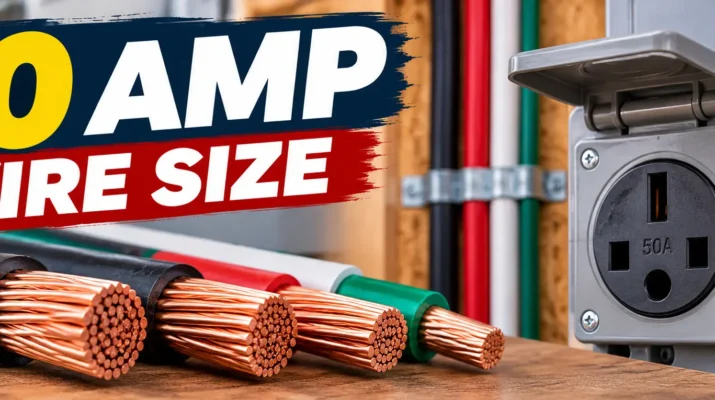
Choosing the correct 50 amp wire size is essential when installing an electrical circuit for an EV charger, electric range, RV outlet, or other high-power equipment. Although 6 AWG copper wire is a common choice, the correct conductor size depends on several electrical and installation requirements.
For example, conductor material, insulation temperature rating, terminal ratings, and circuit length can all influence wire selection. In addition, continuous electrical loads may require a different approach than equipment operating for shorter periods.
Using undersized conductors can cause excessive heating, damage electrical insulation, and increase fire risks. However, choosing oversized wire without checking terminal compatibility can also create installation problems.
This guide explains common wire sizes for 50-amp circuits, how electrical codes affect conductor selection, and what to check before starting a project.
What Is the Correct 50 Amp Wire Size?
For many standard residential installations following the U.S. National Electrical Code (NEC), 6 AWG copper wire is a common choice for a 50-amp branch circuit.
However, the answer changes depending on the conductor and wiring method.
For instance, 6 AWG copper THHN/THWN-2 conductors installed in a suitable raceway may have sufficient ampacity for a 50-amp circuit under common conditions.
Meanwhile, 6 AWG copper NM-B cable has a base ampacity of 55 amps under the NEC’s 60°C ampacity limitation, making it suitable for many ordinary 50-amp applications.
Aluminum wiring requires separate consideration because its conductivity differs from copper.
Quick Wire Size Comparison
The following table shows common NEC ampacity values for selected conductors under reference conditions.
| Wire Size | Copper at 60°C | Copper at 75°C | Aluminum at 75°C |
|---|---|---|---|
| 8 AWG | 40A | 50A | 40A |
| 6 AWG | 55A | 65A | 50A |
| 4 AWG | 70A | 85A | 65A |
These values reflect NEC Table 310.16 reference conditions for conductors rated up to 2,000 volts, with no more than three current-carrying conductors and a 30°C ambient temperature.
For authoritative information about electrical safety requirements, consult the National Fire Protection Association’s National Electrical Code resources.
Although 8 AWG copper has a 75°C ampacity of 50 amps, it is not automatically suitable for every 50-amp breaker.
Terminal temperature limitations, conductor insulation, equipment instructions, and applicable code rules must also be satisfied.
Therefore, a qualified electrician should verify the final selection.
Understanding 50 Amp Wire Gauge and Ampacity
Electrical conductors commonly use the American Wire Gauge (AWG) system.
Interestingly, smaller AWG numbers indicate larger conductor diameters.
For example, 6 AWG wire is thicker than 8 AWG wire.
Larger conductors generally have lower electrical resistance, allowing them to carry more current under comparable conditions.
However, wire thickness alone does not determine safe ampacity.
What Does Ampacity Mean?
Ampacity describes the maximum current a conductor can carry under specified conditions without exceeding its temperature rating.
Several factors influence this rating:
- Conductor material
- Insulation temperature rating
- Ambient temperature
- Number of current-carrying conductors
- Wiring method
- Equipment terminal limitations
For example, conductors installed together in a raceway may require ampacity adjustments when more than three current-carrying conductors are present.
Similarly, high surrounding temperatures may require additional derating.
When planning raceway installations, consulting a conduit fill chart helps determine whether the selected conduit can accommodate the conductors. However, conduit-fill compliance and ampacity adjustment are separate requirements.
What Size Wire for 50 Amp Breaker Installations?
A 50-amp breaker protects circuit conductors against excessive current under applicable electrical code rules.
However, selecting a conductor involves more than matching its advertised ampacity to the breaker rating.
The wiring method and equipment terminals must support the installation.
Choosing the Right Copper Wire Size for a 50-Amp Breaker
For many residential branch circuits, 6 AWG copper provides a straightforward solution.
For instance, an electric range or another appliance may use a properly designed 50-amp branch circuit with suitable copper conductors.
Nevertheless, appliance instructions can specify particular circuit requirements.
Therefore, always check the equipment nameplate and installation manual before selecting wiring.
Aluminum Wire for a 50-Amp Breaker
Under common NEC reference conditions, 6 AWG aluminum conductors have a 75°C ampacity of 50 amps.
However, this does not mean 6 AWG aluminum is appropriate in every installation.
If the applicable terminal temperature limit is 60°C, its base ampacity is lower.
Consequently, a larger conductor, such as 4 AWG aluminum, may be required depending on the installation.
Aluminum conductors also require terminals specifically listed for aluminum. Installers must follow the manufacturer’s instructions for conductor preparation and termination.
Does Cable Type Matter?
Yes. Different cable types have different insulation ratings, construction methods, and installation restrictions.
For example, NM-B cable, individual THHN/THWN-2 conductors, and underground feeder cable are not interchangeable in every environment.
Therefore, a wire size that works in one wiring method may not be acceptable in another.
Copper vs. Aluminum Wire for 50-Amp Circuits
Copper offers lower electrical resistance for a given conductor size.
As a result, copper conductors can often be smaller than aluminum conductors for the same required ampacity.
Aluminum, however, is lighter and may cost less for larger installations.
| Feature | Copper | Aluminum |
|---|---|---|
| Electrical conductivity | Higher | Lower |
| Typical conductor size | Smaller for equal ampacity | Often larger |
| Weight | Heavier | Lighter |
| Material cost | Generally higher | Often lower |
| Connection requirements | Compatible listed terminals | Aluminum-rated terminals required |
Neither material is automatically unsafe when properly selected and installed.
However, aluminum wiring requires particular attention to compatible connections and manufacturer-specified termination procedures.
How Circuit Length Affects Voltage Drop
Wire length matters because electrical resistance increases as conductors become longer.
As a result, long circuits can experience noticeable voltage drop.
Voltage drop occurs when the voltage available at the equipment becomes lower than the voltage supplied at the circuit source.
Excessive voltage drop may affect equipment performance and increase energy losses.
Why Long Wire Runs Need Attention
Consider a detached garage located far from the main electrical panel.
Even when a conductor meets minimum ampacity requirements, the circuit length may justify using a larger wire size.
For example, an electrician might evaluate 4 AWG copper instead of 6 AWG copper for a particularly long run.
However, the correct choice depends on current, conductor resistance, operating voltage, and total circuit length.
Understanding the 3% Recommendation
NEC informational guidance commonly recommends limiting branch-circuit voltage drop to approximately 3% and combined feeder-plus-branch-circuit voltage drop to approximately 5%.
These are generally design recommendations rather than universal mandatory limits.
Nevertheless, they provide useful targets for efficient circuit design.
Continuous Loads and Breaker Requirements
A continuous load is generally one expected to operate at its maximum current for three hours or longer.
Under common NEC rules, branch-circuit conductors and overcurrent protection must account for 125% of the continuous load, unless applicable equipment and code provisions allow otherwise.
For example, a typical 50-amp circuit may support a continuous load of up to 40 amps.
The calculation is:
40 amps × 125% = 50 amps
However, equipment-specific requirements can change the design.
Example: Electric Vehicle Charging
Many residential EV chargers operate for several hours.
Consequently, continuous-load requirements become especially relevant.
A charger configured for 40 amps may be suitable for a properly designed 50-amp circuit when the equipment instructions and applicable code requirements are satisfied.
However, a charger requiring 48 amps continuously generally needs a circuit rated for at least 60 amps under typical rules.
Therefore, always follow the charger’s installation instructions and applicable electrical code.
Single-Phase and Three-Phase Electrical Systems
Residential 50-amp circuits commonly use single-phase electrical systems.
However, commercial and industrial equipment may operate on three-phase power.
Understanding single phase vs three phase becomes useful when comparing electrical loads and conductor requirements.
For example, a 50-amp circuit at 240 volts does not represent the same power capacity as a 50-amp three-phase circuit at 208 volts.
The current rating may be similar, but the power calculations differ.
Therefore, electrical system configuration must be considered before selecting conductors.
Common Applications of 50-Amp Circuits
Several appliances and electrical systems may require circuits rated at 50 amps.
However, the actual requirements depend on the equipment manufacturer and calculated electrical load.
Electric Ranges
Some electric cooking appliances use 40-amp or 50-amp circuits.
However, the appliance nameplate and installation instructions determine the appropriate circuit configuration.
RV Electrical Connections
Many larger recreational vehicles use 50-amp shore-power connections.
In North America, a standard 50-amp RV receptacle commonly supplies two 120-volt hot legs, a neutral, and an equipment grounding connection.
Therefore, the installation differs from a simple 120-volt receptacle.
EV Charging Equipment
Certain EV charging stations operate on 50-amp branch circuits.
However, their charging current must remain within the permitted continuous-load rating.
Workshop Equipment
Some welders and other workshop machines use 50-amp circuits.
Nevertheless, special equipment rules may affect conductor sizing and overcurrent protection.
For example, welding equipment can have installation requirements that differ from ordinary branch circuits.
How to Estimate Electrical Power on a 50-Amp Circuit
Electrical power depends on voltage and current.
For a basic single-phase calculation with a unity power factor:
Power (watts) = Voltage × Current
For example, at 240 volts and 50 amps:
240 × 50 = 12,000 watts
This equals 12 kilowatts.
However, this calculation represents the electrical power associated with 50 amps at 240 volts, not necessarily the permitted continuous load.
For a typical 40-amp continuous load:
240 × 40 = 9,600 watts
That equals 9.6 kilowatts.
If you are unfamiliar with these units, understanding What Is a KW can help explain the relationship between watts, kilowatts, and electrical power.
Common Wire Sizing Mistakes to Avoid
Incorrect conductor selection can create serious electrical hazards.
Therefore, avoid these common mistakes:
- Assuming every 8 AWG copper conductor is suitable for 50 amps
- Ignoring terminal temperature ratings
- Using aluminum wire with incompatible connectors
- Overlooking ambient temperature adjustments
- Failing to account for long circuit runs
- Confusing breaker size with equipment operating current
- Ignoring continuous-load requirements
- Choosing cable unsuitable for the installation environment
Another common mistake involves treating all electrical circuits as identical.
For example, understanding series vs parallel helps explain basic circuit behavior, but residential branch-circuit wiring must follow approved configurations rather than simplified classroom examples.
Because electrical installations involve shock and fire hazards, a qualified electrician should verify conductor selection and installation.
Frequently Asked Questions
Is 6 AWG Wire Enough for 50 Amps?
Often, yes. Under common NEC conditions, 6 AWG copper is suitable for many 50-amp branch circuits. However, wiring method, terminal ratings, ambient temperature, and applicable code requirements must be checked.
Can I Use 8 AWG Wire on a 50-Amp Breaker?
Sometimes, 8 AWG copper may be permitted when its applicable 75°C ampacity is usable and all installation conditions are satisfied.
However, 8 AWG copper NM-B cable is generally not suitable for an ordinary 50-amp branch circuit because its allowable ampacity is limited to the 60°C column.
What Size Wire for 50 Amp Service?
The answer depends on whether you mean a branch circuit, feeder, or service conductors.
Each application has different requirements, so the conductor must be selected using the relevant electrical code provisions.
Is 50 Amps Enough for an EV Charger?
A properly designed 50-amp circuit commonly supports a 40-amp continuous charging load.
However, charger settings, manufacturer instructions, and electrical code requirements determine the permitted configuration.
Does a 50-Amp Circuit Need a Neutral Wire?
Not always. Some 240-volt loads require two hot conductors and an equipment grounding conductor, while others also need a neutral.
The equipment and circuit design determine the required conductors.
Choosing the Right Wire for a Safe Installation
For many ordinary residential applications, 6 AWG copper is a common starting point when evaluating 50 amp wire size.
However, there is no universal conductor size that works for every 50-amp installation.
Instead, consider the wiring method, conductor material, terminal ratings, circuit length, continuous loads, and equipment instructions.
Likewise, check local electrical codes because requirements may differ by jurisdiction and adopted code edition.
Most importantly, have a qualified electrician confirm the design before installation. Proper conductor sizing helps protect electrical equipment, reduce overheating risks, and support reliable long-term operation.