
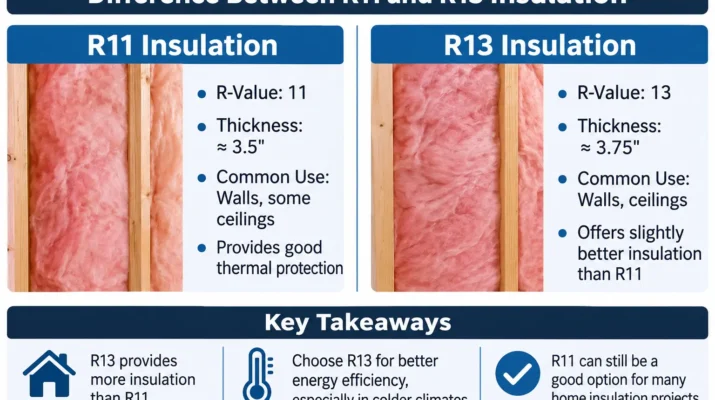
You’re standing in the insulation aisle, and two rolls look almost identical. One says R-11, the other says R-13, and the price gap is small. So what’s the real difference between R11 and R13 insulation? In short, R13 blocks more heat in the same 2×4 wall space, while R11 is a lighter-duty option that still works well in certain spots.
Below, you’ll learn what those numbers mean, how the two compare and which one makes sense for your project.
Difference Between R11 and R13 Insulation: The Quick Answer
Basically, the number tells you how well the insulation resists heat flow. Since 13 is higher than 11, R13 insulates better.
Here’s the short version:
- R13 is the usual choice for exterior 2×4 walls and is often the minimum that codes allow.
- R11 is better suited to interior walls, some floors and spots where code doesn’t demand more.
- Both are commonly sold as about 3.5-inch fiberglass batts, so they fit standard 2×4 framing.
In other words, R13 packs more insulating power into roughly the same thickness.
What Does R-Value Actually Mean?
Simply put, R-value measures thermal resistance, or how well a material slows down heat moving through it. According to the U.S. Department of Energy, a higher R-value means better insulating power.
In winter, insulation keeps warm air inside. Meanwhile, in summer, it helps keep outdoor heat out. As a result, your heating and cooling system doesn’t have to work as hard.
However, R-value only tells part of the story. For example, gaps, compression and air leaks can drag down real-world performance, no matter what the label says.
R11 vs R13 Insulation Side by Side
To make things clear, here’s a quick comparison of typical fiberglass batts. Keep in mind that exact specs vary by brand.
| Feature | R11 | R13 |
|---|---|---|
| Typical thickness | About 3.5 inches | About 3.5 inches |
| Density | Lower | Higher |
| Heat resistance | Good | About 18% higher |
| Fits 2×4 walls? | Yes | Yes |
| Common uses | Interior walls, floors, sound control | Exterior walls, garage walls |
| Meets most exterior wall codes? | Often no | Often yes (in milder climates) |
| Price | Slightly lower | Slightly higher |
Key Difference Between R11 and R13 Insulation Explained
Now let’s break down what actually separates them.
1. Thermal performance. First, R13 resists heat about 18% better than R11, since 13 divided by 11 is roughly 1.18. Put another way, heat moves through R13 batts about 15% more slowly than through R11. That said, total wall performance also depends on studs, sheathing and air sealing.
2. Density. Next, both batts are usually the same thickness. So how does R13 get a higher rating? Basically, manufacturers pack the fibers more tightly, which traps more air and slows heat better.
3. Framing fit. Also, both are designed for 2×4 walls with a 3.5-inch cavity. Typically, exterior walls with 2×4 studs carry roof and floor loads, and if you’re opening one up, our guide on load bearing beam basics explains how those walls and beams share the weight. For deeper 2×6 walls, you’d usually step up to R19 or R21 instead.
4. Cost. Generally, R13 costs a little more per roll. Still, the price gap is usually small, and prices vary by brand, store and location.
5. Sound control. Finally, both help reduce noise between rooms. For interior walls, R11 often does the job well enough, so many people save a bit there.
Where Each Type Fits Best
Good Places for R11
- Interior walls: Mainly for sound dampening between bedrooms or bathrooms.
- Floors over heated spaces: Often enough when heat loss isn’t a big concern.
- Older homes: Sometimes, older framing has shallower cavities where a lighter batt fits better.
- Budget projects: Especially in spots code doesn’t regulate.
Good Places for R13
- Exterior 2×4 walls: Usually the standard choice.
- Garage walls next to living space: Because they separate heated and unheated areas.
- Basement walls with framing: Often, depending on local rules and moisture control.
- Any wall where you want better comfort without changing the framing.
What Building Codes Say
Typically, energy codes set a minimum R-value for exterior walls based on your climate zone. In many warmer areas, R13 in a 2×4 wall is often the minimum. Meanwhile, colder zones usually require more, such as R20 in the cavity or R13 plus continuous insulation on the outside.
Because rules vary by location and code edition, check with your local building department before you buy. Otherwise, you might fail an inspection and have to redo the work.
In most cases, R11 doesn’t meet current code for new exterior walls. So save it for interior and non-regulated spaces.
Difference Between R11 and R13 Insulation in Real Projects
To see how this plays out, here are a few common scenarios.
- Finishing a garage: Here, R13 in the exterior walls makes the space noticeably more comfortable.
- Adding a home office inside the house: Instead, R11 in the interior walls helps cut noise without overspending.
- Remodeling an old bedroom: Usually, swapping thin, old batts for R13 boosts comfort in exterior walls.
Also, insulation works best as part of a bigger efficiency plan. For example, many homeowners pair wall upgrades with efficient appliances, and a heat pump water heater can cut energy use even further in a well-insulated home.
Installation Tips for Better Results
No matter which one you pick, installation makes a huge difference. So follow these tips:
- Wear protection: First, use gloves, long sleeves, goggles and a dust mask, since fiberglass irritates skin and lungs.
- Cut to fit: Next, trim batts snugly around outlets, pipes and wires.
- Don’t compress: Also, squeezing batts lowers their R-value.
- Fill every gap: Otherwise, small voids let heat slip through.
- Seal air leaks: Then, caulk or foam gaps around windows and outlets before insulating.
- Face the right way: Finally, if you use kraft-faced batts, follow local code for vapor retarder placement, which depends on your climate.
Common Mistakes to Avoid
- Using R11 on exterior walls in new builds: Often, it won’t pass code.
- Stuffing R19 into a 2×4 wall: Actually, compressing a thick batt can lower its real performance.
- Skipping air sealing: Even the best batts can’t stop drafts.
- Leaving faced insulation exposed: Since paper facing can burn, cover it with drywall where code requires.
FAQs
Can you use R13 instead of R11 insulation?
Yes, in most cases. Because both are usually 3.5 inches thick, R13 fits the same 2×4 cavities and gives better performance.
Is the difference between R11 and R13 insulation worth the cost?
For exterior walls, usually yes. Since the price gap is small and comfort improves, R13 is often the better value.
Does higher R-value always mean better?
Generally, yes, but only if it’s installed correctly. Also, the insulation must fit the cavity without heavy compression.
Picking the Right Batt
To sum up, choose R13 for exterior 2×4 walls and any space that separates heated and unheated areas. On the other hand, use R11 for interior walls and sound control where code doesn’t require more.
Before buying, check your local code and measure your wall cavities. That way, you’ll get the right fit, pass inspection and enjoy a more comfortable home.