
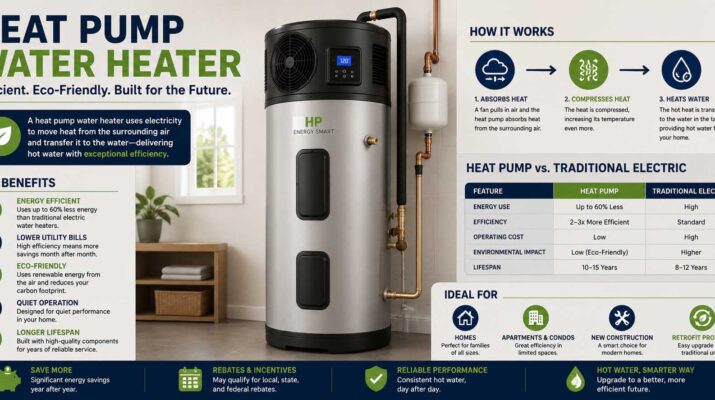
Water heating can account for a noticeable part of a home’s energy use, so choosing a more efficient system can make a meaningful difference. A heat pump water heater takes a different approach from a conventional electric tank. Instead of relying mainly on electric resistance elements to create heat, it moves heat from the surrounding air into the water. That design can reduce electricity use, although installation space, climate, household demand, and upfront cost all matter when deciding whether one belongs in your home.
These systems are also commonly called hybrid electric water heaters because many models combine heat-pump technology with backup electric resistance heating. As a result, homeowners can often choose between efficiency-focused operation and faster recovery when hot-water demand increases.
What Is a Heat Pump Water Heater?
If you are wondering what is a heat pump water heater, think of it as a water heater that works somewhat like a refrigerator in reverse. A refrigerator removes heat from its interior and releases it into the room. By contrast, a heat pump unit collects heat from the surrounding air and transfers that energy into the stored water.
Because the system moves existing heat instead of producing all of its heat through electrical resistance, it can use substantially less electricity under suitable operating conditions. However, actual savings depend on the model, installation environment, water use, local electricity rates, and selected operating mode.
A typical unit includes a storage tank, compressor, evaporator, fan, refrigerant circuit, controls, and backup heating elements. Therefore, it combines several technologies within one appliance.
Although there are many types of pumps used in mechanical and plumbing systems, the “heat pump” in this appliance refers specifically to a refrigeration-based heat-transfer process rather than a conventional water circulation pump.
How Does a Heat Pump Water Heater Work?
First, a fan draws surrounding air across an evaporator coil. Refrigerant inside the system absorbs heat from that air and changes state as part of the refrigeration cycle.
Next, a compressor raises the refrigerant’s pressure and temperature. The system then transfers that collected thermal energy into the water inside the storage tank. Afterward, the refrigerant cycles back through the system and repeats the process.
Consequently, the unit can heat water while consuming less electricity than a conventional resistance-only electric heater under favorable conditions.
At the same time, the appliance releases cooler, drier air into the surrounding space. That effect may be welcome in a warm basement or garage, although it can be less desirable in a small conditioned room during colder months.
Many units also contain standard electric heating elements. Therefore, when the heat pump cannot recover hot water quickly enough, a hybrid operating mode may use resistance heat to increase recovery speed.
The U.S. Department of Energy’s heat pump water heater guidance provides further information about how these systems operate and the factors homeowners should consider when choosing one.
Heat Pump Water Heater vs. Standard Electric Water Heater
The basic difference is how the two systems create or obtain heat.
| Feature | Heat Pump Water Heater | Standard Electric Tank |
|---|---|---|
| Main heating method | Transfers heat from surrounding air | Electric resistance |
| Energy use | Usually lower | Usually higher |
| Purchase price | Usually higher | Usually lower |
| Space requirements | More demanding | Easier to accommodate |
| Operating sound | Fan and compressor produce sound | Usually very quiet |
| Installation | May require extra planning | Generally simpler |
| Recovery | Varies by mode and model | Predictable resistance heating |
| Cooling effect | Cools nearby air | Minimal |
For homeowners replacing an electric storage heater, a heat pump hot water heater can be particularly appealing when lower long-term electricity consumption matters more than getting the lowest upfront purchase price.
However, the conventional option still has advantages. For example, it can fit more easily into tight spaces and does not depend on extracting heat from nearby air.
Benefits of a Heat Pump Water Heater
Lower Electricity Consumption
Efficiency is the main reason people consider this technology. Since the unit transfers heat rather than generating all of it directly with resistance elements, it can deliver more heat energy to the water per unit of electricity consumed.
When comparing specifications, you may see electrical power ratings expressed in kilowatts. If those numbers are unfamiliar, understanding What Is a KW makes appliance specifications and household energy use easier to compare.
Still, do not judge a unit from one electrical rating alone. Tank size, efficiency metrics, household demand, climate, operating mode, and installation conditions all affect real-world performance.
Multiple Operating Modes
Many hybrid models offer several modes. Depending on the manufacturer, these may include heat-pump-only, hybrid, electric, vacation, or high-demand settings.
Heat-pump-only operation generally prioritizes efficiency. Meanwhile, hybrid mode can automatically balance efficiency with hot-water recovery.
For households with occasional periods of heavy demand, these choices can make the system more flexible than its name initially suggests.
Dehumidifying Effect
Because the evaporator removes some moisture while processing surrounding air, the system can have a mild dehumidifying effect.
That characteristic may work well in certain basements and utility spaces. However, homeowners should treat it as a side effect rather than a replacement for dedicated humidity control where that is needed.
Drawbacks to Consider Before Buying
The biggest disadvantage is usually upfront cost. Heat-pump models commonly cost more than basic electric tank heaters, while installation changes can increase the project price further.
They also need suitable airflow. Therefore, placing one inside a very small enclosed closet may require ducting or another manufacturer-approved solution.
Noise deserves attention as well. Since the appliance contains a fan and compressor, it will not be silent. Consequently, installation beside a bedroom or quiet living area may be less appealing than placement in a garage, basement, or dedicated mechanical space.
Cold surroundings can also affect performance. Because the unit obtains heat from ambient air, very low temperatures may reduce heat-pump efficiency or cause the appliance to rely more heavily on backup resistance heating.
Finally, recovery speed matters for larger families. A properly sized tank and suitable operating mode can help, but buyers should compare first-hour delivery or equivalent hot-water performance rather than focusing only on tank capacity.
Choosing the Right Heat Pump Water Heater
Start With Household Hot-Water Demand
Tank size should match how your household actually uses hot water. A small household with moderate demand has different needs from a family that regularly runs multiple showers and appliances close together.
Therefore, look beyond gallon capacity. Compare the manufacturer’s first-hour rating and recovery information because those specifications give a better picture of how much hot water the appliance can supply during busy periods.
Buying an oversized tank is not automatically better, either. Instead, balance capacity, efficiency, physical dimensions, and expected demand.
Check the Installation Space
Before ordering a unit, measure the installation area carefully. Check ceiling height, width, door clearance, drain access, and required service clearances.
Also, verify the manufacturer’s minimum air-volume requirements. Some installations can use duct kits to draw or exhaust air from another location, although compatibility varies between models.
Condensate drainage is another difference from a basic electric tank. Since heat-pump operation creates condensation, the installation needs an approved way to drain that water.
Compare Efficiency and Operating Cost
Do not choose solely by purchase price. Instead, compare energy efficiency information, estimated annual operating cost, warranty coverage, expected household usage, and local electricity prices.
For example, a more expensive model may make financial sense if its efficiency reduces operating costs enough over the ownership period. On the other hand, the payback may be less attractive in a household with very low hot-water demand.
Prices and potential savings vary by model, retailer, installer, location, utility rates, and time.
Rheem Heat Pump Water Heater and Other Brand Choices
A Rheem heat pump water heater is one example shoppers may encounter while comparing hybrid electric systems. However, brand recognition alone should not determine the purchase.
Instead, compare the specific model’s tank capacity, efficiency rating, first-hour performance, noise specifications, warranty, control options, installation requirements, and local service availability.
Smart controls may also matter. For instance, some modern models offer app-based monitoring, scheduling, energy information, or operating-mode controls. Yet these features are only useful if the core water-heating performance suits your household.
Also, confirm that qualified local technicians can service the product. Since a heat pump model contains refrigeration components as well as conventional water-heater parts, servicing can be more specialized than repairing a simple electric tank.
Installation Requirements You Should Check
Heat pump units often require more planning than standard electric water heaters. Therefore, professional installation is usually worth considering, especially when electrical, plumbing, condensate, seismic, code, or ducting work is involved.
The electrical circuit must match the manufacturer’s requirements. Likewise, the installation should meet applicable plumbing and electrical codes.
Location-specific rules can matter as well. Someone researching a heat pump water heater Washington DC installation, for example, should check current District requirements, utility programs, permit rules, and available incentives rather than relying on general national guidance.
Because requirements and incentive programs can change, confirm current details before buying based on an expected rebate or tax benefit.
Controls, Sensors, and Temperature Management
Modern units use sensors and electronic controls to manage the refrigeration cycle, tank temperature, fan, compressor, and backup elements.
Traditional water-heating systems may also use several temperature-sensing technologies. Learning what is a thermocouple can help readers understand one common temperature-sensing device, although the exact sensors and controls used in a heat-pump model depend on its design.
For normal operation, use manufacturer-recommended temperature settings. Higher settings can increase energy use and scalding risk, while settings that are too low can create other water-heating concerns.
Rather than guessing, follow the appliance manual and applicable local guidance.
Heat Pump Water Heater Maintenance
Routine maintenance helps preserve efficiency and dependable operation. Fortunately, most homeowner tasks are fairly straightforward.
Because the unit depends on airflow, check and clean its air filter according to the manufacturer’s schedule. A dirty filter can restrict airflow and make the system work harder.
Meanwhile, keep air intake and exhaust areas clear. If the unit uses ducting, inspect accessible sections for blockage or damage.
The storage tank also requires the same kinds of attention associated with other tank-style water heaters. Depending on the model and local water conditions, that may include checking the anode rod, inspecting for leaks, and following manufacturer guidance on tank maintenance.
Also, periodically inspect the condensate drain. A blocked drain can cause water-management problems around the appliance.
Common Heat Pump Water Heater Problems
A noticeable drop in hot-water availability does not automatically mean the appliance has failed. For example, unusually heavy demand may simply exceed the tank’s normal recovery capacity in its most efficient mode.
In that case, check the selected operating mode first. Switching temporarily to hybrid or high-demand operation, when supported by the model, may increase recovery.
If efficiency appears to decline, inspect the air filter and make sure airflow is not obstructed. Likewise, consider whether the surrounding temperature has changed significantly.
Unusual noises, persistent error codes, refrigerant-related problems, electrical faults, or unexplained water leaks should receive professional attention. Because these appliances combine water, electricity, electronics, and refrigeration equipment, some repairs are not suitable DIY projects.
Is a Heat Pump Water Heater Worth It?
For many households replacing a conventional electric storage heater, it can be a strong option. The case becomes especially attractive when the installation area provides enough air, electricity prices make efficiency valuable, and the household expects to stay in the home long enough to benefit from lower operating costs.
However, it is not the automatic winner for every property. A cramped installation area, unusually cold location, limited electrical capacity, high installation cost, or very low hot-water use may change the calculation.
Therefore, compare total ownership cost rather than the sticker price alone. Include the appliance, installation, expected energy consumption, maintenance, warranty, and any current incentives for which the project actually qualifies.
FAQs About Heat Pump Water Heaters
Does a Heat Pump Water Heater Work in Winter?
Yes, although performance depends partly on the temperature of the air around the unit. In colder spaces, the heat pump may operate less efficiently or rely more on backup resistance heating. Therefore, installation location matters.
Does It Need to Be Installed in a Garage?
No. Garages can work well in some climates, while basements and utility rooms are also common choices. However, the selected location must meet the manufacturer’s requirements for temperature, airflow, clearances, drainage, and other installation conditions.
Is a Heat Pump Water Heater Noisy?
It produces more sound than a basic electric resistance tank because it uses a fan and compressor. Still, sound levels vary between models, so compare manufacturer noise specifications if the appliance will sit near living or sleeping areas.
Can It Run Like a Normal Electric Water Heater?
Many hybrid models include electric resistance elements and operating modes that can use them when needed. However, available modes differ by product, so check the specific model before purchasing.
How Long Does a Heat Pump Water Heater Last?
Service life varies based on product quality, installation, water conditions, usage, maintenance, and component failures. Therefore, warranty length, parts availability, and local service support deserve attention when comparing models.
Making the Right Choice for Your Home
A heat pump water heater makes the most sense when its efficiency advantages match the home’s installation conditions and hot-water needs. Before buying, measure the available space, estimate household demand, confirm electrical and drainage requirements, and compare first-hour performance rather than looking at tank size alone.
Then, compare several models using efficiency, operating modes, noise, warranty, service availability, and total installed cost. With those details checked before purchase, you can decide whether heat-pump technology offers a practical improvement over a conventional electric water heater for your home.