
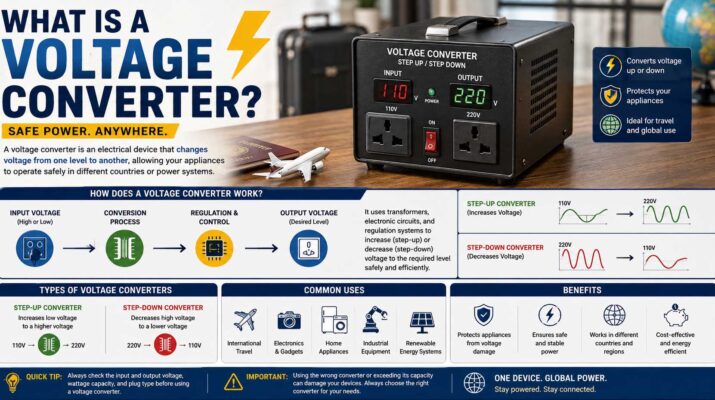
If you have ever tried to use an appliance from one country in another, you may have wondered, what is a voltage converter and whether you actually need one? A voltage converter is a device or electronic circuit that changes electrical voltage from one level to another. For example, it can reduce a 230V supply to 120V or raise 120V to 230V so compatible equipment can operate from a different power source.
However, voltage converters are not all designed for the same job. Some are made for international travel, while others work inside electronic equipment, vehicles, renewable-energy systems, and industrial installations. Therefore, understanding input voltage, output voltage, wattage, frequency, and device requirements helps you choose the right solution.
What Is a Voltage Converter Used For?
A voltage converter changes an available voltage into the voltage required by a device or electrical system. Depending on its design, it may increase voltage, decrease voltage, or convert one form of electrical power while controlling the output.
For example, suppose you own a 120V appliance but travel to a country where wall outlets supply about 230V. Plugging that appliance directly into the higher-voltage supply could damage it. In that situation, an appropriate step-down converter may reduce the voltage before it reaches the appliance.
Voltage conversion also appears inside electronics. Chargers, computers, vehicles, solar equipment, battery systems, and industrial controls often need different voltage levels for different components.
Before selecting a converter, though, check how much electrical power the connected equipment requires. If terms such as watts and kilowatts are unfamiliar, understanding What Is a KW can make converter power ratings much easier to interpret.
How Does a Voltage Converter Work?
The exact process depends on the converter design and whether it handles AC or DC power.
Traditional AC voltage converters may use transformers. A transformer uses electromagnetic induction to transfer energy between windings while changing the voltage level. Depending on the ratio between those windings, the output voltage can be higher or lower than the input.
Meanwhile, electronic converters can use semiconductor switching components, inductors, capacitors, transformers, and control circuits. These components switch and regulate electrical energy to produce the required output.
For DC systems, common converter designs include buck, boost, and buck-boost converters. A buck converter reduces DC voltage, whereas a boost converter increases it. A buck-boost design can provide greater flexibility depending on the circuit.
Therefore, “voltage converter” describes a broad category rather than one specific piece of hardware.
What Is a Step Down Voltage Converter?
A step-down voltage converter takes a higher input voltage and produces a lower output voltage.
For international travel, a common example is converting approximately 220–240V mains electricity for equipment designed around 110–120V. However, the converter must support both the input supply and the appliance’s power requirements.
Consider a 120V-only appliance rated at 200 watts. If the available outlet provides 230V, you would need a converter designed to accept that input and provide an appropriate output. The converter also needs enough power capacity for the appliance.
A step-up converter performs the opposite task. For instance, it may take approximately 120V and provide approximately 230V for compatible equipment.
Neither type should be selected from voltage alone. Wattage, load characteristics, frequency, grounding, connector type, and manufacturer requirements can also matter.
What Is a Voltage Converter for Travel?
A travel voltage converter allows certain single-voltage electrical devices to operate where the local mains voltage differs from the voltage they were designed to use.
However, many modern portable electronics do not need one.
Look at the input label on a laptop charger, phone charger, camera charger, or similar power supply. If it says something such as:
Input: 100–240V, 50/60Hz
the charger is designed for a broad range of international mains supplies. In that case, you generally need only the correct plug adapter for the destination, not a separate voltage converter.
On the other hand, an appliance labeled only for 120V should not automatically be connected to a 230V supply.
This difference matters because a plug adapter and voltage converter perform separate jobs.
| Device | What It Changes | Typical Purpose |
|---|---|---|
| Plug adapter | Plug shape | Makes a plug physically fit another outlet |
| Voltage converter | Voltage level | Matches supply voltage to equipment requirements |
| Travel transformer | AC voltage level | Steps mains voltage up or down |
| USB charger/power supply | Converts and regulates power | Powers compatible electronic devices |
Therefore, never assume a travel adapter converts voltage unless its specifications explicitly say so.
Voltage, Watts, and Frequency: What Should You Check?
Voltage gets most of the attention, yet it is only one part of compatibility.
First, check the input voltage printed on the appliance or its power supply. Then compare it with the electricity supply at your destination or installation.
Next, check the wattage. Your converter needs sufficient capacity for the connected load. In some cases, equipment can briefly draw more power when starting than its normal operating rating suggests.
For that reason, simply matching a 500-watt appliance with any device advertised as a 500-watt converter may not always be a good approach. Follow the converter manufacturer’s load guidance and the appliance manufacturer’s electrical specifications.
Frequency can matter as well. Many countries use 50 Hz mains electricity, while others use 60 Hz. A basic voltage converter does not necessarily change frequency.
Consequently, an appliance that specifically requires one frequency may still be incompatible even after its voltage has been corrected.
For additional background on electrical energy and power systems, the U.S. Department of Energy’s Energy Saver guidance provides consumer information about electricity use and energy technologies.
Single-Phase Power and Voltage Conversion
Most household travel questions involve ordinary single-phase AC supplies. However, larger electrical installations can be more complicated.
For example, industrial equipment may operate from different supply configurations and voltage levels. In those situations, the distinction between single phase vs three phase becomes relevant because a simple consumer travel converter cannot substitute for properly designed industrial power equipment.
Therefore, avoid treating every voltage mismatch as the same problem.
A small travel appliance, an industrial motor, and a piece of laboratory equipment can have very different electrical requirements even if all three involve voltage conversion.
What Is a Voltage Source Converter?
A voltage source converter, often shortened to VSC, is different from the small travel converter that most consumers picture.
In power electronics, a VSC uses switching semiconductor devices to convert and control electrical power. Depending on the system, this technology can support conversion between AC and DC while controlling characteristics such as voltage and power flow.
Voltage source converters appear in applications such as motor drives, renewable-energy integration, power transmission, and other power-electronics systems.
As a result, someone searching “voltage converter” for an international trip usually needs very different equipment from an engineer discussing a VSC.
The shared concept is power conversion, but the scale, circuitry, control methods, and application can differ dramatically.
AC-to-AC, DC-to-DC, AC-to-DC, and DC-to-AC Conversion
Voltage conversion becomes easier to understand when you separate systems by input and output type.
AC-to-AC
An AC-to-AC converter changes an alternating-current supply. A transformer-based step-up or step-down unit is a familiar example.
DC-to-DC
A DC-to-DC converter changes one DC voltage level into another. For example, electronic systems may need to convert a battery voltage into a lower regulated voltage for sensitive components.
AC-to-DC
AC-to-DC conversion turns alternating current into direct current. Laptop power supplies and many other electronic power adapters perform this general type of conversion while also regulating their output.
DC-to-AC
An inverter converts DC into AC. For instance, an inverter can use energy from a battery to provide AC power for suitable equipment.
Electrical systems may also connect components in different configurations. Understanding series vs parallel can help beginners see why voltage and current behave differently when sources or loads are connected in different ways.
Choosing the Right Voltage Converter
Start with the equipment rather than the converter.
Check the manufacturer’s label, manual, or power supply for input voltage, frequency, and power requirements. Then identify the characteristics of the power source you plan to use.
A simple selection process looks like this:
- Read the device input label. Find its supported voltage range and frequency.
- Check the local supply. Confirm the nominal voltage and frequency at your destination.
- Determine whether conversion is necessary. A 100–240V power supply may already handle the available voltage.
- Check power consumption. Select only a converter rated appropriately for the equipment and application.
- Consider startup requirements. Motors and some appliances can have higher starting demands.
- Check plug and socket compatibility. You may need a plug adapter even when voltage conversion is handled.
- Follow manufacturer guidance. Do not use a converter with equipment that its manufacturer excludes.
The cable and connector also need to suit the application. If you are building or maintaining an electrical setup rather than simply traveling, learning about types of cables can help explain why conductor size, insulation, connector design, and intended use matter.
Common Voltage Converter Mistakes
One of the most common mistakes is confusing a plug adapter with a voltage converter. An adapter may let your plug fit the wall socket while leaving the electrical voltage completely unchanged.
Another mistake is assuming that every device purchased in another country needs conversion. Many laptop, tablet, phone, and camera power supplies already support 100–240V.
Likewise, shoppers sometimes focus on voltage while ignoring wattage. An undersized converter may not be suitable for the load, even if its input and output voltages look correct.
Frequency is another easily missed specification. A converter that changes 230V to 120V does not automatically turn 50 Hz electricity into 60 Hz electricity.
Finally, avoid guessing with high-power equipment. Heaters, hair appliances, kitchen equipment, motors, and large electrical loads deserve special attention because their power demands can be much higher than those of small electronics.
Voltage Converter vs Transformer vs Power Adapter
These terms often overlap in everyday conversation, although they are not identical.
A transformer changes AC voltage through electromagnetic induction. Depending on its design, it can step voltage up or down.
A voltage converter is a broader term. It can refer to transformer-based products as well as electronic circuits that change voltage.
Meanwhile, a power adapter often converts and regulates electricity specifically for a device. For example, a laptop’s external power supply commonly accepts mains AC and outputs lower-voltage DC.
An inverter, by comparison, changes DC into AC.
Related electrical machines can convert mechanical and electrical energy as well. For example, understanding alternator vs generator helps distinguish electricity generation from the voltage-conversion job discussed here.
Advantages and Limitations of Voltage Converters
The main benefit is compatibility. A correctly selected converter can allow suitable equipment to operate from a power source with a different voltage.
Converters can also be useful in electronics, vehicles, renewable-energy installations, and specialized technical systems where components require different voltage levels.
Still, conversion has limits.
Converters have maximum ratings, and some produce heat during operation. They may also add weight and bulk, particularly when a high-power transformer is required. In addition, voltage conversion alone cannot solve every compatibility issue.
For travelers, this means checking the appliance before buying extra equipment. Carrying a heavy converter makes little sense if every charger in your bag already accepts 100–240V.
Troubleshooting a Voltage Converter
If a converter does not appear to work correctly, disconnect the equipment before investigating.
Then verify that the input supply falls within the converter’s specified range. Next, confirm that the output setting matches the connected equipment.
After that, compare the appliance’s power requirement with the converter’s supported load. Also inspect plugs, connectors, and accessible cables for obvious damage.
If a fuse or protection system repeatedly trips, do not keep resetting it without finding the cause. Likewise, stop using equipment that becomes unusually hot, smells burnt, sparks, or shows visible damage.
Because mains electricity can cause serious injury and equipment damage, do not open or repair a mains-voltage converter unless you are qualified to work on that equipment. When in doubt, use a qualified technician or replace a questionable consumer unit.
What Is a Voltage Converter? FAQs
Do I Need a Voltage Converter for My Laptop?
Often, no. Many laptop chargers accept 100–240V at 50/60Hz. However, check the exact input label on your charger rather than assuming it supports worldwide voltage.
Can I Use a 120V Appliance in a 230V Country?
Only if the appliance supports that voltage or you use suitable conversion equipment designed for its electrical requirements. A simple plug adapter does not reduce 230V to 120V.
Does a Voltage Converter Change Frequency?
Not necessarily. Many ordinary converters change voltage but do not convert 50 Hz to 60 Hz or vice versa.
What Is a Step-Up Voltage Converter?
A step-up converter raises voltage from a lower level to a higher level. For example, certain units can convert approximately 120V AC to approximately 230V AC.
Can One Converter Power Several Devices?
Potentially, but only when the converter is designed for multiple loads and its specifications support their combined requirements. Follow the manufacturer’s ratings rather than estimating.
A Practical Way to Think About Voltage Conversion
The simplest answer to what is a voltage converter is that it changes an electrical voltage into a level suitable for another device or system. However, choosing one correctly requires more than matching two voltage numbers.
Start by reading the equipment label. Then check voltage, frequency, wattage, connector requirements, and the converter manufacturer’s instructions. For travel, you may discover that your modern electronics already support worldwide voltage and only need a plug adapter.
When actual conversion is necessary, choose equipment designed for the specific load instead of relying on a generic adapter. That approach keeps the setup simpler and reduces the chance of damaging your electronics.