
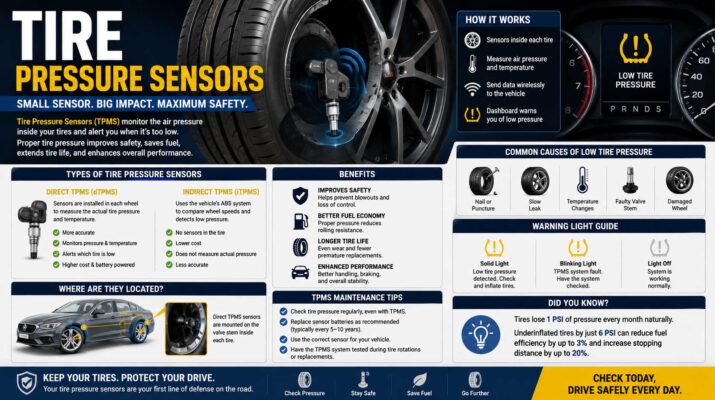
That small tire-shaped warning light on your dashboard connects to technology that drivers rarely think about until something goes wrong. Tire pressure sensors form part of a vehicle’s tire pressure monitoring system, commonly called TPMS. Depending on the system, sensors either measure tire pressure directly or use wheel-rotation data to detect signs of an underinflated tire.
For drivers, TPMS offers a convenient early warning when tire pressure drops significantly. However, sensors can eventually develop problems, their batteries can run down, and the system may need resetting after tire service or pressure adjustments. Knowing how the technology works makes those situations much easier to understand.
What Are Tire Pressure Sensors?
Tire pressure sensors are components that a vehicle’s TPMS uses to monitor tire inflation or detect pressure-related changes.
In a direct TPMS, each wheel usually has an electronic sensor that measures air pressure inside the tire. The sensor sends information wirelessly to the vehicle, which alerts the driver when pressure falls sufficiently below the expected level.
An indirect TPMS works differently. Instead of measuring air pressure with a pressure sensor inside each tire, it generally uses data from the vehicle’s anti-lock braking system to identify changes in wheel behavior associated with underinflation.
Therefore, the phrase “tire pressure sensor” most commonly refers to a direct TPMS sensor, although the exact monitoring technology varies between vehicles.
How Do Tire Pressure Sensors Work?
With direct TPMS, a sensor measures pressure inside each tire. Depending on its design, the sensor assembly may also monitor temperature and contain electronics that process and transmit data.
The sensor periodically communicates with a receiver or vehicle control system. When pressure falls beyond the system’s programmed threshold, the TPMS warning indicator appears on the dashboard.
Some newer vehicles can show individual tire-pressure readings. Meanwhile, other vehicles provide only a general TPMS warning, so the driver still needs to check each tire manually.
This wireless transfer of sensor information is a practical automotive example of what is telemetry, because the system collects measurement data remotely and transmits it to another system for monitoring.
Direct vs. Indirect TPMS
Direct and indirect systems aim to warn drivers about tire-pressure problems, yet their methods differ considerably.
| Feature | Direct TPMS | Indirect TPMS |
|---|---|---|
| Measures air pressure directly | Yes | No |
| Sensor mounted at each wheel | Usually | No dedicated pressure sensor |
| Uses wheel-speed information | Not as primary pressure measurement | Yes |
| Can provide individual pressure readings | Often | Usually not |
| Sensor battery replacement issue | Yes | No dedicated TPMS sensor battery |
| May require recalibration/reset | Sometimes | Often after pressure changes |
Indirect TPMS relies heavily on wheel rotation information. Therefore, understanding wheel speed sensors can help explain how a vehicle detects tire-related differences without directly measuring pressure inside the tire.
Neither approach eliminates routine tire-pressure checks. Instead, TPMS works as a warning system rather than a replacement for normal tire maintenance.
Where Are Tire Pressure Sensors Located?
The location depends on the TPMS design.
In most direct systems, the sensor sits inside the wheel and commonly attaches to the valve stem. From outside the tire, you may see only what looks like a normal valve stem, while the electronic sensor remains hidden inside.
Some designs secure a sensor to another part of the wheel rather than using a conventional valve-stem assembly. Therefore, you generally cannot identify the exact sensor design simply by looking at the tire.
Because direct sensors sit inside the wheel, accessing them normally requires removing the tire from the rim. Consequently, a tire shop or technician with suitable tire-changing equipment commonly handles replacement.
Indirect systems do not have dedicated pressure sensors mounted inside each tire. Instead, the vehicle uses existing wheel-speed information and software to identify changes.
Why Tire Pressure Monitoring Matters
Correct tire pressure affects how a tire performs. Underinflation can increase rolling resistance, change handling characteristics, generate additional heat, and contribute to uneven or accelerated tire wear.
Overinflation can also affect ride quality, contact with the road, and wear patterns.
Therefore, TPMS provides useful information when a meaningful pressure change occurs. Still, drivers should check pressures periodically with a reliable gauge, especially before long trips or when outside temperatures change significantly.
The correct inflation pressure is normally listed on the vehicle’s tire-information placard, often found on the driver’s door jamb. Do not automatically use the maximum pressure printed on the tire sidewall as the vehicle’s normal target pressure.
The National Highway Traffic Safety Administration’s tire safety guidance also explains tire pressure, TPMS, tire maintenance, and the importance of following the vehicle manufacturer’s recommended pressure.
Understanding TPMS as an Instrumentation System
Although TPMS appears simple from the driver’s seat, it combines several technologies.
A direct system may include pressure sensing, signal processing, radio communication, identification codes, a receiver, vehicle software, and dashboard indicators.
In engineering terms, this makes TPMS a useful everyday example when explaining what is instrumentation, since the system measures a physical condition and turns that measurement into information a driver or control system can use.
Some vehicles can also identify which wheel has low pressure. However, this capability may depend on sensor registration, wheel-position learning, and the vehicle’s software design.
As a result, moving tires between positions during rotation can sometimes require a relearn procedure.
How to Reset Tire Pressure Sensors
Drivers frequently need to reset TPMS after inflating tires, rotating wheels, installing new sensors, or seeing a warning light that remains illuminated.
Unfortunately, there is no universal reset procedure.
On some vehicles, the system updates automatically after the driver adjusts all tires correctly and drives for a certain period. On others, you need to start a TPMS calibration or reset through the dashboard menu.
Certain vehicles have a dedicated reset button. Meanwhile, other systems require a sensor relearn procedure using a TPMS service tool.
A sensible general process is:
- Check all tires according to the manufacturer’s pressure-check procedure.
- Inflate them to the vehicle manufacturer’s recommended pressures.
- Check the spare tire too if your vehicle monitors it.
- Use the vehicle’s TPMS reset or calibration menu if required.
- Drive according to the manufacturer’s relearn instructions.
- If the warning remains, inspect for leaks or have the TPMS diagnosed.
Because procedures vary by make, model, and model year, the owner’s manual should be your primary source for the correct reset instructions.
Resetting Is Not the Same as Repairing
A reset will not repair a leaking tire or revive a failed sensor.
For example, suppose you inflate a tire and reset the system, but the same tire loses pressure again a few days later. In that case, the underlying problem may be a puncture, valve leak, wheel issue, or another source of air loss.
Likewise, if a sensor battery has failed, resetting the system usually will not restore communication.
How Long Do Tire Pressure Sensors Last?
Direct TPMS sensors normally contain small internal batteries. Manufacturers design these batteries for long service life, but they generally seal them inside the sensor rather than treating them like easily replaceable household batteries.
A typical direct TPMS sensor may last roughly 5 to 10 years, although actual life varies. Sensor design, transmission frequency, driving conditions, temperature, mileage, and manufacturing differences can all affect lifespan.
Therefore, age becomes a useful clue when several original sensors begin failing on an older vehicle.
For instance, if one original sensor fails after many years and the others are the same age, a tire professional may discuss whether replacing only the failed sensor or several aging sensors makes more practical sense. However, replacing functioning sensors prematurely is not always necessary.
Common Signs of a TPMS Problem
A steady TPMS warning commonly indicates that one or more tires may be significantly underinflated. Therefore, start by checking tire pressure rather than assuming the electronics have failed.
A flashing TPMS warning followed by a steady light can indicate a system malfunction on many vehicles. However, dashboard behavior varies, so check the owner’s manual for your specific model.
Other possible symptoms include a missing individual tire reading, a sensor that will not communicate with diagnostic equipment, or a warning that appears after technicians install new tires or wheels.
Cold weather can also trigger warnings. Since tire pressure changes with temperature, a tire that sat only slightly above the warning threshold in warm weather may fall below it after a substantial temperature drop.
Why a TPMS Sensor May Stop Working
Battery depletion is a common reason an older direct sensor stops communicating. However, it is not the only possibility.
A sensor can also suffer physical damage during tire removal or installation. Likewise, corrosion around the valve hardware can create problems, especially where moisture and road salt are common.
Replacement sensors may need programming or registration before the vehicle recognizes them. In addition, an incompatible sensor can prevent successful communication even when the part physically fits the wheel.
Radio-frequency interference, receiver problems, wiring faults, or vehicle electronics issues are less obvious possibilities. Therefore, proper diagnosis can save money compared with replacing parts based only on the dashboard light.
Replacing Tire Pressure Sensors
When replacement becomes necessary, compatibility matters more than appearance.
First, verify that the sensor works with the exact vehicle year, make, model, and TPMS frequency or protocol. Some aftermarket programmable sensors cover many vehicles, but technicians must configure them correctly.
Next, consider whether you need new valve components, seals, grommets, nuts, or service kits. These small components help maintain a proper seal, so installers should handle them according to the sensor manufacturer’s instructions.
After installation, the vehicle may require a relearn or registration process. Therefore, simply installing a compatible sensor does not guarantee that the dashboard warning will disappear immediately.
Sensor prices and labor costs vary by vehicle, sensor brand, shop, location, and programming requirements.
TPMS Maintenance Tips
Routine attention can reduce confusion and help the monitoring system do its job.
Check tire pressure periodically rather than waiting for the warning light. Also, check pressures before long trips and after major seasonal temperature changes.
When replacing tires, tell the technician that the vehicle has direct TPMS. Experienced tire shops already expect this, but careful handling around the valve area reduces the chance of sensor damage.
If your vehicle displays individual pressure readings, watch for one wheel that repeatedly loses air. A recurring pressure drop deserves inspection even if you can temporarily clear the warning by adding air.
Finally, remember that TPMS monitors pressure; it does not tell you everything about tire condition. Tread depth, cuts, cracking, bulges, alignment-related wear, and tire age still require visual inspection and normal maintenance.
FAQs About Tire Pressure Sensors
Can I Drive With the Tire Pressure Warning Light On?
Check the tires as soon as practical. The warning may indicate underinflation, while a flashing or malfunction indication may mean the monitoring system itself needs attention. Follow the vehicle manufacturer’s guidance for the warning shown.
Do All Tire Pressure Sensors Have Batteries?
Direct TPMS sensors commonly use internal batteries. Indirect TPMS does not require a dedicated battery-powered pressure sensor in each wheel because it relies on other vehicle sensor data.
Can I Replace One TPMS Sensor?
Yes, in many cases you can replace only the failed sensor. However, if all original sensors are similar in age, consider their remaining expected service life when paying for tire removal and installation.
Does Rotating Tires Affect TPMS?
It can. Some vehicles automatically recognize wheel positions, while others require a relearn after rotation. Therefore, check the owner’s manual or service information for your vehicle.
Why Is My TPMS Light On When the Tires Look Fine?
A tire can be underinflated without looking obviously flat. Temperature changes can also reduce pressure, while sensor or system faults can trigger warnings. Therefore, check pressures with a reliable gauge before assuming the TPMS is defective.
Getting the Most From Your Tire Pressure Monitoring System
Tire pressure sensors are easy to ignore because they normally work quietly in the background. However, they combine sensing, wireless communication, vehicle electronics, and software to give drivers useful information about tire inflation.
For the best results, treat TPMS as a backup to good tire maintenance rather than a substitute for it. Check tire pressures regularly, use the pressure specified by the vehicle manufacturer, and investigate repeated warnings instead of continually resetting them.
When a sensor eventually fails, verify compatibility before buying a replacement and find out whether your vehicle requires programming or relearning. That small amount of preparation can make TPMS repairs simpler and help you avoid buying a sensor that your vehicle cannot recognize.