
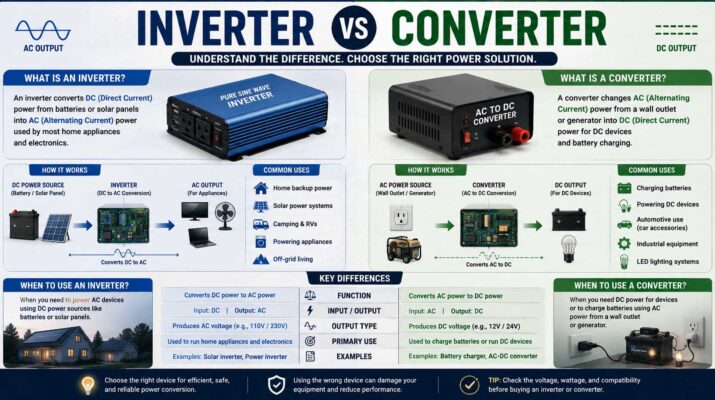
If you work with batteries, solar power, an RV, or an electrical backup system, the terms inverter vs converter can get confusing quickly. The simplest difference is the direction in which each device changes electrical power. An inverter generally turns direct current (DC) into alternating current (AC), while a converter changes electrical power from one voltage or form to another, commonly AC to DC in applications such as RV electrical systems.
Although both devices manage electrical power, they are not interchangeable. Therefore, choosing the right one depends on your power source, the equipment you want to operate, and the voltage that equipment requires.
What Is an Inverter?
An inverter is an electronic device that primarily converts DC electricity into AC electricity. Batteries and many solar energy systems supply DC power, while common household appliances operate on AC.
For example, suppose you have a 12-volt battery but want to operate a 120-volt AC laptop charger. An appropriately sized inverter can take the battery’s DC electricity and create AC output suitable for the charger.
Because of this function, inverters appear in solar installations, recreational vehicles, boats, backup power systems, portable power stations, and off-grid setups.
The basic process looks like this:
Battery or DC source → Inverter → AC electricity → AC device
However, output quality varies. Some inexpensive models produce modified sine wave AC, while higher-quality units commonly provide pure sine wave output.
Pure sine wave inverters more closely reproduce the smooth AC waveform that a typical electrical grid supplies. As a result, they are generally a better option for sensitive electronics, audio equipment, variable-speed motors, and many modern appliances.
What Is a Converter?
A converter is a broader type of electrical device that changes electrical characteristics such as voltage or current type. Depending on its design, it may convert AC to DC, DC to DC, or change one voltage level to another.
In many everyday discussions, especially those involving RVs, the word “converter” refers to an AC-to-DC converter. It receives AC electricity from shore power and produces DC electricity for the vehicle’s 12-volt systems. It may also support battery charging.
If you are trying to understand what is a voltage converter, the key idea is that conversion does not automatically mean turning DC into AC. Instead, manufacturers design converters for several different electrical transformations.
For instance, a phone charger is essentially a type of AC-to-DC power supply. It takes AC electricity from a wall outlet and supplies the lower-voltage DC electricity that the device requires.
Inverter vs Converter: Quick Comparison
Although the names sound similar, their typical jobs are quite different.
| Feature | Inverter | Converter |
|---|---|---|
| Typical conversion | DC to AC | AC to DC or voltage-to-voltage |
| Common input | Battery or solar DC | AC mains or another DC voltage |
| Common output | AC electricity | Usually DC in RV applications |
| Typical purpose | Run AC equipment from batteries | Supply DC loads or change voltage |
| Common applications | Solar, RVs, backup power | RVs, chargers, electronics |
| Battery relationship | Draws energy from a battery | May charge or support a battery |
| Main output concern | Waveform quality | Correct DC voltage and current |
Therefore, when comparing a power converter vs inverter, first identify what electricity you already have and what electricity your equipment needs.
That simple question often tells you which device is appropriate.
How Does an Inverter Work?
An inverter uses electronic switching circuits to rapidly control DC electricity. Those switching actions create an alternating electrical waveform. The inverter’s circuitry then conditions that waveform into usable AC power.
Modern designs can perform this process efficiently, although no inverter reaches perfect efficiency. Consequently, some battery energy becomes heat during operation.
Suppose an appliance needs 500 watts of AC power. The battery must supply somewhat more than 500 watts because the inverter itself consumes energy during conversion.
If electrical power ratings are unfamiliar, understanding What Is a KW can also make inverter specifications easier to compare because manufacturers commonly rate larger inverters in watts or kilowatts.
The U.S. Department of Energy also explains the role of solar inverters and their grid functions, including how inverters convert DC electricity from solar systems into AC electricity.
Pure Sine Wave vs Modified Sine Wave
A pure sine wave inverter generally costs more, yet it provides cleaner AC output. Therefore, many users prefer it for sensitive electronics and equipment that expects grid-like electricity.
A modified sine wave inverter uses a simpler stepped waveform. Although it can operate many basic loads, certain motors, chargers, audio products, and electronically controlled appliances may run poorly, create extra noise, or fail to work correctly.
For that reason, buyers should check equipment requirements rather than choosing an inverter based only on wattage.
How Does a Power Converter Work?
An AC-to-DC converter first receives alternating current. Next, electronic components rectify and regulate that electricity to produce the required DC output.
For example, an RV connected to campground shore power may receive 120-volt AC electricity. Meanwhile, lights, control boards, water pumps, and other onboard systems may operate from a nominal 12-volt DC system.
The converter bridges those two electrical systems.
DC-to-DC converters work somewhat differently. For instance, one might reduce a higher DC voltage to a lower voltage that a particular electronic circuit requires.
Meanwhile, electrical configurations themselves can affect voltage and current behavior. Learning about series vs parallel connections is particularly useful when working with battery banks because the way you connect batteries changes the combined system voltage and available capacity.
Inverter vs Converter in RV Systems
The inverter vs converter RV comparison is one of the most common reasons people search for these terms. That’s because many RVs use both AC and DC electrical systems.
When an RV connects to shore power, its converter can supply DC loads and, depending on the system design, charge the house batteries. However, once shore power disappears, the batteries continue supplying DC electricity.
That’s where an inverter can become useful.
An inverter takes stored DC battery energy and creates AC electricity. Therefore, selected wall outlets or appliances can continue operating without a campground hookup or generator, provided the battery bank and inverter have enough capacity.
RV Converter vs Inverter Example
Imagine an RV parked at a campground.
While connected to shore power:
Campground AC → RV converter → 12V DC system/battery charging
Later, you disconnect and camp without shore power:
Battery DC → RV inverter → AC appliances
Therefore, asking which device is “better” misses the point. In many RV installations, the two devices perform complementary jobs.
Some modern RV and off-grid systems use inverter/charger units that combine several functions in one device. However, exact features vary by model, so buyers should always check the specifications carefully.
Where Inverters Are Commonly Used
Solar energy is one of the most familiar inverter applications. Solar panels generate DC electricity, while homes typically use AC electricity. Therefore, a solar inverter converts the panels’ DC output into usable AC power.
Battery backup systems work similarly. When grid electricity fails, stored battery energy passes through an inverter so supported AC appliances can continue operating.
Vehicles provide another useful example. A vehicle’s electrical system works largely with DC electricity, while an inverter allows certain AC devices to operate from that system.
However, don’t confuse an inverter with the equipment that generates electrical energy while the engine runs. A comparison of alternator vs generator explains those electricity-generating devices rather than DC-to-AC conversion.
Where Converters Make More Sense
Converters are useful whenever a device requires a different voltage or current type from the available power source.
Consumer electronics offer countless examples. Routers, laptops, smart devices, LED equipment, and battery chargers often require low-voltage DC even though a building supplies AC electricity.
Likewise, vehicles and RVs contain many DC components. Therefore, converters help supply the voltage those components require when an AC source is available.
Industrial and commercial systems can involve much larger electrical supplies. In those settings, topics such as single phase vs three phase become relevant because equipment may depend on a specific AC supply arrangement before further power conversion occurs.
Which Device Should You Choose?
Start with the power source.
If you have a battery supplying DC and need to operate AC equipment, you probably need an inverter. However, you must still match the inverter’s input voltage, output voltage, continuous wattage, surge capacity, and waveform to your system.
On the other hand, if you have AC electricity and need DC output, an appropriate AC-to-DC converter or power supply is usually the better choice.
Next, check the load.
Motors, compressors, microwaves, power tools, and similar equipment can require much higher startup power than their normal operating wattage. Consequently, an inverter sized only around normal running watts may shut down when the device starts.
Likewise, converters must provide enough current for connected DC equipment without exceeding their rated output.
Finally, consider future expansion. If you plan to add batteries, solar panels, larger appliances, or other electrical equipment later, choosing a system with reasonable capacity headroom may prevent an expensive replacement.
Common Mistakes When Comparing the Two
One common mistake is assuming both terms describe the same device. While certain combined products perform several conversion functions, a standard inverter and a typical RV converter have different jobs.
Another mistake is shopping only by wattage. Voltage compatibility matters just as much. For example, a 24-volt inverter cannot simply replace a 12-volt model in a 12-volt battery system unless the entire setup supports that change.
Buyers also sometimes overlook efficiency. Because every conversion creates some energy loss, repeatedly converting electricity between AC and DC can reduce the energy available from a battery.
Finally, never assume every inverter produces identical AC power. If sensitive equipment requires a clean sine wave, confirm the inverter’s waveform before purchasing it.
Troubleshooting Inverter and Converter Problems
When an inverter suddenly shuts down, first check the battery voltage and electrical connections. Low battery voltage, loose cables, excessive loads, overheating, or inadequate wiring can trigger protection features.
Meanwhile, if an RV converter appears to stop supplying DC power, check the AC input, circuit breakers, DC fuses, battery connections, and output voltage. However, electrical troubleshooting can involve dangerous voltages, so avoid opening or repairing equipment unless you have the required training.
Heat can also signal a problem. Some warmth is normal because conversion isn’t perfectly efficient. Still, excessive heat, repeated shutdowns, burning smells, damaged wiring, or unusual noises deserve immediate attention.
When in doubt, disconnect the system safely and have a qualified technician inspect it.
Inverter vs Converter FAQs
Can an inverter charge a battery?
A basic inverter normally converts DC into AC rather than charging batteries. However, an inverter/charger combines inversion and battery-charging functions in one unit.
Can a converter run AC appliances?
A typical RV converter supplies DC electricity, so it does not directly provide normal AC output from a battery. You would generally need an inverter for that purpose.
Do RVs need both an inverter and converter?
Not every RV needs both. Still, an RV that uses shore power for charging and also needs AC electricity from batteries may benefit from both functions.
How do I know what size inverter I need?
Add the wattage of the devices you expect to run at the same time. Then, account for startup surges and the inverter manufacturer’s recommendations. Also confirm that the battery bank can safely provide the required current.
Is an inverter the same as a transformer?
No. A traditional transformer changes AC voltage through electromagnetic induction, while an inverter electronically changes DC into AC. Some power-conversion equipment may contain transformers as part of a larger design.
Choosing the Right Power Setup
The easiest way to remember the inverter vs converter difference is to follow the direction of the electricity. If stored DC battery power needs to become AC electricity, an inverter is usually the answer. If AC must become DC, or one voltage must change to another suitable level, a converter may be the right device.
Before buying either one, check input voltage, output requirements, wattage or current capacity, efficiency, and equipment compatibility. Meanwhile, RV owners should consider how they use shore power, batteries, solar, and AC appliances because their electrical system may benefit from both functions.
With those basics clear, the converter vs inverter choice becomes much easier: match the device to the electrical conversion your system actually needs.