
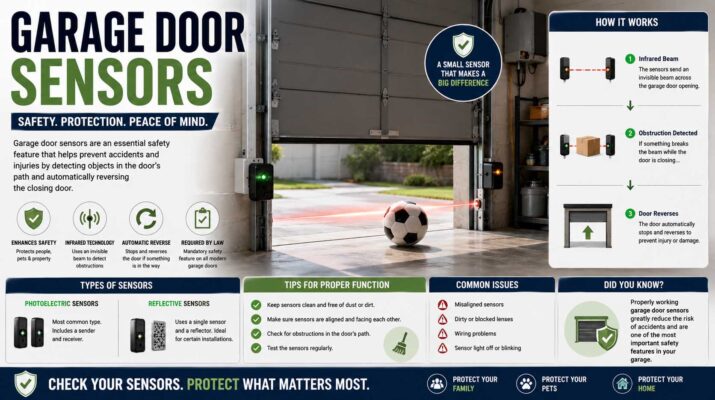
If your garage door starts closing and suddenly reverses, the problem may be much smaller than the door itself. Garage door sensors are small electronic devices installed near the bottom of the garage door opening, yet they play a major role in the system. They detect an obstruction in the door’s path and communicate with the opener so the door does not continue closing normally when something blocks the monitored area. Therefore, understanding how these sensors work can help you diagnose common problems before assuming the opener or door needs major repairs.
Most modern systems use two photo-eye sensors positioned opposite each other. Although their operation is fairly simple, dirt, misalignment, damaged wiring, loose brackets, or component failure can interfere with them.
What Are Garage Door Sensors?
Garage door sensors are safety devices that monitor the area near the bottom of a garage door. Typically, one unit sends an infrared beam across the doorway while the sensor on the opposite side receives it.
As long as the receiving sensor detects the beam, the opener’s control system recognizes that the monitored path is clear. However, when an object interrupts the beam, the system prevents normal closing or causes the door to reverse, depending on when the obstruction occurs.
These devices are often called garage door safety sensors, photo eyes, safety eyes, or photoelectric sensors.
Although they are small, they belong to a wider family of household sensing technologies. For example, window alarm sensors monitor whether windows are opened or closed, while garage safety sensors monitor an optical path rather than the position of a window.
How Do Garage Door Sensors Work?
The basic operating principle is straightforward. One sensor acts as the transmitter, while the other functions as the receiver.
The transmitter sends an invisible infrared light beam across the garage door opening. Meanwhile, the receiver continuously looks for that signal.
When the beam reaches the receiver correctly, the opener can permit normal closing. If a bicycle, box, person, pet, or another object blocks the beam, the receiver can no longer detect the expected signal.
The garage door opener then responds according to its safety logic.
This setup is part of a larger control system. In simple terms, the sensors provide information, the opener’s electronics process it, and the motorized mechanism moves or stops the door.
That relationship is similar to the basic concept behind what is an actuator, because an actuator converts a control command into physical movement. In a garage door system, the motor and drive mechanism provide the movement, while the sensors help determine when that movement should be allowed.
Where Are Garage Door Safety Sensors Located?
Look near the floor on both sides of the garage door opening. In many installations, you will find a small sensor attached to a bracket near each vertical track.
The two units face one another across the opening.
Their low position helps them detect objects that might otherwise be below the main body of the door. However, because they sit close to the floor, they are also exposed to dust, accidental bumps, storage items, tools, moisture, and other garage activity.
Therefore, sensor problems do not always mean an electronic component has failed. Sometimes, the sensors simply need cleaning or realignment.
Signs Your Garage Door Sensors Are Not Working
When garage door sensors are not working, the symptoms can vary by opener model. Still, several problems commonly point toward the safety sensor system.
For example, the garage door may begin closing and then reverse. Alternatively, it may refuse to close normally from the remote control.
You might also notice a blinking indicator light on one sensor. Some garage door openers use flashing lights or diagnostic codes to indicate a sensor-related fault.
Before replacing anything, however, check whether an object is actually blocking the beam.
A cardboard box, broom, bicycle tire, storage container, or even accumulated debris can interfere with the sensor path. As a result, a perfectly functional safety system can appear faulty.
Sensor technology is also used for other household problems. For instance, water sensors for home detect leaks or unwanted moisture rather than physical obstructions. In both cases, though, the sensor provides information that allows another system or the homeowner to respond.
Why Garage Door Sensors Stop Working
Several issues can prevent the photo eyes from communicating correctly.
Dirty Sensor Lenses
Dust, cobwebs, dirt, and garage debris can collect on the sensor lenses. Consequently, the infrared signal may not reach the receiver reliably.
Start by gently cleaning the lens with a soft, dry cloth. Avoid harsh cleaners unless the sensor manufacturer specifically recommends them.
Misaligned Sensors
A sensor can shift after someone bumps the track, moves a storage item, or hits the bracket. Even a relatively small movement may prevent the transmitter and receiver from facing each other correctly.
Loose mounting hardware can create the same problem because vibration may gradually change the sensor position.
Wiring Problems
Many safety sensors connect to the opener using low-voltage wiring. Therefore, loose connections, damaged insulation, pinched wires, or broken conductors can cause intermittent or complete failure.
Visible damage deserves attention, especially if the problem started after renovation, storage work, or accidental impact.
Direct Sunlight
On some systems, strong sunlight hitting the receiving sensor can interfere with reliable detection. If the problem appears mainly at a particular time of day, sunlight may be worth considering.
However, avoid improvised modifications that could obstruct the sensor itself. Instead, check the manufacturer’s recommended solution for the specific opener.
Failed Sensor or Opener Component
Electronic parts do not last forever. A sensor may eventually fail even when its alignment and wiring appear correct.
Likewise, the problem could be elsewhere in the opener system. Therefore, replacing sensors without basic troubleshooting can waste time and money.
How to Align Garage Door Sensors
Learning how to align garage door sensors can solve one of the most common photo-eye problems. However, exact indicator-light behavior varies by manufacturer, so your opener manual should remain the primary reference.
First, remove objects from the garage door opening. Then, inspect both sensor lenses and gently clean away dust or debris.
Next, look at the mounting brackets. Both sensors should generally face directly toward each other rather than pointing upward, downward, or sideways.
If a bracket has shifted, carefully loosen it enough to adjust the sensor. Then, reposition the unit until the sensors face one another correctly.
Many systems use LED indicators to show whether alignment is successful. However, colors and blinking patterns are not universal. Therefore, check the manual rather than assuming that a particular LED color always has the same meaning.
Once alignment appears correct, secure the brackets without moving the sensors out of position.
Finally, test the door according to the manufacturer’s safety-test instructions. If the sensors still behave incorrectly, inspect the wiring or arrange professional service.
A Quick Troubleshooting Guide
| Symptom | Possible cause | First thing to check |
|---|---|---|
| Door starts closing, then reverses | Blocked or misaligned sensor | Clear the opening and check alignment |
| Sensor LED is blinking | Alignment, wiring, or sensor issue | Check the manufacturer’s diagnostic guide |
| One sensor has no light | Power, wiring, or failed component | Inspect connections and visible wiring |
| Problem occurs at certain times | Possible sunlight interference | Observe whether direct sunlight reaches the sensor |
| Problem started after an impact | Sensor or bracket moved | Inspect mounting position |
| Cleaning and alignment do not help | Wiring, sensor, or opener fault | Follow diagnostics or contact a technician |
Although this table can narrow down the problem, opener designs differ. Therefore, use the model-specific manual before making electrical adjustments or replacing components.
Can You Bypass Garage Door Sensors?
People sometimes search for how to bypass garage door sensors when a door refuses to close. However, defeating, covering, disconnecting, or permanently bypassing a safety sensor is not an appropriate troubleshooting solution.
The sensors exist to detect obstructions in the closing path. Disabling that function can allow the door to operate without a safety feature working as intended.
In fact, the U.S. Consumer Product Safety Commission’s garage door opener safety requirements include entrapment-protection requirements for residential automatic garage door openers. These requirements recognize external protection devices such as an electric eye that detects an obstruction without requiring physical contact.
Instead of bypassing the sensors, identify why the system is preventing normal operation.
Check for an obstruction first. Then, clean the lenses, verify alignment, inspect accessible wiring for visible damage, and consult the opener’s diagnostic information.
If the sensors cannot be restored to proper operation, replacement or professional repair is the better approach.
When Should Garage Door Sensors Be Replaced?
Replacement makes sense when testing shows that a sensor has failed, its housing is badly damaged, or its electronics no longer operate correctly despite proper alignment and intact connections.
However, do not buy a replacement based only on appearance.
Compatibility matters because garage door safety sensors are not necessarily interchangeable across every opener. Therefore, check the opener’s brand, model number, sensor part number, and manufacturer compatibility information before ordering.
A very inexpensive generic sensor may not be suitable simply because it looks similar.
Meanwhile, if you are replacing an older opener, compatible safety sensors may already come with the new system. In that case, follow the manufacturer’s installation instructions rather than assuming the existing sensors can remain in use.
How the Sensors Communicate With the Garage Door Opener
Garage door automation is a useful example of how sensing, decision-making, and mechanical movement work together.
The safety sensors supply input about the monitored doorway. Next, the opener’s control electronics interpret that input. Finally, the motor and drive mechanism control door movement according to the system’s programmed behavior.
People learning what is a robot controller? may recognize a similar high-level pattern in automated equipment: sensors provide information, control logic evaluates conditions, and mechanical components perform an action. A garage door opener is much simpler than most industrial robots, but the sense-control-act concept is comparable.
This explains why troubleshooting should consider the entire system rather than treating each sensor as an isolated device.
Maintaining Garage Door Sensors
Garage door sensors generally require little routine attention. Still, occasional inspection can prevent simple problems.
Keep boxes, tools, bicycles, and other stored objects away from the sensors. Likewise, avoid leaning equipment against their mounting brackets.
Periodically check that the lenses remain clean. Meanwhile, look for loose brackets or visible wire damage when cleaning the garage.
If you notice that a sensor frequently loses alignment, inspect the bracket rather than repeatedly repositioning the photo eye. A loose or damaged mount may be the real problem.
You should also test the garage door’s safety features according to the opener manufacturer’s recommended procedure and schedule. If the door does not respond as the manual says it should, stop treating the issue as a minor inconvenience and have the system checked.
Common Garage Door Sensor Mistakes
One common mistake is replacing sensors before checking for dirt or misalignment. Since these problems are easy to investigate, they should usually come first.
Another mistake is assuming every LED works the same way. Manufacturers use different light colors and diagnostic patterns, so advice for one opener may not apply to another.
People may also focus entirely on the sensors when damaged wiring is causing the fault. Therefore, a visual inspection of accessible low-voltage wiring can be useful.
Most of all, avoid treating a safety feature as an obstacle to normal operation. If the opener refuses to close because it cannot verify the sensor signal, the goal should be to restore the safety system rather than disable it.
Frequently Asked Questions
Do Both Garage Door Sensors Need to Work?
A photo-eye safety system is designed around the sensors operating correctly as a pair. If the opener cannot confirm the expected signal, normal closing behavior may be restricted. Exact operation varies by model.
Why Is One Garage Door Sensor Blinking?
A blinking light can indicate misalignment, a wiring problem, an interrupted beam, or another diagnostic condition. Since LED meanings vary between manufacturers, check the manual for your opener model.
Can Dirt Make Garage Door Sensors Stop Working?
Yes. Dust, cobwebs, and debris can interfere with the sensor lenses. Therefore, gentle cleaning is one of the simplest troubleshooting steps.
Why Does My Garage Door Close and Then Immediately Open?
An obstruction or safety-sensor problem is one possible cause, but it is not the only one. Door travel settings, mechanical problems, opener settings, or other faults may also produce unusual movement. If sensor checks do not solve the issue, follow the manufacturer’s troubleshooting process.
How High Should Garage Door Sensors Be?
Correct mounting requirements depend on the system and applicable installation requirements. Rather than estimating or changing their height based on a general online figure, follow the instructions supplied for your specific garage door opener and sensor set.
Keeping the Safety System Reliable
Garage door sensors use a relatively simple idea—an optical beam across the doorway—but they form an essential part of the opener’s safety system. Therefore, when a door refuses to close, start with basic checks instead of immediately replacing parts.
Clear the opening, clean the lenses, check the mounting brackets, verify alignment, and look for visible wiring problems. If those steps do not restore proper operation, consult the model-specific diagnostic guide or a qualified garage door technician.
Most of all, keep the sensors working as designed. A properly aligned and functioning sensor system is far more valuable than a temporary workaround that removes the protection it was installed to provide.