
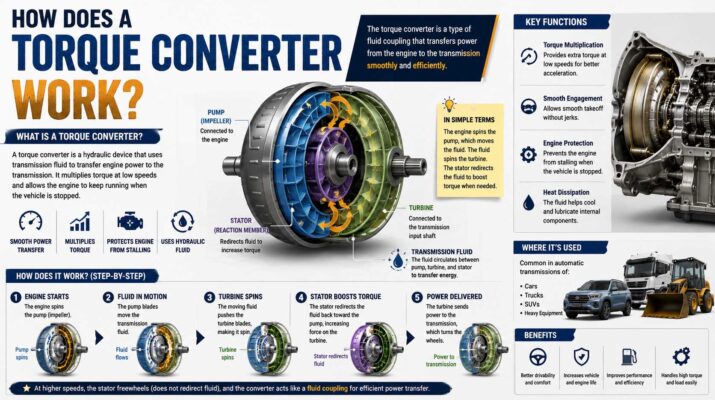
If you drive an automatic car, you may wonder, how does a torque converter work when there is no traditional clutch pedal? A torque converter uses automatic transmission fluid and several rotating components to transfer engine power to the transmission. It also allows the engine to keep running while the vehicle is stopped, multiplies torque under certain conditions, and can lock mechanically at cruising speeds to improve efficiency.
Although the unit looks like a sealed metal housing, a lot happens inside it. The impeller moves fluid, the fluid drives a turbine, and a stator redirects the returning flow. Meanwhile, modern torque converters usually include a lockup clutch that reduces energy losses once the vehicle is moving steadily.
Understanding these parts makes the whole system much easier to picture.
What Is a Torque Converter?
A torque converter is a fluid coupling located between an engine and an automatic transmission. Its basic job is similar to the job performed by a clutch in a manual transmission: it connects engine output to the transmission while allowing that connection to change as driving conditions change.
However, the two systems achieve this differently. If you are learning how does a clutch work, the key difference is that a conventional manual clutch normally transfers power through direct friction between solid components. A torque converter initially transfers much of its power through moving transmission fluid.
This fluid connection lets the engine continue rotating when the car is stationary. For example, when you hold the brake at a traffic light while the transmission remains in Drive, the engine does not normally stall.
Once you release the brake and press the accelerator, the converter transfers more torque into the transmission and the vehicle moves forward.
Main Parts Inside a Torque Converter
Most conventional torque converters rely on four major components.
| Component | Main Job |
|---|---|
| Impeller/Pump | Moves transmission fluid using engine power |
| Turbine | Receives fluid energy and drives the transmission input |
| Stator | Redirects returning fluid to improve torque multiplication |
| Lockup clutch | Creates a mechanical connection at suitable speeds |
The converter housing connects to the engine through the flexplate. Therefore, when the engine rotates, the housing and impeller rotate as well.
The turbine sits opposite the impeller. Although they are close together, they are not simply bolted together. Instead, transmission fluid carries energy from one rotating component to the other.
The stator sits between them and changes the direction of returning fluid. Consequently, it plays a major role during acceleration.
Finally, the lockup clutch becomes especially useful once torque multiplication is no longer needed.
How Does a Torque Converter Work Step by Step?
The easiest way to understand a torque converter is to follow the energy from the engine toward the transmission.
1. The Engine Spins the Impeller
As soon as the engine runs, it turns the torque converter housing and impeller. The impeller contains curved vanes that push automatic transmission fluid outward as it rotates.
Engine speed matters here. If you are unfamiliar with the term what is rpm, RPM simply describes revolutions per minute and tells you how quickly a rotating component, such as the engine crankshaft, is turning.
As engine RPM rises, the impeller generally moves fluid with greater energy.
2. Fluid Drives the Turbine
Next, the fast-moving fluid leaves the impeller and strikes the turbine blades.
That fluid force causes the turbine to rotate. Since the turbine connects to the transmission input shaft, its rotation sends power into the transmission.
This arrangement explains why a vehicle can sit in Drive without the engine and transmission input always rotating at exactly the same speed. Some speed difference, commonly called slip, can exist between the impeller and turbine.
3. The Stator Redirects Returning Fluid
After passing through the turbine, the fluid must return toward the impeller. However, simply letting it flow back in an unfavorable direction would reduce efficiency and oppose the impeller’s rotation.
Therefore, the stator redirects that returning fluid.
During conditions where torque multiplication is useful, a one-way clutch prevents the stator from rotating freely in the unfavorable direction. As a result, the stator changes the fluid’s direction before the fluid re-enters the impeller.
This redirection allows the converter to multiply torque, particularly when there is a large speed difference between the impeller and turbine.
4. The Converter Approaches Coupling
As the vehicle gains speed, the turbine begins rotating closer to the speed of the impeller. Consequently, the fluid-flow relationship changes and the need for torque multiplication decreases.
At this stage, the converter behaves increasingly like a fluid coupling.
However, some slip can remain. That slip wastes energy as heat, which is one reason modern automatic transmissions use lockup torque converters.
How Does a Lockup Torque Converter Work?
So, how does a lockup torque converter work differently from a basic fluid coupling?
Once driving conditions are suitable, a lockup clutch inside the converter can create a direct mechanical connection between the converter housing and turbine side of the drivetrain. As a result, the transmission no longer has to rely entirely on fluid slip for power transfer.
The transmission control system decides when to apply the clutch based on factors such as vehicle speed, engine load, gear selection, throttle position, and transmission strategy.
Because the exact control logic varies by vehicle, lockup does not always occur at one fixed speed.
Once engaged, the lockup clutch can reduce slip. Therefore, less engine power turns into unwanted heat, and fuel efficiency can improve. The U.S. Department of Energy’s vehicle efficiency guidance also explains how driving behavior and vehicle operation can affect overall fuel economy.
Modern vehicles may also control lockup progressively rather than treating the clutch as a simple fully on or fully off device.
A control solenoid may help regulate hydraulic pressure used for clutch operation. Readers interested in this type of electromechanical control can also look at what is a solenoid to understand how electrical commands can control hydraulic functions.
How Does a Lock Up Torque Converter Work When Accelerating?
During stronger acceleration, the transmission may release or adjust the lockup clutch when operating conditions require more flexibility. Later, it can apply the clutch again when conditions stabilize.
Therefore, lockup behavior can change constantly during normal driving without the driver doing anything manually.
How Does a Stall Torque Converter Work?
The word “stall” can sound like the engine has failed, but stall speed has a specific meaning in torque-converter terminology.
So, how does a stall torque converter work?
In simple terms, stall speed relates to the operating condition where the engine can reach a certain RPM while the turbine is prevented from turning, such as under a controlled test condition. The actual observed stall speed depends on the converter as well as engine torque and the vehicle setup.
A converter designed for a higher stall characteristic allows the engine to reach a higher RPM under these conditions before the drivetrain fully responds in the same way a lower-stall setup would.
This can be useful in performance applications because some engines produce their strongest useful torque higher in the RPM range.
However, a high-stall converter is not automatically better. The right choice depends on engine characteristics, vehicle weight, gearing, tire size, intended use, and other drivetrain factors.
How Does a High Stall Torque Converter Work?
A high stall torque converter changes converter characteristics so that the engine can operate at a higher speed under high-load, low-turbine-speed conditions.
For example, a performance engine may produce relatively modest torque at very low RPM but become much stronger higher in its operating range. A properly matched converter can help place the engine closer to that useful range during hard acceleration.
However, converter selection requires balance. A poorly matched high-stall unit can generate extra heat, make street driving less pleasant, or reduce efficiency.
Therefore, performance builds often pair converter selection with suitable transmission cooling and drivetrain planning.
This idea is somewhat comparable to why engine configuration affects power delivery. A discussion such as 2 stroke vs 4 stroke also shows how mechanical design can change where and how an engine produces usable power, although those engine designs are separate from torque-converter operation.
Torque Converter vs Manual Clutch
Both devices manage power between an engine and transmission, yet their operation differs significantly.
| Feature | Torque Converter | Manual Clutch |
|---|---|---|
| Typical transmission | Conventional automatic | Manual |
| Initial power transfer | Hydraulic/fluid | Friction contact |
| Driver clutch pedal | No | Yes |
| Can multiply torque | Yes, under appropriate conditions | No |
| Allows engine to idle while stopped | Yes | Yes, when clutch is disengaged |
| Lockup capability | Common in modern designs | Direct friction engagement is fundamental |
A torque converter offers smooth automatic operation, while a manual clutch gives the driver direct control over engagement.
Neither approach is universally better. Instead, each fits a different transmission design and driving experience.
Why Torque Converters Produce Heat
A torque converter cannot transfer energy through fluid without some losses, especially while the impeller and turbine rotate at different speeds.
Some of that energy becomes heat in the transmission fluid. Therefore, automatic transmissions need effective fluid circulation and cooling.
Heat becomes a greater concern during heavy towing, demanding driving, repeated hard acceleration, or other conditions that produce substantial converter slip.
Lockup helps because it can reduce slip during suitable driving conditions. Still, the transmission must maintain the correct fluid condition and temperature.
For this reason, owners should follow the vehicle manufacturer’s transmission-fluid type, service procedures, and maintenance intervals rather than assuming one fluid or interval fits every automatic transmission.
Signs a Torque Converter May Have a Problem
Torque converter problems can overlap with transmission, engine, mount, ignition, or driveline faults. Therefore, one symptom alone rarely proves that the converter has failed.
Possible warning signs include:
- Shuddering under certain driving conditions
- Unusual slipping or RPM flare
- Delayed or inconsistent power transfer
- Excessive transmission heat
- Strange noises from the transmission area
- Poor acceleration
- Lockup clutch problems
- Transmission-related diagnostic trouble codes
For example, someone searching why does my car jump when i accelerate should not immediately blame the torque converter. Harsh movement during acceleration can come from several systems, including the transmission, engine, drivetrain mounts, fuel delivery, or ignition components.
Proper diagnosis matters because replacing a converter is far more involved than replacing a simple external component.
What Is Torque Converter Shudder?
Shudder often feels like a brief vibration or driving over a rough surface. In some vehicles, it can occur when the lockup clutch is applying, releasing, or slipping abnormally.
However, similar vibrations can come from tires, engine misfires, driveshaft problems, mounts, transmission issues, or other components.
Therefore, technicians may check diagnostic codes, fluid condition, live transmission data, engine operation, and the conditions under which the vibration appears before blaming the converter.
Using the wrong transmission fluid can also affect friction characteristics in systems that depend on specific fluid specifications. Consequently, fluid selection should always follow manufacturer requirements.
Advantages of a Torque Converter
One major advantage is smoothness. Because fluid transfers power during much of low-speed operation, the system can absorb some drivetrain shock and provide gradual engagement.
Torque multiplication is another useful feature. During acceleration from low vehicle speed, the stator can help increase torque delivered toward the transmission under the right conditions.
Meanwhile, lockup technology addresses one of the traditional disadvantages of fluid coupling: continuous slip. Once the clutch applies, the drivetrain can transfer power more efficiently.
Finally, the system works automatically. Drivers do not need to coordinate a clutch pedal every time the vehicle starts, stops, or changes gear.
Common Questions About Torque Converters
Does a Torque Converter Always Spin?
When the engine is running, the converter housing and impeller normally rotate with the engine. However, the turbine can rotate at a different speed depending on operating conditions.
Does a Torque Converter Multiply Horsepower?
No. A torque converter can multiply torque under certain operating conditions, but it does not create free energy or extra engine horsepower. Energy losses also occur during hydraulic power transfer.
Why Doesn’t an Automatic Car Stall at a Stop?
At idle with the vehicle held stationary, the torque converter allows a speed difference between the engine-driven impeller and the turbine. Therefore, the engine can continue running even though the wheels are stopped.
Do All Automatic Transmissions Use Torque Converters?
No. Conventional planetary automatic transmissions commonly use them, but other transmission designs can use different launch and coupling systems. Dual-clutch transmissions, for example, use clutches, while some continuously variable transmissions use other arrangements depending on their design.
Can You Drive With a Bad Torque Converter?
A minor symptom may not immediately stop a vehicle, but continuing to drive with a serious converter or transmission problem can cause overheating, poor power transfer, contamination, or further damage. Therefore, a persistent shudder, slipping condition, unusual noise, or transmission warning should be diagnosed promptly.
The Simple Way to Picture Torque Converter Operation
If you are still asking how does a torque converter work, picture a continuous loop of moving transmission fluid. First, the engine spins the impeller. Then, the impeller sends fluid toward the turbine, which transfers rotation into the transmission. Meanwhile, the stator redirects returning fluid when torque multiplication is needed.
As vehicle speed rises, the impeller and turbine speeds become closer. Then, under suitable conditions, the lockup clutch can mechanically connect the system more directly and reduce hydraulic slip.
That combination of fluid coupling, torque multiplication, and controlled lockup is what lets a conventional automatic car pull away smoothly, remain in Drive at a stop, and transfer power efficiently once it reaches cruising conditions.