
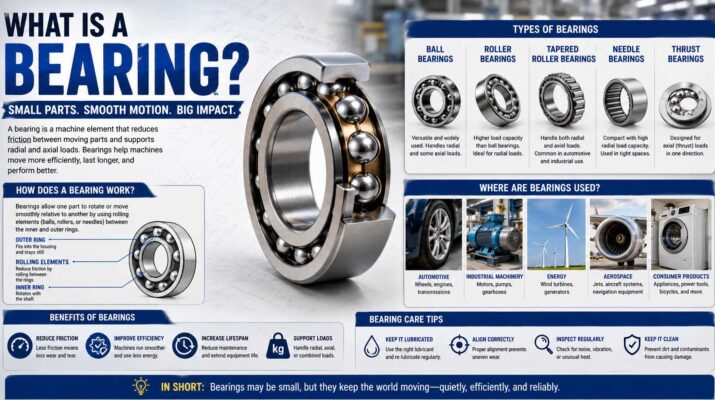
If you have ever watched a wheel, electric motor, fan, or machine shaft rotate smoothly, a bearing was probably helping it move. So, what is a bearing? A bearing is a mechanical component that supports moving parts, guides their motion, and reduces friction between surfaces. Most bearings sit between a rotating shaft and a stationary housing, allowing the shaft to move efficiently while carrying radial, axial, or combined loads.
Although bearings are often small compared with the machines that use them, their job is essential. Without suitable bearings, friction creates extra heat and wear, while shafts may become difficult to control. As a result, everything from bicycles and cars to factory equipment and household appliances relies on bearings.
What Is a Bearing and Why Is It Needed?
A bearing allows one component to move relative to another while keeping that movement controlled.
Imagine a metal shaft rotating directly inside a metal housing. Because the surfaces rub against each other, friction resists movement. Consequently, the parts generate heat and gradually wear.
A bearing creates a more efficient interface between those components. Depending on its design, it may use rolling balls, cylindrical rollers, tapered rollers, needles, or a low-friction sliding surface.
Therefore, bearings perform several jobs at once. They reduce friction, support loads, maintain shaft alignment, and help machinery operate smoothly.
Their role becomes especially clear when studying different types of machines, because rotating equipment ranging from electric motors to industrial pumps depends on controlled shaft movement.
How Does a Bearing Work?
The operating principle depends on the bearing type. However, rolling-element bearings provide the easiest example.
A typical ball bearing contains an inner ring, an outer ring, rolling balls, and a cage. The inner ring usually fits around a rotating shaft, while the outer ring fits into a stationary housing.
As the shaft rotates, the balls roll along specially shaped tracks called raceways.
Rolling friction is generally much lower than the friction created when two surfaces slide directly against each other. Therefore, the shaft can rotate with less resistance.
Meanwhile, the cage keeps the balls properly spaced so they do not bunch together.
Some bearings also include shields or seals. These components help retain lubricant while limiting contamination from dust, dirt, or moisture.
What Happens to the Load?
A bearing does more than enable rotation. It must also transfer force from the moving component to the supporting structure.
For example, a wheel bearing carries forces between the wheel assembly and the vehicle.
Engineers generally classify these forces as radial or axial loads.
A radial load acts perpendicular to the shaft. In contrast, an axial or thrust load acts parallel to the shaft.
Some bearing designs handle mainly one type, while others support combined loads.
Main Parts of a Rolling Bearing
Although designs vary, many common rolling bearings contain several basic components.
The inner ring fits around the shaft and usually rotates with it. Meanwhile, the outer ring typically sits inside a housing.
Between them are the rolling elements. Depending on the design, these may be balls, cylinders, tapered rollers, spherical rollers, or needle-shaped rollers.
The cage, sometimes called the separator, maintains proper spacing between those rolling elements.
Finally, lubricant reduces friction and helps protect contact surfaces from wear. Sealed bearings may retain their lubricant internally, while some industrial designs require periodic lubrication.
These simple components can operate at impressive speeds. Therefore, anyone learning what is rpm will often encounter bearing specifications because rotational speed directly affects bearing selection, lubrication, heat generation, and service life.
What Is a Ball Bearing?
A ball bearing uses spherical rolling elements between its inner and outer raceways.
Because balls make relatively small contact areas with the raceways, these bearings can operate with low friction and at high rotational speeds.
Deep-groove ball bearings are among the most common examples. You can find them in electric motors, fans, power tools, appliances, automotive components, and countless other devices.
Ball bearings can generally handle radial loads along with moderate axial loads, although exact capabilities depend on their design.
They are popular because they combine compact dimensions, efficient rotation, availability, and relatively simple construction.
However, a ball bearing is not automatically the best option for every application. Heavy loads or unusual operating conditions may require roller, thrust, or specialized bearings instead.
For more detailed technical information about bearing designs and selection principles, the SKF rolling bearings guide provides manufacturer guidance on common bearing types and applications.
Common Types of Bearings
Different applications create different loads, speeds, alignment requirements, and environmental conditions. Consequently, manufacturers produce many bearing designs.
| Bearing Type | Main Strength | Typical Applications |
|---|---|---|
| Ball bearing | Low friction and high speed | Motors, fans, appliances |
| Cylindrical roller bearing | High radial-load capacity | Industrial machinery |
| Tapered roller bearing | Combined radial and axial loads | Vehicles, gearboxes |
| Needle bearing | High capacity in limited space | Transmissions, machinery |
| Thrust bearing | Axial-load support | Automotive and industrial systems |
| Spherical roller bearing | Handles misalignment | Heavy industrial equipment |
| Plain bearing | Simple sliding movement | Hinges, pivots, machinery |
Choosing among these designs requires more than comparing physical dimensions. Engineers also consider speed, load direction, lubrication, temperature, expected life, contamination, and alignment.
What Is a Wheel Bearing?
A wheel bearing supports a vehicle’s wheel and allows it to rotate with low friction.
Depending on the vehicle design, the bearing may form part of a hub assembly. It must withstand the vehicle’s weight while handling forces produced during acceleration, braking, and cornering.
That combination makes wheel bearings demanding components.
A failing wheel bearing may produce humming, grinding, or growling noises that change with vehicle speed. In some cases, excessive play can also develop.
Because wheel bearings affect wheel operation and vehicle safety, suspected failure should receive professional inspection rather than being ignored.
Bearings also appear throughout automotive drivetrains. For instance, understanding how does a clutch work shows how bearings can support or control movement within systems that repeatedly transfer power between rotating components.
What Is a Thrust Bearing?
A thrust bearing primarily supports axial loads.
Instead of carrying forces mainly across the shaft, it manages forces that act along the shaft’s axis.
Several designs exist. For example, thrust ball bearings use balls, while thrust roller bearings use rollers when greater load capacity is required.
You may find thrust bearings in automotive systems, machine tools, gearboxes, turbines, marine equipment, and other machinery where axial forces occur.
However, thrust bearings are not interchangeable with every conventional radial bearing. Therefore, the direction and magnitude of the load must match the selected bearing’s capabilities.
Ball Bearings vs. Roller Bearings
Ball and roller bearings operate on similar principles, yet the shape of their rolling elements changes how they distribute loads.
Therefore, ball bearings generally offer low friction and work well at higher speeds.
A roller provides a larger contact area. Consequently, roller bearings can often carry heavier loads.
That difference explains why compact electric motors commonly use ball bearings, while heavy industrial machinery may rely on cylindrical or spherical roller bearings.
However, operating conditions still determine the best choice. Speed, available space, alignment, lubrication, and load direction can matter just as much as maximum load capacity.
Where Are Bearings Used?
Bearings appear almost anywhere controlled mechanical motion occurs.
Electric motors use them to support rotating shafts. Likewise, pumps, generators, compressors, fans, conveyors, and machine tools rely on bearings.
Cars contain numerous bearings in wheels, transmissions, engines, steering systems, accessories, and driveline components.
For example, an automatic transmission contains several rotating assemblies. Learning how does a torque converter work helps show why accurate support and controlled rotation are so important when power moves through automotive drivetrains.
Meanwhile, smaller bearings appear in computer cooling fans, household appliances, power tools, skateboards, bicycles, and office equipment.
Even tiny precision instruments may use specialized bearings when smooth, predictable motion matters.
Bearings, Springs, and Other Mechanical Components
Bearings rarely operate alone. Instead, they form part of larger mechanical assemblies.
Shafts transmit rotational motion, while gears alter speed or torque. Seals prevent contamination or fluid leakage. Meanwhile, springs can store mechanical energy, maintain pressure, absorb shock, or return components to their original position.
Therefore, understanding types of springs alongside bearings can make it easier to see how individual mechanical components cooperate inside vehicles, machinery, and automated equipment.
Each part performs a different function, yet system reliability depends on all of them working together correctly.
Advantages of Using Bearings
The most obvious advantage is reduced friction.
Lower friction allows machines to operate more efficiently while limiting unnecessary heat generation.
Bearings also provide accurate support. They help maintain a shaft’s position while still allowing controlled rotation.
Another advantage is predictable performance. Manufacturers produce standardized bearing sizes and specifications, so designers can choose components according to known load and speed requirements.
Finally, replaceable bearings can protect more expensive machinery. Technicians can often replace a worn bearing without replacing the shaft, motor, wheel, or entire machine.
Why Bearings Fail
Even high-quality bearings eventually wear, but poor operating conditions can cause premature failure.
Insufficient or incorrect lubrication is a common problem. Without a suitable lubricant film, contact surfaces experience greater friction and heat.
Contamination causes trouble as well. Dirt, metal particles, or moisture can damage raceways and rolling elements.
Incorrect installation can also shorten service life. For example, applying installation force through the wrong ring may transfer damaging loads through the rolling elements.
Misalignment, excessive loads, electrical damage, corrosion, and operating beyond recommended speeds can create further problems.
Therefore, proper bearing selection is only the beginning. Installation and maintenance matter throughout the component’s working life.
Common Signs of a Bad Bearing
A damaged bearing may produce grinding, rumbling, humming, squealing, or clicking sounds. However, sound alone cannot identify every bearing problem.
Excessive vibration is another warning sign. Likewise, unusual heat around the bearing housing can suggest poor lubrication, excessive load, incorrect clearance, or internal damage.
In rotating equipment, declining performance or increased power consumption may also indicate rising friction.
Meanwhile, visible looseness or shaft play can suggest severe wear.
Because other mechanical faults can produce similar symptoms, proper inspection should confirm the cause before replacing parts.
How to Make Bearings Last Longer
Start with the correct bearing for the application.
The selected component should match the expected radial and axial loads, operating speed, temperature, shaft dimensions, environment, and required service life.
Next, use the correct lubricant. Both too little and too much lubrication can cause problems, depending on the bearing and application.
Installation also deserves care. Keep components clean, use suitable tools, and avoid transmitting installation force through rolling elements.
Then, monitor equipment for changing noise, temperature, and vibration.
Finally, protect bearings from contamination. Good seals and clean maintenance practices can dramatically reduce damage caused by dust, water, and debris.
Frequently Asked Questions About Bearings
What Is a Bearing in Simple Terms?
A bearing is a mechanical component that supports movement while reducing friction. It commonly allows a shaft, wheel, or other component to rotate smoothly relative to a stationary structure.
What Is a Load-Bearing Wall?
A load-bearing wall is unrelated to mechanical bearings. In construction, it is a structural wall that supports loads from parts of a building above it and transfers those forces toward the foundation.
What Is a Ball Bearing Used For?
A ball bearing reduces rotational friction while supporting loads. Common applications include electric motors, fans, appliances, power tools, vehicles, and industrial equipment.
What Is a Thrust Bearing Used For?
A thrust bearing primarily supports forces acting parallel to a shaft. It appears in machinery where rotating components generate significant axial loads.
Do All Bearings Contain Balls?
No. Bearings may contain balls, cylindrical rollers, tapered rollers, spherical rollers, or needle rollers. Plain bearings do not require rolling elements because they operate through sliding contact.
Do Bearings Need Lubrication?
Most bearings require some form of lubrication. Grease or oil reduces friction, limits wear, helps control heat, and can protect surfaces from corrosion. However, lubrication requirements vary by bearing design.
How Long Does a Bearing Last?
There is no universal lifespan. Load, speed, lubrication, contamination, temperature, alignment, installation quality, and bearing design all affect service life.
Why Such a Small Component Matters
Understanding what is a bearing becomes much easier once you look at the problem it solves: moving components need support without excessive friction.
A well-chosen bearing lets wheels turn, motor shafts spin, industrial equipment operate, and countless everyday devices move smoothly. Meanwhile, different designs handle different challenges, from high-speed ball bearings to heavy-duty roller bearings and axial-load thrust bearings.
Therefore, when choosing or troubleshooting a bearing, focus on load direction, speed, lubrication, operating environment, and correct installation rather than size alone. Those factors usually determine whether a bearing runs reliably for years or fails far earlier than expected.