
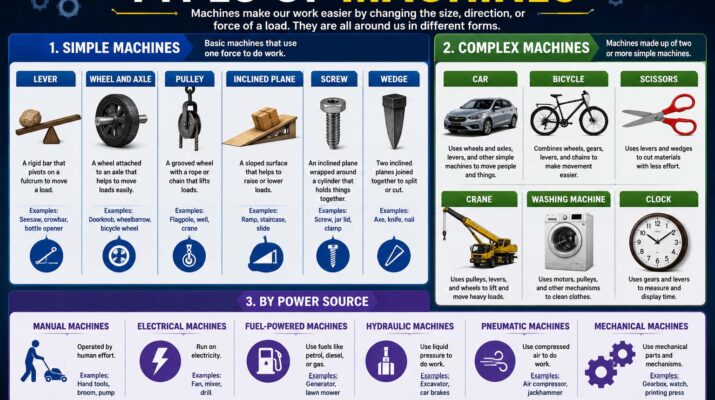
Machines make everyday tasks easier, faster, and more accurate. From the washing machine in your home to the robotic equipment used in factories, different types of machines are designed to solve specific problems by reducing human effort or increasing productivity.
Some machines are incredibly simple, while others combine electronics, sensors, software, and mechanical components to perform complex operations. Understanding how machines work helps students, professionals, and everyday users appreciate the technology behind modern life.
In this guide, you’ll learn about the major categories of machines, how they work, where they’re used, and why each type plays an important role across homes, businesses, manufacturing, healthcare, transportation, and many other industries.
What Are Types of Machines?
It changes the size, direction, or speed of force, allowing people to complete tasks more efficiently than they could by hand.
Machines generally fall into two broad categories:
- Simple machines
- Complex (compound) machines
Simple machines use basic mechanical principles, while complex machines combine multiple simple machines with motors, electronics, or computerized controls.
Although technology has advanced dramatically, modern machines still rely on the same mechanical principles discovered centuries ago.
Types of Machines Explained
The easiest way to understand the different types of machines is to group them by their design and purpose.
| Machine Type | Primary Purpose | Common Examples |
|---|---|---|
| Simple machines | Change force or motion | Lever, pulley, wedge |
| Compound machines | Combine multiple mechanisms | Bicycle, scissors |
| Electrical machines | Convert electrical energy | Motors, generators |
| Hydraulic machines | Use fluid pressure | Hydraulic press |
| Pneumatic machines | Use compressed air | Air tools |
| Mechanical machines | Operate using moving parts | Gear systems |
| CNC machines | Computer-controlled manufacturing | CNC mills |
| Robotic machines | Automated tasks | Industrial robots |
| Smart machines | AI-assisted automation | Warehouse robots |
Each category has unique advantages depending on the application.
Types of Simple Machines
Among all machine categories, the types of simple machines provide the foundation for nearly every mechanical device used today.
There are six classical simple machines.
Lever
A lever consists of a rigid bar that pivots around a fixed point called the fulcrum.
Examples include:
- Crowbars
- Seesaws
- Bottle openers
- Wheelbarrows
Levers help lift heavy objects using less effort.
Wheel and Axle
This machine reduces the force needed to move or rotate objects.
Examples include:
- Steering wheels
- Doorknobs
- Hand carts
- Screwdrivers
Pulley
Pulleys use ropes or cables running over wheels to lift loads efficiently.
You’ll find them in:
- Elevators
- Construction cranes
- Flagpoles
- Window blinds
Inclined Plane
An inclined plane is simply a sloped surface that reduces the effort required to move objects upward.
Examples include:
- Loading ramps
- Staircases
- Accessibility ramps
Wedge
A wedge converts force into splitting or cutting action.
Examples include:
- Axes
- Knives
- Chisels
- Nails
Screw
A screw transforms rotational movement into linear motion.
Examples include:
- Wood screws
- Car jacks
- Bench vises
- Jar lids
Although these machines appear simple, they form the basis of nearly every advanced mechanical system.
Compound Machines
Most equipment people use every day is actually a compound machine.
Compound machines combine two or more simple machines into a single system that performs more complex tasks.
Examples include:
- Bicycles
- Lawn mowers
- Washing machines
- Cranes
- Elevators
- Printing presses
Because several mechanisms work together, compound machines provide greater efficiency than individual simple machines.
Electrical Machines
Electrical machines convert electrical energy into mechanical energy or vice versa.
The two most common categories are:
- Electric motors
- Electric generators
Electric motors power countless products, including:
- Fans
- Refrigerators
- Elevators
- Electric vehicles
- Factory equipment
Generators perform the opposite function by converting mechanical energy into electricity.
One key specification used to measure rotating electrical equipment is what is rpm, since rotational speed directly affects machine performance and efficiency.
Hydraulic Machines
Hydraulic machines use pressurized liquid to multiply force.
Instead of relying on gears or belts alone, these machines transfer energy through hydraulic fluid.
Common examples include:
- Excavators
- Hydraulic presses
- Car lifts
- Forklifts
- Aircraft landing systems
Hydraulic systems can move extremely heavy loads while maintaining precise control.
Because liquids are nearly incompressible, hydraulic machines generate impressive lifting power.
Pneumatic Machines
Pneumatic machines operate using compressed air rather than hydraulic fluid.
These machines are popular because they are lightweight, fast, and relatively simple to maintain.
Examples include:
- Air drills
- Spray painting equipment
- Pneumatic hammers
- Packaging machinery
Factories often prefer pneumatic systems when speed matters more than maximum force.
Mechanical Machines
Mechanical machines depend on moving components such as:
- Gears
- Belts
- Chains
- Bearings
- Shafts
- Springs
Unlike purely electrical equipment, these machines transmit motion directly through mechanical parts.
Examples include:
- Clocks
- Gearboxes
- Conveyor systems
- Manual presses
- Wind-up mechanisms
Many industrial systems combine mechanical parts with electrical controls for higher efficiency.
Computer-Controlled Machines
Modern manufacturing depends heavily on computer-controlled machines.
Instead of relying entirely on manual operation, these systems receive digital instructions that guide every movement with remarkable precision.
Examples include:
- CNC milling machines
- CNC lathes
- Laser cutters
- Waterjet cutters
- 3D printers
Computer-controlled manufacturing has dramatically improved product quality while reducing waste.
Many automated systems also rely on what is an actuator to convert electrical signals into precise mechanical movement, allowing equipment to position tools accurately during production.
Robotic and Smart Machines
Robotic machines are designed to perform tasks automatically with little or no human intervention. While early industrial robots repeated the same motion over and over, modern robots can adapt to changing conditions using sensors, computer vision, and artificial intelligence.
You’ll find robotic machines in:
- Automotive manufacturing
- Electronics assembly
- Warehouses
- Hospitals
- Agriculture
- Space exploration
Many smart machines combine robotics with cloud computing, machine learning, and Internet of Things (IoT) technology. This allows them to collect data, make decisions, and improve efficiency over time.
Common Types of Machines Used at Home
You don’t have to work in a factory to use machines every day. Homes are filled with machines that make daily life easier.
Some common household machines include:
- Washing machines
- Dishwashers
- Vacuum cleaners
- Blenders
- Microwave ovens
- Coffee makers
- Air conditioners
Among these, types of washing machines are one of the most searched topics because buyers often compare top-load, front-load, semi-automatic, and fully automatic models before making a purchase.
Coffee lovers also compare different types of nespresso machines, looking at features such as milk frothers, capsule compatibility, water tank size, and brewing options.
Healthcare technology has also become more accessible. For example, several types of cpap machines help people with sleep apnea by delivering continuous or adjustable air pressure to keep airways open during sleep.
Industrial Machines That Power Modern Manufacturing
Industrial machines are built for continuous operation, high precision, and heavy workloads. They help manufacturers produce everything from food and clothing to automobiles and electronics.
Common industrial machines include:
- CNC machines
- Injection molding machines
- Hydraulic presses
- Conveyor systems
- Packaging equipment
- Welding robots
- Milling machines
- Lathes
The garment industry is a good example of specialized machinery. An industrial sewing machine is designed to operate at much higher speeds than a standard home sewing machine while handling thicker fabrics and extended production cycles.
As manufacturing becomes more automated, factories continue adopting smarter equipment to improve productivity and maintain consistent quality.
Key Components Found in Many Machines
Although machines vary widely, many share the same basic components.
| Component | Purpose |
|---|---|
| Motor | Produces movement |
| Gears | Transfer power and change speed |
| Bearings | Reduce friction |
| Belts and chains | Transmit motion |
| Shafts | Connect rotating parts |
| Sensors | Detect position or conditions |
| Controller | Manages machine operations |
| Frame | Supports the structure |
Industrial automation often depends on accurate measurement and monitoring. Understanding what is instrumentation helps explain how sensors and control systems allow machines to operate safely and consistently.
How Modern Machines Work Together
Today’s machines rarely operate alone.
Instead, they often form part of an automated workflow.
A simplified workflow looks like this:
Input → Sensor Detection → Controller Processing → Machine Action → Quality Check → Finished Product
For example:
- Sensors detect raw material.
- The controller analyzes incoming data.
- Motors or actuators move the equipment.
- Tools perform the required operation.
- Sensors inspect the finished product.
- The system repeats the cycle automatically.
Many automated machines also use what is a solenoid technology to control valves, locks, and fluid movement through electrically operated switches.
Advantages of Different Types of Machines
Machines continue to evolve because they offer significant benefits across nearly every industry.
Some of the biggest advantages include:
- Faster production
- Greater accuracy
- Reduced physical effort
- Improved workplace safety
- Better product consistency
- Lower operating costs over time
- Ability to handle repetitive tasks
- Increased productivity
Smart machines also generate valuable performance data that businesses can use to improve maintenance schedules and reduce downtime.
Challenges and Limitations
Despite their benefits, machines also have some drawbacks.
Common challenges include:
- High purchase costs
- Maintenance requirements
- Energy consumption
- Operator training
- Software updates for computerized systems
- Mechanical wear over time
Complex machines may also require specialized technicians when repairs are needed.
Tips for Choosing the Right Machine
Whether you’re buying equipment for home or business use, consider these factors before making a decision.
Define Your Purpose
Choose a machine designed for the work you perform most often.
Consider Capacity
Larger machines are not always better. Select a size that matches your workload.
Look for Energy Efficiency
Efficient machines reduce electricity costs over their lifetime.
Check Maintenance Requirements
Some machines require regular lubrication, filter replacement, or calibration.
Review Safety Features
Emergency stop buttons, overload protection, and safety guards are valuable features, especially for industrial equipment.
Think About Future Expansion
Businesses should consider machines that can integrate with automation systems as production grows.
Basic Maintenance Tips
Proper maintenance extends machine life and improves reliability.
A simple maintenance routine includes:
- Clean machines regularly.
- Inspect moving parts for wear.
- Lubricate components when recommended.
- Tighten loose fasteners.
- Replace damaged belts and seals.
- Keep software updated on computerized equipment.
- Follow the manufacturer’s maintenance schedule.
Preventive maintenance is usually far less expensive than emergency repairs.
Frequently Asked Questions
What are the main types of machines?
The main categories include simple machines, compound machines, mechanical machines, electrical machines, hydraulic machines, pneumatic machines, CNC machines, robotic machines, and smart machines.
Why are simple machines still important?
Simple machines are the building blocks of modern engineering. Even advanced equipment relies on principles such as levers, pulleys, screws, and wheels.
Which industries use the most machines?
Manufacturing, construction, healthcare, agriculture, transportation, mining, logistics, and food production all depend heavily on machines.
Are smart machines replacing traditional machines?
Not entirely. Smart machines often build on traditional mechanical systems by adding sensors, software, and automation instead of replacing the underlying technology.
What’s the difference between mechanical and electrical machines?
Mechanical machines mainly rely on moving parts to transfer force, while electrical machines use electrical energy to create or control movement.
Final Thoughts
Machines have transformed nearly every part of modern life, from household appliances to advanced industrial automation. Understanding the different types of machines makes it easier to choose the right equipment, appreciate how technology works, and recognize the engineering behind everyday tools.
Whether you’re learning about the six simple machines, exploring automated manufacturing, or comparing specialized equipment for home or business use, knowing how each machine operates helps you make smarter decisions. As automation, robotics, and artificial intelligence continue to advance, machines will become even more capable while remaining grounded in the same mechanical principles that have powered innovation for centuries.