
If you’ve ever compared different types of ammunition, you’ve probably wondered about the difference between centerfire and rimfire cartridges. At first glance, they look similar, yet they operate differently and are designed for different purposes. Whether you’re learning about firearms, researching ammunition technology, or simply curious about how cartridge ignition works, understanding these two designs helps explain why each remains widely used today.
Although centerfire and rimfire ammunition both launch a bullet using expanding gases, the method of ignition, performance, cost, and durability vary significantly. Those differences influence everything from recreational target shooting to hunting and professional applications.
Difference Between Centerfire and Rimfire Explained
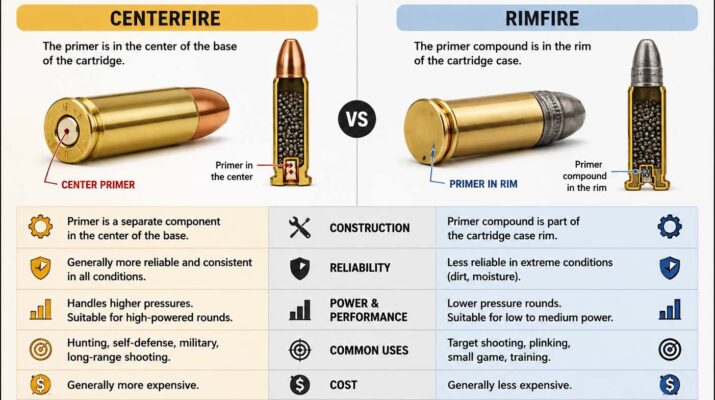
The easiest way to understand the difference between centerfire and rimfire is to look at where the primer—the ignition source—is located.
| Feature | Centerfire | Rimfire |
|---|---|---|
| Primer location | Center of the cartridge base | Inside the rim of the cartridge |
| Reloadable | Usually yes | Generally no |
| Common calibers | Medium to large calibers | Mostly small calibers |
| Reliability | Very high | Good for recreational use |
| Typical use | Hunting, defense, military, law enforcement | Training, plinking, small game hunting |
When people ask what is the difference between centerfire and rimfire, the answer almost always begins with primer placement because it affects nearly every other characteristic of the cartridge.
How Does Centerfire Ammunition Work?
A centerfire cartridge contains a separate metal primer seated in the exact center of the cartridge base.
When the firearm’s firing pin strikes this primer, it creates a spark that ignites the powder inside the casing. The rapidly expanding gases push the bullet down the barrel at high speed.
This design has become the standard for most modern rifles, pistols, and shotguns because it provides dependable ignition and supports higher chamber pressures.
Components of a Centerfire Cartridge
A typical centerfire cartridge includes:
- Bullet
- Brass or steel case
- Powder charge
- Separate primer located in the center
Since the primer is removable, experienced reloaders can replace spent primers, refill powder, and seat new bullets. That makes centerfire ammunition reusable under proper conditions.
How Rimfire Ammunition Works
Unlike centerfire designs, rimfire cartridges do not have a separate primer.
Instead, a thin layer of priming compound is spun into the hollow rim during manufacturing. When the firing pin crushes the edge of the rim, the priming compound ignites and fires the cartridge.
This simpler manufacturing process helps keep costs lower, making rimfire ammunition popular for beginners and casual target shooting.
The most well-known example is the .22 Long Rifle (.22 LR), which has remained one of the world’s most widely used cartridges for decades.
What Is the Main Difference Between Centerfire and Rimfire Ammunition?
Many beginners ask, what is the main difference between centerfire and rimfire ammunition? While there are several distinctions, the primer design remains the defining feature.
Centerfire cartridges use a replaceable primer in the center of the base.
Rimfire cartridges rely on primer compound distributed inside the rim itself.
That single engineering decision affects:
- Maximum operating pressure
- Manufacturing cost
- Reliability
- Reloadability
- Cartridge strength
- Typical applications
As a result, centerfire ammunition dominates professional, military, and hunting markets, while rimfire continues to excel in affordable recreational shooting.
Why Centerfire Is Better for High-Power Applications
Centerfire cartridge cases are thicker and stronger than rimfire cases.
Because they withstand much higher pressures, manufacturers can load them with significantly more propellant without compromising safety. This allows centerfire ammunition to achieve greater velocity, energy, and effective range.
The materials used in cartridge cases are carefully selected for strength and durability. If you’re interested in how engineers compare material performance, our guide on what is the strongest metal explains why certain metals excel under extreme stress.
Advantages of Centerfire Ammunition
Centerfire cartridges offer several practical benefits.
- Excellent reliability
- Suitable for high-pressure loads
- Available in many calibers
- Easier to reload
- Longer service life
- Better for hunting and personal defense
- Widely supported by firearm manufacturers
These advantages explain why nearly all modern service pistols and military rifles use centerfire ammunition.
Limitations of Centerfire
Despite its strengths, centerfire ammunition also has some disadvantages.
- Higher purchase cost
- Greater recoil in larger calibers
- Louder report
- Firearms are often more expensive
For casual target shooting, these trade-offs may not always justify the added performance.
Why Rimfire Remains Popular
Although rimfire technology is older, it continues to serve an important role.
Because the cartridges are inexpensive to manufacture, shooters can practice more frequently without spending as much on ammunition. Lower recoil also makes learning proper shooting techniques much easier.
That combination of affordability and ease of use explains why many first-time shooters begin with rimfire firearms.
Advantages of Rimfire Ammunition
Rimfire cartridges remain popular because they are:
- Affordable
- Lightweight
- Easy to shoot
- Low recoil
- Widely available
- Excellent for beginner training
- Ideal for recreational target shooting
For many owners, a rimfire rifle becomes the firearm they use most often simply because it’s inexpensive to operate.
Difference Between Rimfire and Centerfire in Everyday Use
The practical difference between rimfire and centerfire becomes much clearer when comparing common shooting activities.
Someone practicing at a local range may fire hundreds of rimfire rounds in a single afternoon because the ammunition is affordable and produces minimal recoil.
By contrast, hunters, competitive shooters, and professionals typically rely on centerfire cartridges because they offer higher accuracy over longer distances, greater stopping power, and improved reliability under demanding conditions.
Your intended use often determines which cartridge type makes the most sense rather than one being universally better than the other.
Common Uses for Centerfire and Rimfire Ammunition
Choosing between centerfire and rimfire often comes down to the job you need the cartridge to do. While both fire a projectile using expanding gases, they are optimized for different situations.
When Centerfire Is the Better Choice
Centerfire ammunition is commonly used for:
- Hunting medium and large game
- Personal and home defense
- Law enforcement
- Military applications
- Long-range target shooting
- Precision shooting competitions
Its ability to handle higher pressures gives shooters more power, greater range, and improved performance in demanding conditions.
When Rimfire Makes More Sense
Rimfire ammunition shines in situations where low cost and light recoil matter most.
Common uses include:
- Learning firearm basics
- Recreational target shooting
- Plinking
- Small game hunting
- Pest control on suitable small animals
Because recoil is minimal, many instructors recommend rimfire firearms for beginners who want to develop safe shooting habits before moving to larger calibers.
Centerfire vs. Rimfire: Reliability Comparison
Reliability is another area where the two cartridge types differ.
Centerfire primers are manufactured as separate components and are generally more consistent. As a result, failures to fire are relatively uncommon when quality ammunition is used.
Rimfire cartridges, on the other hand, depend on the priming compound being evenly distributed around the rim. If the compound is uneven or the rim isn’t struck correctly, the cartridge may not ignite.
This doesn’t mean rimfire ammunition is unreliable—it simply has a slightly higher chance of a misfire compared with quality centerfire ammunition.
Cost Differences
Price is one of the biggest reasons many people choose rimfire ammunition.
Since rimfire cartridges use a simpler manufacturing process and less material, they usually cost much less per round than centerfire alternatives.
Centerfire ammunition costs more because of:
- Separate primer construction
- Stronger cartridge cases
- Larger powder charges
- More complex manufacturing
For someone practicing regularly at the shooting range, those savings can add up quickly over time.
Can You Reload Centerfire and Rimfire Cartridges?
One of the most frequently asked questions is whether spent cartridges can be reused.
Centerfire cases are typically reloadable. After firing, experienced reloaders can remove the spent primer, insert a new one, refill the powder, and seat another bullet. This helps reduce long-term ammunition costs and allows for customized loads.
Rimfire cartridges are different. Because the primer compound is built into the rim during manufacturing, the case is generally considered disposable after one use. Reloading rimfire ammunition is impractical and not recommended.
Safety Tips for Handling Ammunition
No matter which cartridge type you choose, safe handling should always come first.
Follow these basic guidelines:
- Store ammunition in a cool, dry location.
- Use only the caliber recommended by your firearm manufacturer.
- Inspect cartridges for dents, corrosion, or damage before use.
- Never mix different calibers together.
- Wear appropriate eye and hearing protection while shooting.
- Keep ammunition away from children and unauthorized users.
Following these practices helps improve both safety and firearm reliability.
Myths About Centerfire and Rimfire
Several misconceptions continue to circulate among new shooters. Let’s clear up a few of the most common ones.
Myth: Rimfire Is Less Accurate
Not necessarily.
Many .22 LR rifles are exceptionally accurate at shorter distances. Rimfire simply isn’t designed for the same power and long-range performance as most centerfire cartridges.
Myth: Centerfire Always Means Larger Calibers
Centerfire cartridges come in a wide range of sizes, including several small-caliber options used for target shooting and varmint hunting.
Myth: Rimfire Ammunition Is Unsafe
Modern rimfire ammunition is safe when used correctly in firearms chambered for it. Like any ammunition, safety depends on proper storage, handling, and firearm maintenance.
Frequently Asked Questions
What is the main difference between centerfire and rimfire ammunition?
The primary difference is the location of the primer. Centerfire cartridges have a separate primer in the middle of the case, while rimfire cartridges contain priming compound inside the rim.
Which is more powerful?
Centerfire ammunition is generally much more powerful because its stronger case can safely contain higher-pressure loads.
Which is better for beginners?
Rimfire is often recommended for beginners because it produces less recoil, costs less, and allows new shooters to build confidence without excessive noise or kick.
Is centerfire ammunition more reliable?
Yes. In general, centerfire cartridges have a lower rate of misfires thanks to their separate primer design and stronger construction.
Why can’t rimfire cartridges usually be reloaded?
The priming compound is built into the rim during manufacturing. Once fired, the rim cannot be restored in a practical or safe way.
Engineering Behind Cartridge Design
Although the ignition systems are different, both cartridge types rely on the same basic engineering principles. The expanding gases generated by burning propellant create pressure that pushes the bullet through the barrel.
That forward motion is an example of what is thrust, where expanding gases generate force to propel an object in a specific direction. While the scale differs from aerospace applications, the underlying physics are remarkably similar.
Likewise, the cartridge case itself must withstand tremendous pressure without deforming. Manufacturing materials are selected for their balance of strength, flexibility, and durability. This is one reason cartridge cases aren’t made from brittle materials such as traditional cast iron. If you’re curious about how different metals perform under stress, our comparison of wrought iron vs cast iron highlights why material properties matter in engineering.
Quick Reference: Which Should You Choose?
| If You Want… | Better Choice |
|---|---|
| Affordable practice | Rimfire |
| Low recoil | Rimfire |
| Beginner-friendly shooting | Rimfire |
| Hunting large game | Centerfire |
| Personal defense | Centerfire |
| Long-range accuracy | Centerfire |
| Reloadable ammunition | Centerfire |
| Maximum power | Centerfire |
The Bottom Line
Understanding the difference between centerfire and rimfire makes it much easier to choose the right ammunition for your needs.
If your goal is affordable practice, learning the basics, or recreational shooting, rimfire ammunition offers excellent value and an enjoyable shooting experience.
If you need greater power, improved reliability, longer range, or reloadable cartridges, centerfire ammunition is the better option. That’s why it remains the standard for hunting, competitive shooting, law enforcement, and military use.
Rather than asking which system is universally better, consider how you plan to use it. Once you understand what is the difference between centerfire and rimfire, selecting the right cartridge becomes a straightforward decision based on performance, cost, and intended application.