
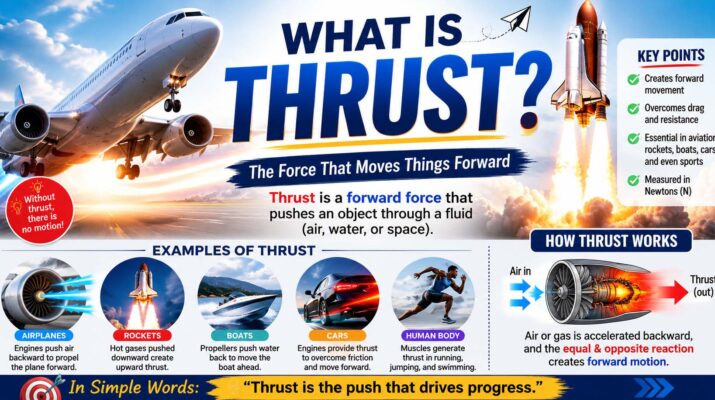
The question what is thrust comes up in many fields, including aerospace engineering, mechanical systems, transportation, and even fitness and health. Although the meaning changes with the context, it generally refers to a force that pushes an object in a specific direction.
What Is Thrust?
Thrust is a force that moves an object forward by pushing mass in the opposite direction. In other words, it follows Newton’s third law: for every action, there is an equal and opposite reaction.
For example, when an engine pushes gas backward, the object attached to that engine moves forward. As a result, we call this forward push thrust. A free body diagram also shows this clearly, because it draws every force acting on an object and the direction of its motion.
Engineers usually measure this force in newtons (N), kilonewtons (kN), or pounds-force (lbf). Without it, modern aircraft, rockets, and many transportation systems simply could not move.
How Does Thrust Work?
The basic idea is simple. First, an engine produces energy through fuel combustion, electric power, or mechanical movement. Next, it speeds up gases, air, water, or another working fluid in one direction. Finally, the reaction force pushes the object the other way.
For this reason, the same process powers airplanes, rockets, jet skis, ships, and drones. In addition, learning about 2 stroke vs 4 stroke engines makes it easier to see how different engine designs produce the power behind forward motion.
Why Is Thrust Important?
This force lets machines overcome resistance and move efficiently. For instance, it makes flight possible, supports space travel, moves ships, and powers many industrial systems. Therefore, it remains one of the most basic ideas in modern engineering.
According to NASA’s Beginner’s Guide to Aeronautics, thrust is the force that moves an aircraft through the air, and the aircraft’s propulsion system produces it.
Types of Thrust
Different technologies create this push in different ways.
Jet Engine Thrust
A jet engine first draws in air and compresses it. Then, it mixes the air with fuel, ignites the mixture, and pushes the hot gases out the back. As a result, the aircraft moves forward.
Rocket Thrust
Unlike aircraft, rockets carry both fuel and an oxidizer. Because of this, they can produce force even where there is no oxygen in the air, such as in space.
Marine Thrust
Ships and boats usually move forward with propellers. The propeller pushes water backward, so the vessel moves forward.
Thrust vs Drag
A useful comparison is the push forward against the drag that holds an object back.
| Thrust | Drag |
|---|---|
| Pushes forward | Resists motion |
| Generated by engines | Caused by air or water resistance |
| Increases speed | Reduces speed |
| Supports movement | Opposes movement |
What Is Thrust Vectoring?
Thrust vectoring ranks among the most modern aerospace technologies. Simply put, it means steering the direction of the engine exhaust to make an aircraft more agile.
As a result, pilots gain better agility, stronger control at low speeds, better takeoff performance, and faster changes of direction. For example, the F-22 Raptor, the Su-35, and the F-35 Lightning II all use this technology. Meanwhile, engineers continue to refine it for modern aviation.
What Is a Thrust Bearing?
In mechanical engineering, many people want to know about the thrust bearing. In short, it is a special bearing that handles axial loads.
An axial load is a force that pushes along a rotating shaft, whether forward, backward, upward, or downward. Therefore, you will find these bearings in automotive transmissions, industrial machinery, turbines, and marine propulsion systems. Without them, extra friction could damage the equipment.
Types of Thrust Bearings
First, ball bearings suit lighter loads. Next, roller bearings handle heavier applications. Finally, fluid bearings work well in high-speed industrial systems. In short, each type serves different engineering needs.
Common Bearing Problems
Heavy loads or poor lubrication often cause excessive wear. Similarly, friction or poor maintenance can lead to overheating. In addition, vibration may point to bearing damage, while unusual noise often signals wear.
For this reason, routine inspections help prevent failures.
What Is a Hip Thrust?
The hip thrust also shows up often in searches. This move is a strength-training exercise that mainly works the glutes, while also engaging the hamstrings and core muscles.
In this context, the word refers to a forward pushing movement of the hips rather than a mechanical force.
What Is Tongue Thrust?
Tongue thrust also comes up often in searches. It describes a pattern in which the tongue pushes forward against or between the teeth during swallowing, speaking, or rest.
Over time, it can lead to dental alignment issues, speech difficulties, and orthodontic problems. Fortunately, dentists and speech specialists often help manage it. Once again, the word simply describes a pushing movement.
Real-World Applications of Thrust
This force shapes many technologies we use every day. For example, aircraft rely on engine power for takeoff and steady flight. Likewise, rockets use it to escape Earth’s gravity and travel through space.
Similarly, ships depend on propellers to move through water. Understanding what is an actuator also helps explain how machines control movement with electrical, hydraulic, or pneumatic energy.
In manufacturing, industrial equipment often uses thrust bearings to support moving parts and reduce friction. Overall, this shows how widely the idea applies across industries.
Future Developments in Propulsion Technology
Modern engineers keep improving propulsion systems. For instance, new work focuses on electric aircraft, advanced rocket engines, hybrid systems, sustainable aviation fuels, and better vectoring control. Above all, these innovations aim to raise efficiency and cut environmental impact.
Engine designers also work to increase power output, often measured in kilowatts (kW), while keeping fuel use low. After all, more power often means a stronger push and better overall performance.
Frequently Asked Questions
What is thrust?
It is the force that pushes an object forward by expelling mass in the opposite direction. Typically, engines, rockets, propellers, and jet turbines produce it.
How does this force work?
It follows Newton’s third law of motion: for every action, there is an equal and opposite reaction. So, when an engine pushes gases or other material backward, it creates a forward force that moves the object.
What does vectoring do for an aircraft?
Vectoring changes the direction of an engine’s exhaust. As a result, it improves an aircraft’s maneuverability, stability, and control, especially during advanced flight moves.
Where do people use axial-load bearings?
These bearings support loads that act parallel to the shaft. Consequently, automotive, industrial, and mechanical equipment commonly use them to reduce friction between moving parts.
Why do people do hip exercises like this?
The exercise mainly targets the glutes, while also working the hamstrings and core. Therefore, people commonly use it to build lower-body strength, power, and athletic performance.
Can a tongue pushing habit affect teeth?
Yes. If left untreated, pressing the tongue against or between the teeth can affect dental alignment and speech.
Conclusion
Understanding what is thrust gives you insight into one of the most important ideas in engineering and technology. From jet engines and rockets to ships and industrial machinery, this force makes movement possible and powers many modern systems.
Finally, if you’re studying aviation, mechanical engineering, or transportation, related topics such as what is RPM give a fuller picture of how engine speed affects performance and the force needed to move vehicles efficiently.