
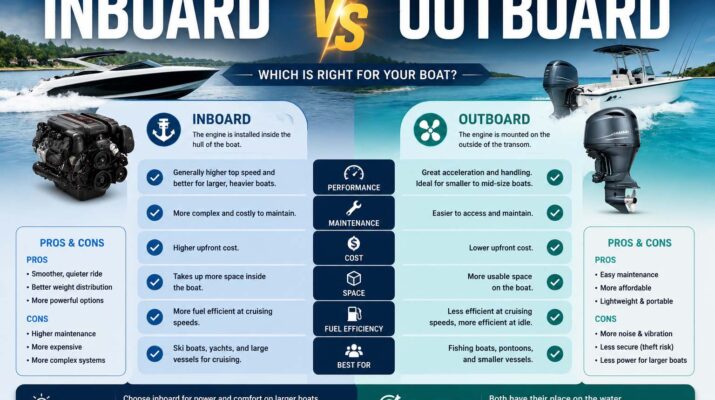
Whether you’re buying your first boat or upgrading to a newer model, understanding inboard vs outboard engines can help you make a smart choice.
Both engine types power boats well. However, they differ in design, performance, upkeep, fuel use, and the overall boating experience.
This guide explains how each system works, along with its pros, cons, upkeep needs, and best uses. Also, if you’re new to boat engines, learning what is RPM helps you see how engine speed affects performance.
What Is an Inboard Engine?
An inboard engine usually sits near the middle of the boat. Then, a driveshaft connects it to the propeller under the hull.
For example, you’ll find inboards on ski boats, wake boats, and large cruisers. In addition, yacht-style boats and many work boats use them.
Because the engine sits inside the hull, the boat shields it from water and weather.
What Is an Outboard Engine?
An outboard engine mounts on the outside back wall of the boat, called the transom. In fact, the engine, gearbox, and propeller all come as one single unit.
For example, fishing boats, pontoon boats, and small leisure boats often use outboards. Likewise, center-console boats and coastal boats rely on them.
Outboards are popular because they are easy to reach and replace when needed.
Inboard vs Outboard Comparison Table
| Feature | Inboard Engine | Outboard Engine |
|---|---|---|
| Engine Location | Inside Hull | Outside Transom |
| Maintenance Access | Moderate | Easy |
| Initial Cost | Often Higher | Usually Lower |
| Space Efficiency | Less Interior Space | More Interior Space |
| Fuel Efficiency | Good for Large Boats | Excellent for Small Boats |
| Replacement Ease | More Complex | Easier |
| Shallow Water Use | Less Suitable | Better |
| Top Speed | Strong Performance | Often Faster |
Overall, this table shows some of the biggest differences between the two systems.
Outboard vs Inboard Boats: Which Is Better?
The answer depends on how you plan to use your boat. For instance, the J.D. Power guide to inboard and outboard motors also says neither type wins in every case.
Outboard boats are best for leisure boating, fishing, coastal cruising, and weekend trips. In addition, they offer easy upkeep, good fuel economy, more room inside, and simpler engine swaps.
Inboard boats, on the other hand, are best for watersports, long trips, heavy-duty work, and large boats. Moreover, they offer better weight balance, strong towing power, and better handling in rough water.
In short, the ideal choice depends on what matters most to you on the water.
Outboard vs Inboard Motor: How They Work
Knowing how each system works can make your decision easier.
With an inboard motor, the engine stays fixed inside the hull. Instead, a rudder behind the propeller steers the boat. As a result, this design gives stable handling and smooth power.
An outboard motor, by contrast, turns as a whole unit to steer the boat. Because the engine itself rotates, steering is often quicker and more precise. That is why anglers and leisure boaters love outboards.
Inboard vs Outboard Performance
Performance is often a big factor when you compare these motors.
Modern outboards have become very powerful. For example, they often reach higher top speeds and speed up faster. In addition, their light design helps the boat move quickly.
Also, people often measure engine power in kilowatts. So, understanding What Is a KW gives you another way to compare engine output.
Inboard engines, however, often win at towing. For instance, they shine when pulling wakeboarders and skiers or carrying heavy loads. This is because their central weight improves stability.
Inboard vs Outboard Fuel Efficiency
Fuel costs can greatly affect what you spend over the years.
Many modern outboards use advanced fuel injection, light materials, and efficient cruising. As a result, they often burn less fuel. In addition, learning the parts of a carburetor shows how older fuel systems differ from the fuel injection in newer outboards.
Inboards, on the other hand, can be efficient on larger boats that need steady power. However, their efficiency depends heavily on boat size, weight, engine type, and cruising speed.
Inboard vs Outboard Maintenance Requirements
Upkeep is another important factor.
Outboards are easier to service because you can reach the engine easily. For example, common jobs include oil changes, new spark plugs, propeller checks, and cooling system checks.
Inboards, in contrast, may take more effort since the engine sits inside the hull. For instance, owners service the engine, inspect the shaft, maintain the cooling system, and check the bilge.
Above all, regular upkeep matters no matter which engine you choose.
Inboard vs Outboard Boat Maintenance Costs
Costs vary with engine size and how often you use the boat.
Outboards generally mean lower repair bills, easier replacement, and faster service. In contrast, inboards often involve more labor, complex drivetrain parts, and higher installation costs.
However, inboards can last a very long time when you maintain them well.
Best Applications for Inboard Boats
An inboard vs outboard boat comparison often comes down to how you’ll use it. For example, choose an inboard for watersports. Wakeboarding and waterskiing benefit from steady power and a better wake.
In addition, cruisers and yachts often rely on inboard engines. Moreover, the central engine position improves balance and stability.
Best Applications for Outboard Boats
Outboards shine in several situations. For example, anglers get more deck space, better steering, and easier use in shallow water.
Similarly, families enjoy simple controls, lower ownership costs, and easier upkeep. Finally, many modern center-console boats use several outboards for coastal cruising because they add speed and backup power.
Troubleshooting Common Boat Engine Issues
Both engine types can run into problems. For example, if the engine won’t start, check for a dead battery, fuel supply problems, or ignition faults.
Similarly, if it overheats, check the water intake for blockages. Also, inspect the cooling system and the water pump impeller.
In addition, a loss of power often points to dirty fuel filters, a damaged propeller, or an engine that needs tuning. Likewise, too much vibration may come from a bad propeller, worn engine mounts, or a misaligned driveshaft.
In the end, catching problems early can prevent costly repairs.
How to Choose Between Inboard and Outboard
First, decide on your main activity. Ask yourself whether you’ll mostly fish, do watersports, cruise, or head offshore.
Next, think about upkeep. Outboards usually give easier access for maintenance.
Then, check your budget. Include the purchase price, fuel, service, and long-term ownership costs.
After that, look at storage. You can often tilt an outboard out of the water, which lowers the risk of corrosion.
Finally, think long-term about how your boating needs may change. Also, learning about 2 stroke vs 4 stroke engines shows how engine type affects upkeep, fuel use, and performance.
Future Trends in Boat Engine Technology
New ideas keep improving both systems. For example, makers now offer better fuel injection and digital engine monitoring. In addition, electric and hybrid boat engines are growing, along with stronger rust protection.
As a result, owning a boat is getting easier and more efficient than ever.
Similarly, engine output affects what is thrust, especially when a boat speeds up, carries heavy loads, or tows riders.
Frequently Asked Questions
What is the difference between inboard and outboard engines?
Inboard engines sit inside the boat’s hull. In contrast, outboard engines mount on the outside of the transom.
Which is easier to maintain?
Outboards are generally easier to maintain because you can reach them easily and remove or replace them more simply.
Are outboards faster than inboards?
Many modern outboards offer higher top speeds and quicker acceleration. However, overall performance depends on the boat’s design and engine size.
Which is better for watersports?
Many riders prefer inboard boats for wakeboarding and waterskiing. This is because they deliver smoother power and a better wake.
Do outboard boats use less fuel?
On many smaller leisure boats, yes. In fact, their light design and modern fuel injection often make outboards more fuel efficient.
Which lasts longer?
Both types can give many years of reliable service. However, you need to maintain them well and follow the maker’s advice.
Inboard vs Outboard: Which Should You Choose?
When comparing inboard vs outboard, neither option is better for everyone. Instead, the right choice depends on how you use your boat, your upkeep preferences, your speed goals, and your budget.
Outboards are ideal for fishing, leisure boating, and easy upkeep. Meanwhile, inboards excel at watersports, larger boats, and strong towing. So, by weighing your goals and long-term costs, you can confidently pick the engine that fits your needs best.