
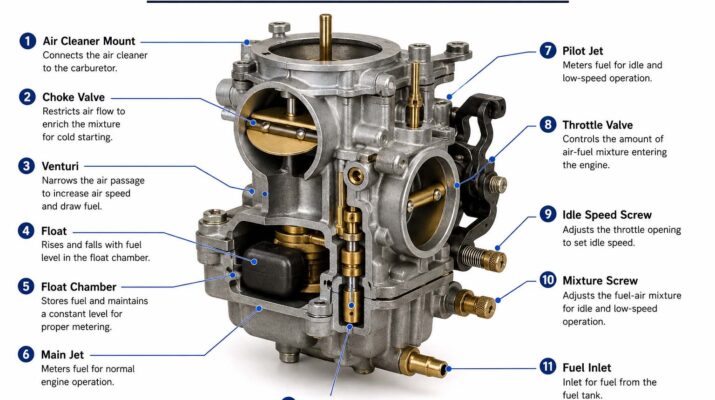
Carburetors may not be as common in modern cars as they once were, but they still appear in many motorcycles, lawn mowers, generators, chainsaws, and older vehicles. If you’re trying to understand the parts of a carburetor, learning what each component does is the first step toward understanding how an engine mixes air and fuel.
Although a carburetor may look like a simple metal assembly, it contains several precision components that work together to supply the engine with the appropriate air-fuel mixture. Each part has a specific job, from controlling the fuel level to regulating airflow. Therefore, understanding these components can make engine maintenance and troubleshooting easier.
Parts of a Carburetor and Their Functions
Most traditional float-type carburetors share several essential components. However, their exact designs vary depending on the engine, manufacturer, and intended application.
| Carburetor part | Primary function |
|---|---|
| Float chamber | Holds a small supply of fuel |
| Float | Helps maintain the correct fuel level |
| Needle valve | Regulates fuel entering the chamber |
| Venturi | Increases airflow speed and lowers static pressure |
| Main jet | Meters fuel for higher engine loads |
| Idle jet | Supplies fuel when the throttle is nearly closed |
| Choke valve | Enriches the mixture during cold starting |
| Throttle valve | Regulates airflow and engine power |
| Air intake | Allows air to enter the carburetor |
| Fuel inlet | Connects the carburetor to the fuel supply |
Together, these components help the engine operate at different speeds and loads. Some carburetors also include accelerator pumps, mixture screws, emulsion tubes, and additional fuel circuits.
How a Carburetor Works
Before examining individual components, it helps to understand the basic operating process.
First, air enters through the intake and passes through the venturi. As the airflow speeds up, its static pressure decreases. This pressure difference helps draw fuel through the appropriate metering circuits.
Next, the fuel mixes with the incoming air. The resulting mixture travels through the intake passage toward the engine’s cylinders, where the engine compresses and ignites it in a spark-ignition system.
Meanwhile, the throttle controls how much air can enter the engine. As the driver or operator opens the throttle, airflow increases, and the carburetor’s fuel circuits respond to changing operating conditions.
Although modern vehicles commonly use electronic fuel injection, carburetors remain useful examples of mechanical engineering. Their operation also connects to concepts explored in what is mechatronics?, where mechanical components and control technologies work together.
Understanding the Main Carburetor Components
Each component contributes to fuel delivery, airflow, or engine control. The following sections explain how the main parts work and what can happen when they malfunction.
Float Chamber
The float chamber acts as a small fuel reservoir inside many carburetors. It stores fuel close to the metering circuits so the engine can draw from a relatively steady supply.
As engine demand changes, the fuel level needs to remain within the range specified by the manufacturer. Otherwise, the mixture may become too rich or too lean.
A damaged chamber, leaking gasket, or incorrect fuel level can cause operating problems. Therefore, inspect the chamber and its seals whenever fuel leaks appear around the carburetor.
Float
The float moves up and down with the fuel level inside the chamber. It usually works through a small hinge or pivot connected to the inlet needle.
When the fuel level drops, the float moves downward and allows the needle valve to open. As fuel enters and raises the level, the float rises and closes the valve.
This process resembles the float mechanism in a toilet tank. However, carburetor floats require the correct movement and adjustment to maintain reliable fuel delivery.
If the float sticks, develops a leak, or becomes damaged, the engine may experience flooding, fuel starvation, or inconsistent operation.
Needle Valve
The needle valve works alongside the float to regulate incoming fuel. It opens when the chamber needs more fuel and closes when the level reaches its intended point.
A worn needle or contaminated valve seat may prevent the valve from sealing properly. As a result, fuel can overflow into the carburetor.
Conversely, a valve that remains closed or restricts flow can starve the engine of fuel. Cleaning or replacing the affected component may resolve the problem, depending on its condition.
Venturi
The venturi is one of the most important parts of a carburetor because it helps draw fuel into the incoming air.
This narrowed section accelerates the airflow and reduces its static pressure. The resulting pressure difference helps pull fuel from the metering circuit into the air stream.
However, the venturi does not control the entire fuel supply by itself. The jets, fuel level, air pressure, and other circuits also affect the final mixture.
Keeping the air passage clean helps the carburetor operate as designed.
Fuel Jets and Why They Matter
Fuel jets contain small, precisely sized openings that meter fuel into the airflow. Different circuits supply fuel under different operating conditions, so the engine can run when idling, accelerating, or working under load.
Main Jet
The main jet meters fuel primarily during higher-load operation. Its effect depends on the carburetor’s design and the position of the throttle.
A jet with a larger metering opening generally allows more fuel to pass under comparable conditions. Nevertheless, simply installing a larger jet does not guarantee better performance. The correct size depends on the engine, carburetor, and operating setup.
A clogged main jet may cause hesitation, reduced power, or poor performance under load.
Idle Jet
The idle jet, also called the pilot jet on many motorcycle carburetors, supplies fuel when the throttle is nearly closed.
At this point, the main metering circuit may not provide the mixture needed to keep the engine running smoothly. Therefore, the idle circuit helps maintain stable operation at low speeds.
A blocked pilot passage can cause rough idling, difficult starting, or stalling when the throttle closes. Cleaning the circuit with suitable products and following the manufacturer’s instructions can help restore normal operation.
The Choke Valve
Cold engines often need a richer mixture to start reliably. The choke helps provide this mixture by restricting incoming air or, in some designs, using another mechanism to enrich fuel delivery.
When the engine warms up, the choke should return toward its normal operating position. Older engines may use a manual lever, while others have automatic choke systems.
If the choke remains engaged after the engine warms up, the mixture may become excessively rich. This can lead to rough running, increased fuel consumption, or dark exhaust smoke.
The Throttle Valve
The throttle regulates the amount of air entering the engine. Depending on the carburetor design, it may use a butterfly plate or a sliding valve.
When the operator opens the throttle, the engine can draw in more air. The fuel-metering circuits then respond to the changing airflow and pressure conditions.
Consequently, opening the throttle generally allows the engine to produce more power, provided the fuel mixture and other operating conditions remain appropriate.
A sticking throttle valve or damaged linkage can interfere with engine response. If the throttle does not move freely, inspect the linkage and follow the equipment manufacturer’s service instructions.
Understanding airflow also helps explain concepts such as what is thrust, which describes how moving gases can generate force in different mechanical and propulsion systems.
Parts of a Carburetor Diagram: Following Air and Fuel
A carburetor diagram helps you identify components and understand how air and fuel travel through the assembly.
The airflow path in a simplified carburetor may look like this:
Air Intake → Venturi and Metering Area → Throttle Valve → Engine Intake
The fuel path follows a separate route:
Fuel Tank → Fuel Inlet → Needle Valve → Float Chamber → Metering Circuit → Air Stream
These paths interact inside the carburetor to produce the mixture the engine needs. However, the precise arrangement varies by design, and some carburetors contain additional passages and circuits.
When using a diagram for maintenance, match the drawing to your specific carburetor model. This approach helps you identify the correct jets, seals, screws, and linkages rather than relying on a generic illustration.
Carburetors also appear in older marine engines. Understanding the differences between inboard vs outboard engines can provide useful context when learning why marine engine layouts and maintenance requirements differ.
Parts of a Small Engine Carburetor
Small engines often use compact carburetors on equipment such as:
- Lawn mowers
- Portable generators
- Pressure washers
- Snow blowers
- Chainsaws
Although their size and design vary, many small-engine carburetors include a fuel inlet, metering circuits, a throttle mechanism, and a starting-enrichment system.
Some use a float chamber, while others rely on a diaphragm and fuel-pumping mechanism. Therefore, not every small-engine carburetor contains the same parts.
Because these systems may have small fuel passages, stale gasoline and debris can cause problems quickly. Regular inspection and proper seasonal storage help reduce the risk of blocked passages and starting difficulties.
Parts of a Motorcycle Carburetor
Motorcycle carburetors use the same basic principles as other carburetors, but their designs often prioritize compact dimensions and responsive throttle control.
Common components include:
- Float chamber, where fitted
- Float and needle valve, where fitted
- Main jet
- Pilot or idle jet
- Throttle slide or butterfly valve
- Choke or enrichment system
- Venturi
- Air and fuel passages
Some motorcycles use multiple carburetors, particularly on engines with multiple cylinders. In these systems, correct adjustment and synchronization help the cylinders receive appropriate mixtures and respond consistently.
However, carburetor designs differ between motorcycles. A slide-type carburetor, for example, does not use exactly the same throttle arrangement as a butterfly-type design.
If you’re learning about motorcycle engine systems, this guide to types of motorcycles offers additional context about the different machines that may use different fuel-delivery systems.
Common Carburetor Problems and Their Causes
Carburetors can develop problems through normal wear, contamination, incorrect adjustments, or long periods of storage. Fortunately, understanding the symptoms can help narrow down the possible cause.
| Problem | Possible cause | Common symptom |
|---|---|---|
| Clogged jet | Fuel deposits or debris | Hesitation, poor power, or stalling |
| Fuel overflow | Faulty float or needle valve | Fuel leaking from the carburetor |
| Rich mixture | Choke remaining engaged or incorrect metering | Rough running or dark exhaust smoke |
| Lean mixture | Restricted fuel flow or an air leak | Hesitation or poor running |
| Sticking throttle | Dirty linkage or damaged components | Slow or inconsistent throttle response |
| Hard starting | Fuel-delivery issue or another engine fault | Engine struggles to start |
These symptoms do not always identify a single failed part. For example, hard starting can also result from ignition problems, stale fuel, or a dirty air filter. Therefore, check the complete system before replacing components.
Clogged Jets
Old gasoline can leave deposits that restrict the narrow passages inside a carburetor. As a result, the engine may idle poorly, hesitate during acceleration, or lose power under load.
Inspect the affected passages and clean them using a method approved for the carburetor. Avoid forcing wire or other hard objects through precision openings because they can damage the metering surfaces.
Fuel Overflow
Fuel overflow often points to a float that sticks or fails to control the inlet needle correctly. A damaged seal or contaminated valve seat may also allow excess fuel to enter the chamber.
If you notice leaking gasoline, stop using the equipment and keep it away from flames, sparks, and other ignition sources. Address the leak before restarting the engine.
Rich or Lean Running
A rich mixture contains more fuel than the engine needs under the current conditions, while a lean mixture contains less fuel relative to the air.
Possible causes include an incorrectly operating choke, restricted fuel flow, an unsuitable jet, or an air leak. Because similar symptoms can have different causes, diagnose the underlying issue before changing carburetor settings.
Basic Carburetor Maintenance Tips
Routine maintenance can prevent many common problems. In addition, proper fuel storage helps reduce the buildup of deposits inside small passages.
Follow these practical steps:
- Use fresh fuel that meets the equipment manufacturer’s requirements.
- Inspect and maintain the air filter.
- Check fuel lines for cracks, leaks, or deterioration.
- Store seasonal equipment according to the manufacturer’s instructions.
- Inspect seals and linkages for wear.
- Clean the carburetor when deposits restrict fuel or air passages.
- Replace damaged components with compatible parts.
Before servicing the assembly, consult the equipment’s manual and follow its safety instructions. The official Briggs & Stratton carburetor repair and maintenance guide provides additional guidance for compatible small-engine equipment.
Carburetor vs. Fuel Injection
Carburetors and fuel-injection systems both supply fuel to an engine, but they use different methods.
| Feature | Carburetor | Fuel injection |
|---|---|---|
| Fuel delivery | Uses pressure differences and metering circuits | Uses injectors to meter fuel |
| Control | Primarily mechanical in traditional designs | Often electronically controlled |
| Mixture adjustment | Depends on carburetor design and operating conditions | Can respond to sensor inputs and control strategies |
| Maintenance | May allow straightforward mechanical servicing | Often requires diagnostic equipment |
| Cold starting | May use a choke or enrichment circuit | Often uses electronic control strategies |
| Common applications | Older vehicles and many small engines | Most modern passenger cars and many newer engines |
Fuel injection offers precise control and can adapt fuel delivery to changing operating conditions. However, carburetors remain useful because their mechanical operation is relatively easy to understand and service.
The best system depends on the engine’s design, emissions requirements, intended use, and maintenance needs.
Why Understanding Carburetor Parts Is Useful
Learning how a carburetor works helps you recognize the purpose of its major components and understand common engine symptoms.
For example, knowing how the float and needle valve interact can help you investigate fuel overflow. Similarly, understanding the idle circuit can help explain why an engine stalls when the throttle closes.
These skills are useful for equipment owners, students, hobbyists, and technicians. They also provide a foundation for learning about mechanical systems, troubleshooting methods, and engineering careers. For broader context, read what do engineers do.
Frequently Asked Questions
What is the most important part of a carburetor?
No single component performs every function. The venturi, metering circuits, float system, and throttle work together to deliver an appropriate air-fuel mixture.
Do all carburetors have the same parts?
No. Many traditional float-type carburetors share similar components, but designs differ. Diaphragm carburetors, for example, use a different fuel-delivery arrangement from many float-type designs.
Why does a carburetor have a choke?
A choke or enrichment system helps a cold engine start by providing a richer mixture. Once the engine warms up, the system should return to its normal operating condition.
Can a dirty carburetor cause engine problems?
Yes. Deposits can restrict fuel or air passages and interfere with metering. Consequently, an engine may experience hard starting, rough idling, hesitation, or reduced power.
Are carburetors still used today?
Yes. Although electronic fuel injection dominates modern passenger cars, carburetors remain in use on various motorcycles, small engines, older vehicles, and other equipment.
Final Thoughts
Understanding the parts of a carburetor helps explain how an engine receives the air-fuel mixture it needs to run. From the float and needle valve to the venturi, jets, choke, and throttle, each component contributes to fuel delivery or airflow control.
Although carburetor designs vary, the same basic principles help you understand their operation and recognize common faults. With the correct service information, careful maintenance, and attention to fuel-system safety, you can make better decisions when inspecting or troubleshooting carbureted equipment.