
Have you ever placed a vinyl record on a turntable and wondered, how does a record player work? It might seem almost magical that a tiny needle can turn grooves in a plastic disc into detailed music. In reality, the process combines mechanical movement, electromagnetic principles, and audio amplification.
Although modern turntables offer features such as Bluetooth, USB recording, and automatic tonearms, the basic playback process remains much the same. The stylus follows the record’s grooves, the cartridge converts its movements into an electrical signal, and the audio system turns that signal into sound.
How Does a Record Player Work?
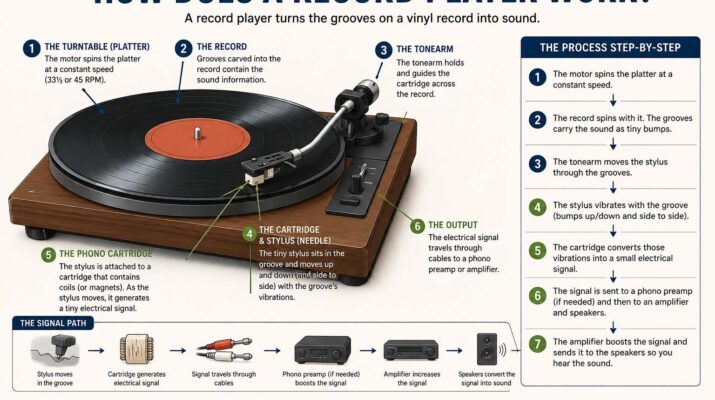
A record player converts physical movements stored in a vinyl record’s grooves into an electrical audio signal. An amplifier and speakers then turn that signal into audible music.
Here is the process, step by step:
- The motor rotates the platter at the correct speed.
- The stylus follows the tiny variations in the record’s grooves.
- The tonearm transfers the stylus’s movements to the cartridge.
- The cartridge converts those movements into an electrical signal.
- A phono preamp boosts the signal and applies the appropriate equalization.
- An amplifier supplies the power needed to drive the speakers.
- The speakers move air to reproduce the recorded music.
Each stage serves a specific purpose. Together, these components let a physical disc reproduce voices, instruments, and other recorded sounds.
Understanding the Main Components
Before exploring the playback process in detail, it helps to understand the parts that make a turntable work.
| Component | Main purpose |
|---|---|
| Platter | Supports and rotates the record |
| Motor | Supplies rotational power |
| Tonearm | Holds and guides the cartridge |
| Stylus (needle) | Traces the record’s grooves |
| Cartridge | Converts mechanical movement into an electrical signal |
| Phono preamp | Boosts and equalizes the signal |
| Amplifier | Provides the power needed for playback |
| Speakers | Convert electrical signals into sound waves |
Some turntables combine several functions in one unit. For example, a model with a built-in phono preamp needs fewer separate components than a traditional setup.
However, every record player still needs a way to rotate the record, read its grooves, and reproduce the resulting audio.
Step 1: The Motor Spins the Record
This steady rotation is an essential part of how does a record player work because it keeps playback speed consistent
The motor starts the process by rotating the platter. The record rests on this circular platform while the stylus follows its grooves.
Most vinyl records use one of three common playback speeds:
- 33⅓ RPM: Commonly used for full-length albums.
- 45 RPM: Often used for singles and certain special releases.
- 78 RPM: Used by many older shellac records.
Choosing the correct speed matters because rotation affects both pitch and timing. If a record spins too slowly, the music sounds lower in pitch. Conversely, excessive speed makes it sound faster and higher.
Many modern turntables use electronic speed controls to maintain consistent rotation. Belt-drive models transfer power through a belt, while direct-drive models connect the motor more directly to the platter.
Step 2: How Does a Record Player Needle Work?
The needle, more accurately called the stylus, reads the physical information stored in the record’s grooves. Manufacturers commonly use diamond tips because diamond resists wear and can accurately trace very small groove details.
The grooves are not smooth channels. Instead, they contain microscopic variations that correspond to the recorded audio. As the record rotates, the stylus follows these variations and moves in response.
The stylus does not independently recognize voices or instruments. Rather, it follows a physical pattern that represents the original sound.
For stereo records, the two groove walls carry the left and right audio channels. Consequently, the stylus and cartridge must track these variations accurately to reproduce the recording.
This mechanical process also helps explain why does vinyl sound better, a question that interests many music enthusiasts. Personal preference, mastering, playback equipment, and recording quality all influence how different formats sound.
Step 3: The Cartridge Converts Movement Into Electricity
The stylus cannot produce the full audio signal by itself. Instead, its movement passes through a small supporting component called the cantilever to the cartridge’s internal mechanism.
Most conventional phono cartridges use electromagnetic principles to convert this mechanical movement into an electrical signal.
Two common designs are moving magnet and moving coil cartridges.
Moving Magnet (MM) Cartridges
Moving magnet cartridges use a small magnet attached to the moving assembly. As the stylus follows the groove, the magnet moves relative to stationary coils, generating an electrical signal.
These cartridges are popular because they offer several practical advantages:
- Many models are relatively affordable.
- Replacement styli are available for numerous designs.
- They work with a wide range of phono preamps.
- They suit many beginner and intermediate turntables.
For these reasons, moving magnet cartridges are a practical starting point for many vinyl listeners.
Moving Coil (MC) Cartridges
Moving coil cartridges use a different arrangement. Instead of moving a magnet relative to stationary coils, the stylus moves small coils within a magnetic field.
Some MC cartridges offer excellent tracking and detailed reproduction. However, performance depends on the individual cartridge and the rest of the audio system, not simply its design category.
They also tend to cost more, and some models require a specialized phono preamp or additional amplification.
Therefore, compare cartridge compatibility, replacement costs, and setup requirements before choosing one.
Step 4: Why a Phono Preamp Is Essential
The electrical signal produced by a phono cartridge is much weaker than the standard line-level signal used by many audio devices. As a result, a typical turntable needs a phono preamp before it can connect properly to a regular amplifier or powered speakers.
A phono preamp performs two important functions.
First, it boosts the weak cartridge signal to a usable level. Second, it applies RIAA equalization, which reverses the standardized frequency adjustments used when cutting records.
During record production, engineers reduce low-frequency levels and boost high-frequency levels according to the RIAA recording curve. During playback, the phono stage reverses those changes to restore the intended tonal balance.
Without suitable equalization, the music can sound unusually thin and bright.
Some turntables include a built-in phono preamp. Others require an external unit or an amplifier with a dedicated phono input.
Before connecting your equipment, check whether the turntable’s output is set to PHONO or LINE. Connecting a phono-level output directly to an ordinary line-level input can result in very low volume.
For a further technical explanation of how vinyl grooves become sound, see Yamaha’s guide to how a vinyl record makes sound.
Step 5: The Amplifier and Speakers Reproduce the Music
This final stage completes how does a record player work by turning the electrical audio signal into audible music.
After the phono preamp prepares the signal, the audio travels to the amplifier or another suitable playback stage.
The amplifier supplies the electrical power needed to drive passive speakers. The speakers then convert that electrical energy into mechanical movement.
For example, a typical speaker driver uses a voice coil and magnetic field to move a cone or diaphragm. This movement creates pressure changes in the surrounding air, which reach your ears as sound.
Some systems use powered speakers with built-in amplification. In that setup, you may not need a separate amplifier.
The complete signal path can therefore look like this:
Vinyl record → Stylus → Cartridge → Phono preamp → Amplifier → Speakers
Although the signal passes through several components, each performs a specific task during playback.
Can a Record Player Damage Vinyl Records?
A properly adjusted turntable can play records repeatedly, but physical contact always creates some potential for wear. Careful setup and cleaning help minimize that risk.
The stylus must maintain stable contact with the groove without applying excessive tracking force. If the force is too low, the stylus may mistrack or skip. If it is too high, it can increase wear.
To protect your collection:
- Follow the cartridge manufacturer’s recommended tracking force.
- Keep the stylus and records clean.
- Check cartridge alignment when setting up the turntable.
- Replace a worn or damaged stylus.
- Handle records by their edges to limit fingerprints and surface contamination.
Dust, scratches, poor alignment, and unsuitable tracking force can all affect playback quality. Therefore, regular maintenance is more effective than waiting until you hear distortion.
Vinyl vs. Digital Audio: What’s the Difference?
Both vinyl and digital audio reproduce recorded music, but they store and process audio differently.
| Feature | Vinyl records | Digital audio |
|---|---|---|
| Storage method | Physical variations in grooves | Digitally encoded data |
| Playback | A stylus traces the grooves | Electronic circuitry reads and decodes data |
| Physical contact | Required during normal playback | Usually unnecessary |
| Common issues | Dust, scratches, stylus wear, speed variation | File errors, connection problems, or playback-device issues |
| Maintenance | Requires record and stylus care | Depends on the playback equipment and storage method |
Vinyl provides a physical listening experience, while digital formats offer convenient storage and access. However, neither format automatically guarantees better sound quality.
The recording and mastering, playback equipment, and listening environment all contribute to the result. Many listeners enjoy both formats for different reasons.
How Does a Bluetooth Record Player Work?
A Bluetooth turntable combines traditional vinyl playback with wireless audio transmission. The record still produces sound through the stylus and cartridge, but an additional transmitter sends the audio to compatible wireless speakers or headphones.
The process generally follows these steps:
- The platter rotates the record.
- The stylus follows the grooves.
- The cartridge generates an analog electrical signal.
- The phono stage prepares the signal when required.
- The Bluetooth transmitter encodes and sends the audio wirelessly.
- The receiving device decodes the signal and reproduces the music.
This arrangement reduces the need for speaker cables. However, Bluetooth introduces digital processing into the signal path, so the final sound depends on the transmitter, codec, receiving device, and other equipment.
Before purchasing a Bluetooth model, check whether it transmits audio to wireless speakers, receives audio from a phone, or supports both functions. These capabilities are not interchangeable.
Belt Drive vs. Direct Drive
The drive system determines how the motor rotates the platter. Most conventional turntables use either a belt-drive or direct-drive design.
Belt-Drive Turntables
A belt-drive turntable uses a belt to transfer the motor’s rotation to the platter.
Potential advantages include:
- Mechanical isolation that can help reduce motor vibration.
- A design commonly used for home listening.
- Straightforward operation on many models.
However, belts can stretch or wear over time. When that happens, the turntable may need a replacement belt to maintain proper speed.
Direct-Drive Turntables
A direct-drive turntable couples the motor more directly to the platter.
Its advantages often include:
- Fast startup.
- Convenient speed changes on suitable models.
- Strong performance for cueing and DJ use.
- No drive belt to replace.
Direct drive does not automatically guarantee better sound, just as belt drive does not guarantee lower noise. Motor design, speed stability, isolation, and overall construction all matter.
Choose the system that best matches your listening habits and budget.
Common Record Player Problems and Fixes
Even a well-maintained turntable can develop playback problems. Fortunately, many common issues have straightforward causes.
| Problem | Possible cause | What to check |
|---|---|---|
| Skipping | Dirty record, damaged stylus, or incorrect tracking force | Clean the record and inspect the setup |
| Distorted sound | Worn stylus, alignment problems, or damaged grooves | Check the stylus and cartridge alignment |
| Low volume | Missing phono preamp or incorrect input setting | Check the PHONO/LINE setting and amplifier input |
| Incorrect speed | Wrong RPM selection or a drive-system issue | Select the correct speed and inspect the belt if applicable |
| Excessive crackling | Dust, static, scratches, or groove wear | Clean the record and inspect its condition |
| No sound | Loose connections or an incorrect signal path | Check cables, input settings, and power |
Start with simple checks before replacing components. For instance, a low-volume problem may require only the correct input setting rather than a new amplifier.
If the issue persists, consult the manufacturer’s instructions for your particular turntable and cartridge.
Record Player Maintenance for Better Sound
Regular care helps preserve your equipment and records. A few simple habits can also reduce noise and improve tracking.
Clean Your Records
Use a suitable record-cleaning brush to remove loose dust before listening. For deeper cleaning, choose a method designed for vinyl and follow the product instructions.
Store records in appropriate inner sleeves and return them to their covers after use. In addition, avoid touching the playing surface unnecessarily.
Inspect and Clean the Stylus
Dust can accumulate on the stylus and interfere with accurate tracking. Use a stylus brush or cleaning method recommended by the manufacturer.
Always handle the assembly carefully. Never push sideways against the stylus, as this can damage the delicate cantilever.
Replace the stylus according to its condition and the manufacturer’s guidance rather than waiting for severe distortion.
Keep the Turntable Level
Place the turntable on a stable, level surface. This helps the tonearm track the groove consistently.
Also, avoid placing it on unstable furniture or near speakers that cause excessive vibration. If your turntable has adjustable feet, follow the manufacturer’s leveling instructions.
Check the Drive System
For belt-drive models, inspect the belt if the platter struggles to start or maintain speed. For direct-drive models, follow the manufacturer’s maintenance guidance instead of attempting unnecessary internal adjustments.
Record Player Features to Consider Before Buying
Modern record players offer a variety of features, but the best choice depends on your needs.
Consider these options before making a purchase:
- Built-in phono preamp: Simplifies connection to equipment without a dedicated phono input.
- Bluetooth output: Sends audio to compatible wireless speakers or headphones.
- USB output: Allows supported models to send audio to a computer for recording.
- Adjustable tracking force: Helps users set up compatible cartridges correctly.
- Replaceable stylus: Makes routine maintenance easier.
- Auto-stop or automatic return: Adds convenience at the end of playback.
- Speed selection: Supports the record formats you plan to play.
A beginner does not necessarily need every feature. Instead, prioritize reliable speed control, a suitable cartridge, straightforward setup, and compatibility with your existing speakers or amplifier.
How Record Player Signal Processing Works
Record players combine mechanical precision with electrical signal processing. The cartridge generates a small signal, and the phono stage prepares it for the rest of the audio system.
Likewise, many other technologies convert physical or electrical changes into useful information. For example, learning what is a solenoid introduces another application of electromagnetic principles.
Communication systems use different methods to represent and transmit information. Similarly, how does morse code work explains how patterns of short and long signals can communicate messages.
These technologies serve different purposes, but each illustrates how carefully controlled physical signals can carry meaningful information.
Record Player FAQs
How does a record player work?
A record player spins a vinyl record while a stylus traces its grooves. The cartridge converts the stylus’s movement into an electrical signal, which the phono stage and amplifier prepare for the speakers. The speakers then reproduce the recorded music as sound waves.
Does the stylus damage vinyl records?
A correctly installed stylus with suitable tracking force can play records with relatively little wear. However, repeated playback can gradually wear both the stylus and the record. Dirt, scratches, poor alignment, and incorrect tracking force can increase the risk of damage.
Can Bluetooth reduce sound quality?
Bluetooth can affect sound quality because the system may encode and compress audio before transmission. The result depends on the codec, equipment, and settings. A wired connection avoids Bluetooth transmission, although the overall quality still depends on the complete audio system.
Why do vinyl records crackle?
Crackling can result from dust, static electricity, scratches, damaged grooves, or a dirty stylus. Start by cleaning the record and stylus appropriately. If the noise continues, inspect the record for damage.
How long does a record player stylus last?
Stylus lifespan varies with its design, condition, maintenance, and usage. Follow the cartridge manufacturer’s replacement guidance, and inspect the stylus if you notice distortion, skipping, or changes in playback quality.
Do all record players need a separate amplifier?
No. Some record players include built-in amplification and speakers, while others connect to powered speakers. A traditional turntable generally needs compatible amplification and speakers, as well as a suitable phono stage when the signal path requires one.
Getting the Best Performance From Your Record Player
Understanding how does a record player work starts with knowing how the stylus, cartridge, and amplifier work together to reproduce music.
Knowing how does a record player work also helps you maintain your equipment and identify common playback problems
Understanding the mechanics behind vinyl playback makes it easier to appreciate the engineering involved. The platter maintains rotation, the stylus follows the grooves, and the cartridge converts microscopic movements into an electrical signal.
From there, the phono preamp, amplifier, and speakers complete the journey from physical information to audible music.
With proper setup, careful cleaning, and suitable equipment, you can enjoy your records while reducing unnecessary wear. Whether you prefer a traditional wired system or a modern Bluetooth turntable, understanding each component helps you choose the right equipment and get more from your vinyl collection.