
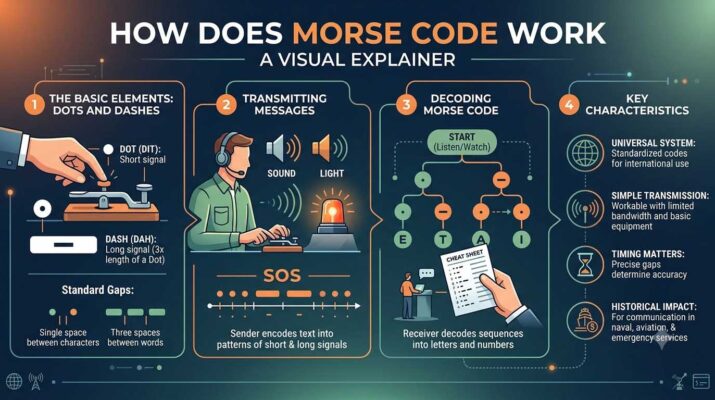
Imagine sending a message using only short and long signals. There’s no keyboard, touchscreen, or spoken language—just a pattern of sounds, flashes, or taps. That’s exactly how Morse code works. If you’re wondering how does morse code work, the answer is simple: it converts letters, numbers, and certain punctuation marks into patterns of dots and dashes.
Although Morse code dates back to the 19th century, people still recognize and use it today. For example, amateur radio operators, emergency communication enthusiasts, and historians continue to study the system. It also offers a practical way to explore how simple signals can carry meaningful information.
In this guide, you’ll learn how to send and receive Morse code, understand its timing rules, and recognize common signals such as SOS.
What Is Morse Code?
Morse code is a communication system that represents letters, numbers, and selected punctuation marks through combinations of two basic signals:
- Dot (·): A short signal.
- Dash (–): A longer signal.
Each character has a specific pattern. For example, the letter A uses a dot followed by a dash, while B uses a dash followed by three dots.
| Character | Morse Code |
|---|---|
| A | · – |
| B | – · · · |
| C | – · – · |
| S | · · · |
| O | – – – |
| 1 | · – – – – |
| 5 | · · · · · |
These patterns allow people to transmit messages using different methods, including sound, light, radio signals, and physical taps.
Morse code is a coding system rather than a separate spoken language. In the same way that basic coding concepts use defined symbols and rules to represent information, Morse code follows a consistent system that receivers can learn and interpret.
How Does Morse Code Work?
The process involves three main steps: encoding a message, transmitting its signals, and decoding the result.
First, the sender converts each character into its corresponding dot-and-dash pattern. Next, the sender transmits those signals in the correct order. Finally, the receiver interprets the patterns and reconstructs the original message.
Consider the word CAT:
- C = – · – ·
- A = · –
- T = –
The sender transmits each letter in sequence, leaving the appropriate gaps between characters. Meanwhile, the receiver listens to the signals or watches them and identifies each pattern.
For example, someone who knows Morse code can recognize the sequence for CAT without hearing the word spoken aloud. The system works because both people follow the same standardized code.
The International Telecommunication Union maintains the international standard for Morse code characters. You can consult its official International Morse Code recommendation for the recognized character patterns and operational provisions.
Why Timing Matters
Morse code depends on timing as much as it depends on dots and dashes. Without consistent pauses, a receiver may struggle to identify where one character ends and the next begins.
The standard timing system uses a dot as its basic unit.
| Signal or pause | Relative length |
|---|---|
| Dot | 1 unit |
| Dash | 3 units |
| Gap between parts of one character | 1 unit |
| Gap between letters | 3 units |
| Gap between words | 7 units |
For example, a dash lasts three times as long as a dot. Similarly, the pause between words lasts longer than the pause between letters.
As a result, a clear rhythm makes messages easier to understand. Accurate timing also matters in other communication technologies, including what is telemetry, where systems transmit and interpret information through signals and data.
Understanding Morse Code Through an Example
One of the easiest ways to understand the system is to examine a short message.
Take the word HI:
- H = · · · ·
- I = · ·
The sender transmits four short signals for H, pauses briefly, and then sends two short signals for I.
The receiver identifies each character by its pattern and spacing. Therefore, both people can exchange the message without using spoken words.
However, the receiver needs to understand the code beforehand. Morse code does not automatically translate unfamiliar languages; it represents characters that the receiver must recognize.
How Does Morse Code Work With Tapping?
Morse code can transmit information through tapping instead of electronic equipment or radio signals. The sender creates short and long taps on a suitable surface, while the receiver listens for the patterns.
For example:
- Short tap = Dot
- Long tap = Dash
A well-known distress signal uses this sequence:
SOS: · · · – – – · · ·
A person can tap three short signals, three long signals, and three short signals, using clear pauses to separate the groups.
Because tapping requires little or no equipment, it can be useful when other communication methods are unavailable. Nevertheless, the sender and receiver must agree on the signal patterns and maintain clear timing.
How Does Morse Code Work With Lights?
Morse code can also communicate information through flashes of light. Instead of producing sounds, the sender switches a light on and off for different durations.
Common examples include:
- Flashlights
- Signal lamps
- Ship signaling lights
- Other suitable light sources
A short flash represents a dot, while a longer flash represents a dash. The character patterns and spacing remain the same, regardless of the transmission method.
For instance, a sender could use a flashlight to transmit SOS at night. Meanwhile, someone watching from a distance could interpret the sequence if they understand Morse code and can see the flashes clearly.
However, visibility matters. Fog, obstacles, bright surroundings, and excessive distance can make light signals difficult to recognize.
What Is the SOS Signal?
SOS is one of the best-known Morse code signals because of its association with distress calls.
Its pattern is:
· · · – – – · · ·
That means three dots, three dashes, and three dots, sent as one continuous sequence with the appropriate timing between signal elements.
People often associate SOS with the phrase “Save Our Souls,” but the letters were selected primarily because the signal is distinctive and easy to transmit.
Although SOS is widely recognized, it does not replace modern emergency communication procedures. In an actual emergency, use the available local emergency services and established distress-signaling methods whenever possible.
How Morse Code Was Originally Sent
Morse code became closely associated with electrical telegraphy during the 19th century. Early telegraph systems allowed operators to send coded messages over wires, making long-distance communication much faster than physically delivering written messages.
The process worked through a telegraph key. When an operator pressed the key, the device completed an electrical circuit and sent a signal along the wire.
A brief press represented a dot, while a longer press represented a dash. At the receiving end, another operator interpreted the incoming pattern and converted it into text.
This technology helped transform communication across long distances. It also demonstrated why reliable electrical connections matter: a working circuit allows electrical signals to travel between connected points. Understanding what is continuity can help explain this basic principle.
Modern Uses of Morse Code
Today, smartphones, computers, and digital networks handle most everyday communication. Even so, Morse code remains relevant in several areas.
Common uses and applications include:
- Amateur radio: Some radio enthusiasts use Morse code to communicate with other operators.
- Education: Teachers use it to demonstrate encoding, signaling, and communication history.
- Historical study: Museums and historians explore its role in the development of telecommunications.
- Emergency preparedness: Some people learn simple signaling methods as an additional communication skill.
- Hobbies: Enthusiasts practice decoding messages, participating in radio activities, and learning the alphabet.
Morse code is not a universal replacement for modern communication systems. Instead, it offers a specialized method that remains useful to people who study or practice it.
Modern electronics have developed far beyond telegraph machines. For instance, learning what is a bootloader helps explain how modern devices prepare their systems before running software.
How to Read Morse Code
Learning how does Morse code work becomes easier when you start with a small group of common letters. Rather than memorizing the entire alphabet at once, practice a few patterns until you can recognize them quickly.
Here are eight useful letters to begin with:
| Letter | Morse code |
|---|---|
| E | · |
| T | – |
| A | · – |
| N | – · |
| I | · · |
| M | – – |
| S | · · · |
| O | – – – |
First, learn to recognize each pattern visually. Then, listen to audio examples and try identifying the letters without looking at the answers.
As your confidence improves, practice short words and simple sentences. Over time, you can focus more on recognizing the rhythm instead of counting individual dots and dashes.
How to Write Morse Code
Writing Morse code involves reversing the reading process. Start with a word, identify each letter, and replace it with its corresponding pattern.
For example, consider DOG:
- D = – · ·
- O = – – –
- G = – – ·
The written message is:
– · · / – – – / – – ·
The slashes separate the letters for easier reading. In actual transmission, the sender uses timing gaps rather than literal slashes.
Similarly, spaces between words help distinguish one word from another. Without proper separation, even correct patterns can become difficult to interpret.
Advantages of Morse Code
Morse code offers several practical benefits, especially in situations where simple signaling is useful.
It Works With Simple Equipment
Morse code does not require a smartphone or computer. Depending on the circumstances, a person can transmit it through sound, light, tapping, or suitable radio equipment.
It Supports Alternative Communication
When speaking is impractical, a person may be able to communicate through flashes or taps. However, this depends on visibility, audibility, distance, and the receiver’s knowledge of the code.
It Can Be Effective for Radio Communication
Morse code can work well in certain radio conditions, including situations where operators need to communicate using relatively narrow signal bandwidths. Therefore, some amateur radio operators continue to practice it.
It Teaches Structured Communication
Learning Morse code encourages attention to patterns, timing, and accuracy. These skills can also introduce beginners to broader ideas about how communication systems encode information.
Disadvantages of Morse Code
Despite its advantages, Morse code has limitations.
It Takes Practice to Learn
Beginners need time to recognize characters and understand their rhythms. Reading individual symbols is only the first step; fluent recognition requires continued practice.
It Can Be Slower Than Modern Messaging
For everyday communication, typing a message is often more convenient. Sending and decoding Morse code manually can take longer, especially for people who are still learning.
Timing Errors Can Cause Confusion
A dot that lasts too long or a pause that falls in the wrong place can make a message difficult to understand. Consequently, clear timing is essential.
Both People Need to Understand the System
Morse code only works when the sender and receiver share an understanding of its patterns. Someone unfamiliar with the code may hear or see the signals without knowing what they mean.
Beginner Tips for Learning Morse Code
If you want to learn Morse code, consistent practice is more helpful than trying to memorize everything in one session.
Start With a Few Letters
Begin with simple patterns such as E, T, I, M, S, and O. Once you can recognize them comfortably, add more letters and numbers.
Practice Every Day
Even five to ten minutes of focused practice can help you build familiarity. Short sessions also make it easier to maintain a regular learning routine.
Listen to the Rhythm
Try recognizing characters by their sound instead of counting every dot and dash. This approach helps you become more comfortable with real transmissions.
Practice With Familiar Words
Use your name, city names, or short everyday words. Because you already know the answers, you can focus on learning the patterns.
Improve Accuracy Before Speed
Start slowly and maintain clear timing. Then, gradually increase the speed as your recognition improves.
Common Mistakes Beginners Make
New learners often make a few predictable mistakes. Fortunately, you can correct most of them with deliberate practice.
- Ignoring timing: Remember that the gaps between signals and letters carry meaning.
- Learning too many characters at once: Start with small groups and expand gradually.
- Practicing too quickly: Focus on accurate patterns before increasing speed.
- Forgetting word spaces: Use suitable pauses to separate words clearly.
- Relying only on written charts: Practice listening as well, because real signals are often recognized through rhythm.
By correcting these habits early, you can build a stronger foundation and avoid confusion as messages become longer.
Frequently Asked Questions
How does Morse code work?
Morse code represents letters, numbers, and selected punctuation marks through combinations of short signals called dots and longer signals called dashes. The receiver identifies the patterns and uses timing to separate characters and words.
Is Morse code difficult to learn?
Morse code is relatively simple to begin learning, but becoming fluent takes practice. Start with a few common letters, then gradually work toward complete words and sentences.
Why is SOS so famous?
SOS is widely recognized as a distress signal. Its Morse code pattern—three dots, three dashes, and three dots—is distinctive and can be transmitted through sound, light, or other suitable signaling methods.
Can Morse code be sent without electronics?
Yes. People can transmit Morse code through tapping, flashing lights, or other methods that produce distinguishable short and long signals. However, the receiver must be able to detect and interpret those signals.
Do people still use Morse code today?
Yes. Some amateur radio operators, educators, historians, and hobbyists continue to use or study it. Although it no longer serves as a primary communication method for most people, it remains a recognized signaling system.
A Simple Communication System That Still Matters
Understanding Morse code reveals how a small set of signals can communicate meaningful information. Each character has a defined pattern, while timing helps the receiver distinguish letters and words.
Whether you transmit dots and dashes through sound, light, radio, or tapping, the underlying principle stays the same. Both participants need to understand the code and recognize the signals accurately.
Although modern communication technology offers faster and more convenient options, Morse code remains an important part of communication history. It also provides an accessible way to explore encoding, signaling, and the basic principles behind reliable information exchange.