
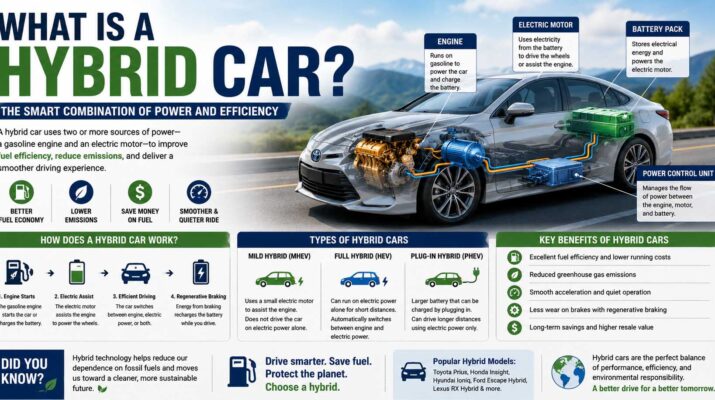
If you are shopping for a fuel-efficient vehicle, you may be wondering, what is a hybrid car and how is it different from a regular gasoline or electric vehicle? A hybrid car combines an internal-combustion engine with one or more electric motors and a battery. Instead of relying entirely on gasoline or electricity, the vehicle manages these power sources to improve efficiency while providing the range and convenience people expect from a conventional car.
That basic idea sounds simple, although modern hybrid systems can be surprisingly sophisticated. The car may drive on electric power, use its gasoline engine, or combine both depending on speed, battery charge, acceleration, temperature, and driving conditions.
Meanwhile, regenerative braking can recover some energy that would otherwise be lost during slowing. As a result, many hybrids can reduce fuel use without requiring the driver to completely change everyday driving habits.
What Is a Hybrid Car?
A hybrid car is a vehicle that uses at least two forms of propulsion, most commonly a gasoline engine paired with an electric motor and rechargeable battery.
In practical terms, the electric system assists or temporarily replaces the gasoline engine when doing so improves efficiency. For instance, some hybrids can move at lower speeds using electricity alone. When stronger acceleration is needed, the gasoline engine can start and work with the electric motor.
So, what is a hybrid car mean in everyday driving? Essentially, it means you have a vehicle that can intelligently switch between or combine gasoline and electric propulsion rather than depending exclusively on one energy source.
Unlike a battery-electric vehicle, a conventional hybrid does not normally need to be plugged into a charger. Instead, it generates and recovers electrical energy while being driven.
How Does a Hybrid Car Work?
A hybrid powertrain coordinates several components rather than treating the engine and electric motor as completely separate systems.
Although designs differ among manufacturers, most hybrids contain:
- An internal-combustion engine
- One or more electric motors
- A high-voltage traction battery
- Power electronics
- A transmission or power-split mechanism
- Regenerative braking
- A computerized energy-management system
When you start driving, the vehicle’s computer determines the most efficient way to provide the requested power.
For example, a full hybrid may use its electric motor during gentle low-speed driving. Then, as power demand rises, the gasoline engine can start automatically. Under hard acceleration, both systems may provide power together.
Engine speed also changes according to load and drivetrain design, so understanding what is rpm can help explain why a hybrid’s engine may sound different from that of a conventional vehicle during acceleration.
Regenerative braking recovers energy
Regenerative braking is one of the key technologies behind hybrid efficiency.
In a conventional car, braking converts much of the vehicle’s kinetic energy into heat through friction. In contrast, a hybrid can use its electric motor as a generator during deceleration.
Therefore, some of the vehicle’s motion gets converted back into electrical energy and stored in the traction battery.
However, regenerative braking cannot recover all the energy used to accelerate the vehicle. Friction brakes are still necessary for strong braking, low-speed stopping, emergencies, and situations where regeneration is limited.
What Is a Hybrid Car Battery?
Hybrid vehicles normally have a high-voltage traction battery that supplies energy to the electric motor. They also commonly use a separate low-voltage electrical system for accessories and vehicle electronics.
The traction battery is much larger and more powerful than a conventional starter battery, although it is generally smaller than the battery pack found in a fully electric vehicle.
The vehicle’s control system manages the battery automatically. Consequently, drivers of conventional hybrids generally do not need to manually decide when the battery should charge or discharge.
When comparing electrical components in vehicles, you may also encounter discussions about alternator vs generator because conventional and electrified powertrains can handle electricity generation differently.
Main Types of Hybrid Cars
Not every vehicle carrying a “hybrid” badge operates in the same way. Therefore, understanding the major categories is useful before buying one.
| Hybrid type | Electric-only driving | Plug-in charging | Main purpose |
|---|---|---|---|
| Mild hybrid | Usually little or none | No | Assist gasoline engine |
| Full hybrid | Yes, under some conditions | No | Reduce fuel consumption |
| Plug-in hybrid | Yes, generally farther | Yes | Combine EV-style driving with an engine |
What Is a Mild Hybrid Car?
If you are asking what is a mild hybrid car, think of it as a gasoline-powered vehicle with stronger electrical assistance.
A mild-hybrid system may help the engine during acceleration, improve stop-start operation, recover energy during braking, and power electrical systems more efficiently.
However, most mild hybrids cannot propel the vehicle for meaningful distances using electricity alone.
Therefore, mild hybrids generally provide a smaller step toward electrification than full hybrids.
Full hybrid
A full hybrid can usually operate using the engine, electric motor, or a combination of both.
At suitable speeds and loads, the vehicle may temporarily move with its gasoline engine switched off. Then, when more power is needed or battery conditions require it, the engine starts automatically.
This seamless switching is one reason conventional hybrids are easy for beginners. In most situations, the driver simply operates the vehicle normally while the control system handles energy management.
What Is a Plug In Hybrid Car?
Commonly abbreviated as PHEV, a plug-in hybrid combines an internal-combustion engine with a larger rechargeable battery that can receive energy from an external charging source.
Because its battery is generally larger than a conventional hybrid battery, a PHEV can typically travel farther using electricity alone.
For people with predictable daily commutes and convenient charging, that arrangement can allow many routine trips to use mostly electric energy. Meanwhile, the gasoline engine remains available for longer journeys.
However, real-world efficiency depends heavily on charging habits. If a driver rarely plugs in a PHEV, they may miss much of the benefit that its larger battery was designed to provide.
Hybrid vs Gasoline vs Electric Cars
The best powertrain depends on where you drive, how far you travel, and whether convenient charging is available.
| Feature | Gasoline Car | Hybrid | Battery EV |
|---|---|---|---|
| Gasoline engine | Yes | Yes | No |
| Electric traction motor | Usually no | Yes | Yes |
| External charging required | No | Only PHEVs | Yes |
| Regenerative braking | Usually no | Yes | Yes |
| Tailpipe emissions | Yes | Yes when engine operates | None |
| Fuel station use | Yes | Yes | No |
| Charging infrastructure dependence | No | Low to moderate | Higher |
A conventional hybrid can make sense for drivers who want better fuel efficiency without routinely connecting the vehicle to a charger.
Meanwhile, an EV may suit someone who has reliable home charging and wants fully electric driving. A PHEV sits between those options, although it provides its strongest advantage when charged regularly.
Why Hybrid Cars Can Be More Fuel Efficient
Hybrid systems improve efficiency in several ways.
First, an electric motor can assist the gasoline engine when extra power is required. As a result, manufacturers can design the powertrain to operate efficiently across common driving conditions.
Second, regenerative braking captures part of the vehicle’s kinetic energy during deceleration.
Third, a hybrid can shut off its engine when gasoline power is unnecessary. For instance, certain full hybrids can move through slow traffic electrically for short periods.
Therefore, hybrids often perform especially well in stop-and-go driving, where repeated braking creates opportunities for energy recovery.
Your driving style still matters, though. Rapid acceleration, high speeds, heavy loads, extreme temperatures, and other conditions can affect fuel economy.
What Does Driving a Hybrid Feel Like?
For most drivers, operating a hybrid feels much like driving a conventional automatic vehicle.
You press the accelerator and brake normally, while the computer handles transitions between electric and gasoline power. However, you may notice that the engine shuts off more frequently or that the vehicle moves silently at low speeds.
Braking can also feel slightly different because the system blends regenerative and friction braking.
Meanwhile, features unrelated to the hybrid powertrain generally operate normally. For example, if you want to understand how does cruise control work, the basic purpose remains maintaining or managing vehicle speed, although modern hybrid models may pair it with adaptive driver-assistance technology.
Some hybrids use continuously variable or electronically controlled power-split transmissions. Consequently, engine sound may not rise and fall exactly as drivers expect from a traditional stepped automatic transmission.
Advantages of Hybrid Cars
One of the biggest benefits is reduced gasoline consumption compared with a similar conventional vehicle, although the exact savings vary considerably by model and driving conditions.
Hybrids can also provide convenient electrification without requiring conventional hybrid owners to install home charging equipment.
Another advantage is energy recovery. Instead of wasting most braking energy as heat, regenerative braking can return part of it to the traction battery.
Likewise, electric motors provide strong torque from low speeds, which can make acceleration feel smooth and responsive.
For drivers who are not ready for a fully electric car, a hybrid can serve as a practical middle ground.
Disadvantages to Consider
Hybrid technology also brings trade-offs.
For one, a hybrid can cost more than a comparable non-hybrid model. Whether fuel savings compensate for the difference depends on purchase price, fuel prices, annual mileage, ownership period, and real-world efficiency.
The powertrain is also more complex because it combines combustion and electrical components. Although modern hybrids are designed for long-term use, specialized components can be expensive if they eventually require replacement outside warranty coverage.
A hybrid still uses gasoline as well. Therefore, conventional hybrids do not eliminate tailpipe emissions.
Plug-in hybrids create another consideration: charging. A PHEV may be less compelling if the owner has no convenient way to recharge it regularly.
Hybrid Cars and Different Drivetrain Layouts
Being a hybrid does not automatically tell you which wheels receive power.
Hybrid vehicles can use front-wheel drive, rear-wheel drive, or all-wheel-drive configurations. Some models create all-wheel drive mechanically, while others use an electric motor to power a second axle.
As a result, buyers comparing traction systems may also want to understand what’s the difference between awd and 4wd, since those terms describe drivetrain arrangements rather than whether a vehicle is hybrid.
Likewise, hybridization does not dictate a single transmission design. Some systems use planetary power-split arrangements, while other electrified vehicles use conventional-style transmissions or different dedicated hybrid designs.
Drivers familiar with manual vehicles may wonder how does a clutch work and whether hybrids use one. The answer depends on the particular powertrain, since hybrid transmission designs vary significantly between manufacturers.
Is a Hybrid Car Right for You?
A hybrid may make sense if you regularly drive in city or mixed conditions and want to reduce fuel consumption without depending entirely on charging infrastructure.
A conventional full hybrid is especially convenient for drivers who cannot charge at home because the vehicle manages its own traction-battery energy during normal operation.
Meanwhile, a plug-in hybrid may suit someone who can charge regularly, drives shorter daily distances, yet still wants a gasoline engine available for longer trips.
However, don’t buy based on the word “hybrid” alone. Compare official efficiency ratings, purchase price, warranty coverage, cargo space, driving characteristics, insurance costs, and your expected annual mileage.
Also consider how long you plan to keep the vehicle. A higher purchase price becomes easier to evaluate when you compare total ownership costs rather than fuel economy alone.
Frequently Asked Questions
What is a hybrid car in simple terms?
A hybrid car combines an internal-combustion engine with an electric motor and battery. Depending on the design, the electric system can assist the engine or propel the car without the engine for limited periods.
Does a hybrid car need to be plugged in?
A conventional hybrid does not normally need external charging. However, a plug-in hybrid is designed to connect to an external electricity source so its larger battery can be recharged.
Can a hybrid drive without gasoline?
Some full hybrids can drive short distances or operate briefly using electricity alone. A plug-in hybrid can generally travel farther electrically. However, conventional hybrids and PHEVs still rely on their combustion engines under certain conditions.
What happens when a hybrid battery gets low?
The vehicle’s energy-management system controls the battery automatically. In a conventional hybrid, the engine and regenerative braking can provide energy as needed while the system keeps the battery within its intended operating range.
Is a hybrid the same as an electric car?
No. A hybrid retains an internal-combustion engine, whereas a battery-electric vehicle uses electric motors without a gasoline or diesel engine.
Choosing the Right Kind of Electrified Car
Understanding what is a hybrid car becomes easier once you stop thinking of “hybrid” as one specific technology. Mild hybrids mainly assist the engine, full hybrids can use electric propulsion more extensively, and plug-in hybrids add external charging and a larger battery.
Before buying, consider where you drive, your daily mileage, fuel costs, access to charging, and how long you expect to own the vehicle. Then compare actual models rather than assuming every hybrid delivers the same benefits.
For many drivers, the appeal is straightforward: a hybrid can reduce gasoline use while keeping the familiar flexibility of an internal-combustion engine.