
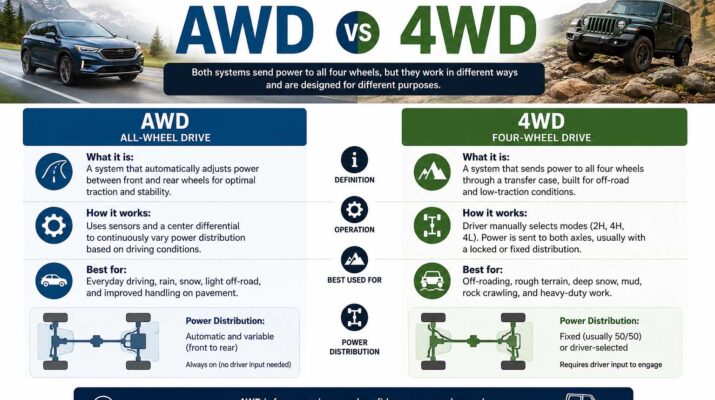
If you’ve ever shopped for an SUV or truck, you’ve probably wondered what’s the difference between AWD and 4WD. At first glance, both systems send power to all four wheels, so they sound almost identical. In reality, they are designed for different driving situations and offer different advantages.
For most everyday drivers, an all-wheel drive (AWD) vehicle provides better traction on wet roads, snow, and light gravel without requiring any driver input. Four-wheel drive (4WD), on the other hand, is built for challenging off-road conditions where maximum traction is essential.
Understanding how these systems work can help you choose a vehicle that matches your driving habits, climate, and budget.
What’s the Difference Between AWD and 4WD?
The biggest difference is how power reaches the wheels and when it happens.
| Feature | AWD | 4WD |
|---|---|---|
| Primary Purpose | Everyday driving | Off-road driving |
| Driver Control | Automatic | Usually driver selectable |
| Best For | Rain, snow, icy roads | Mud, rocks, deep snow, sand |
| Transfer Case | Usually no | Yes |
| Low-Range Gear | No | Often included |
| Fuel Economy | Generally better | Usually lower |
| Typical Vehicles | Crossovers, SUVs, sedans | Trucks, off-road SUVs |
Although both improve traction, they are engineered for different environments.
How AWD Works
All-wheel drive constantly monitors wheel grip using electronic sensors. If one wheel begins slipping, the system automatically redirects power to wheels with better traction.
Modern AWD systems combine several technologies, including:
- Wheel speed sensors
- Electronic stability control
- Traction control
- Computer-controlled differentials
Because everything happens automatically, the driver usually doesn’t need to press any buttons or change driving modes.
This makes AWD an excellent option for commuters who regularly drive through rain, snow, or changing road conditions.
How 4WD Works
Four-wheel drive is traditionally designed for vehicles expected to travel well beyond paved roads.
A typical 4WD system includes a transfer case that distributes power equally between the front and rear axles. Many systems also include a low-range gear (4L), which provides extra torque for steep climbs, deep mud, or rocky terrain.
Most traditional systems allow the driver to choose between modes such as:
- 2H (Two-Wheel Drive)
- 4H (Four-Wheel Drive High)
- 4L (Four-Wheel Drive Low)
Unlike AWD, these settings usually require manual selection before entering difficult terrain.
What’s the Difference Between a 4WD and an AWD in Daily Driving?
When people ask what’s the difference between a 4wd and an awd, they’re usually trying to decide which system makes more sense for everyday use.
For city streets and highways, AWD is generally the better choice because:
- It works automatically.
- It handles changing weather well.
- It improves confidence on slippery pavement.
- It requires very little driver knowledge.
A 4WD vehicle can certainly drive on paved roads, but its extra hardware adds weight and complexity that many daily drivers simply don’t need.
AWD Advantages
AWD offers several benefits for regular drivers.
Better Road Traction
Rain, ice, and light snow reduce tire grip. AWD automatically transfers power where it’s needed most, helping maintain stability.
Easy to Use
There are no buttons to press or modes to select. Everything operates in the background.
Better Cornering Stability
Many modern AWD systems improve handling by adjusting power between wheels during turns.
Good for Mixed Weather
Drivers living in regions with changing seasons often appreciate AWD because it performs well throughout the year.
If you’re also curious about how engine speed affects vehicle performance, our guide on what is rpm explains why RPM plays an important role in power delivery and efficiency.
4WD Advantages
Although AWD is convenient, 4WD shines when roads disappear altogether.
Excellent Off-Road Capability
Mud, sand, steep hills, and rocky trails demand maximum traction.
A true 4WD system is specifically designed for these environments.
Low-Range Gearing
Low-range gears multiply torque, allowing slow, controlled movement over difficult obstacles.
Better for Heavy Work
Construction sites, farms, forest roads, and towing heavy loads often benefit from a traditional 4WD system.
AWD Disadvantages
No drivetrain is perfect.
Some drawbacks of AWD include:
- Higher purchase price
- Slightly lower fuel economy than front-wheel drive
- More components that may require maintenance
- Less capable during extreme off-road driving
4WD Disadvantages
Four-wheel drive also has trade-offs.
Common disadvantages include:
- Heavier drivetrain
- Higher maintenance costs
- Reduced fuel efficiency
- Less comfortable for everyday commuting
- Requires driver knowledge to use correctly
What’s the Difference Between FWD, RWD, AWD, and 4WD?
Another common question is what’s the difference between fwd rwd awd and 4wd.
Here’s a quick comparison.
| Drivetrain | Power Goes To | Best Use |
| FWD | Front wheels | Daily commuting |
| RWD | Rear wheels | Performance, towing |
| AWD | All wheels automatically | All-weather driving |
| 4WD | All wheels when selected | Serious off-road driving |
Front-wheel drive is the simplest and most fuel-efficient option.
Rear-wheel drive often provides better balance for sports cars and trucks.
AWD balances convenience with improved traction.
4WD focuses on maximum capability away from paved roads.
Which Vehicles Usually Have AWD?
AWD has become extremely popular in:
- Compact SUVs
- Crossovers
- Luxury sedans
- Performance cars
- Electric vehicles
Manufacturers often include AWD as an optional upgrade on higher trim levels.
Which Vehicles Usually Have 4WD?
You’ll usually find 4WD on vehicles designed for demanding work or adventure.
Examples include:
- Pickup trucks
- Large body-on-frame SUVs
- Off-road vehicles
- Utility vehicles
- Expedition vehicles
These vehicles are built to withstand rough terrain where AWD systems may struggle.
Which System Is Better in Snow?
This question doesn’t have a one-size-fits-all answer.
For plowed roads and winter commuting, AWD is usually more practical because it reacts automatically to slippery surfaces.
For deep snow, unplowed roads, or mountain trails, 4WD often performs better because of its low-range gearing and stronger mechanical components.
No matter which system you choose, winter tires remain one of the biggest factors in maintaining traction.
Does AWD Replace Winter Tires?
No.
Many people assume AWD alone guarantees safe winter driving.
In reality:
- AWD helps the vehicle move forward.
- Winter tires improve acceleration.
- Winter tires also improve braking.
- Winter tires improve steering control.
Even the best AWD system cannot overcome poor tire grip.
What’s the Difference Between a AWD and 4WD for Towing?
People also search for what’s the difference between a awd and 4wd when towing trailers.
Both systems can tow effectively, but 4WD vehicles generally have higher towing capacities because they’re often built on stronger truck platforms.
If you regularly tow boats, campers, or heavy trailers, vehicle design matters just as much as drivetrain choice. For boat owners, understanding inboard vs outboard engines can also help when matching a tow vehicle to your trailer’s weight and intended use.
Maintenance Tips
Whether you own AWD or 4WD, proper maintenance keeps the drivetrain working efficiently.
Regular maintenance includes:
- Rotating tires on schedule
- Checking differential fluids
- Inspecting transfer case fluid (4WD)
- Maintaining proper tire pressure
- Replacing worn tires as a complete set when recommended
Uneven tire wear can confuse electronic AWD systems and increase drivetrain stress.
Common Myths About AWD and 4WD
Myth: AWD Is Always Better
Not necessarily.
AWD is better for everyday driving, while 4WD is better for demanding off-road conditions.
Myth: 4WD Can Be Used Everywhere
Some part-time 4WD systems should not be engaged on dry pavement because drivetrain binding can occur.
Always follow the manufacturer’s recommendations.
Myth: More Driven Wheels Mean Better Braking
Braking depends mostly on tire grip and the braking system, not on whether the vehicle has AWD or 4WD.
Choosing the Right Drivetrain
Ask yourself these questions before buying.
Choose AWD if you:
- Drive mostly on paved roads
- Experience rain or snow regularly
- Want automatic operation
- Prefer comfort and convenience
Choose 4WD if you:
- Drive off-road frequently
- Tow heavy loads
- Travel on rugged trails
- Need maximum traction in extreme conditions
Vehicle weight, suspension design, and tires also affect performance. That’s similar to how drivetrain components work together in a manual transmission, which is explained in how does a clutch work.
Frequently Asked Questions
Is AWD safer than 4WD?
Neither system is automatically safer. Both improve traction, but safe driving habits and quality tires matter just as much.
Does AWD use more fuel?
Yes. AWD systems usually consume slightly more fuel than comparable front-wheel-drive vehicles because they power additional drivetrain components.
Can AWD go off-road?
Yes, but only on light trails, gravel roads, or mild terrain. Serious off-roading is where 4WD performs much better.
Is 4WD worth the extra cost?
If you regularly drive off-road, tow heavy equipment, or live in remote areas with rough roads, it can be well worth the investment.
Is AWD the same as four-wheel drive?
No. Although both send power to all four wheels, AWD works automatically for changing road conditions, while 4WD is generally designed for tougher terrain and often requires manual selection.
Making the Right Choice
Knowing what’s the difference between AWD and 4WD makes shopping for a vehicle much easier. AWD delivers excellent confidence for daily driving in changing weather, while 4WD provides the rugged capability needed for demanding trails, deep mud, and challenging terrain.
Before making your decision, think about where you drive most often rather than preparing for the occasional extreme situation. Most drivers benefit more from the convenience of AWD, while outdoor enthusiasts, contractors, and off-road adventurers will appreciate the extra capability that a true 4WD system offers.
Just as different engine designs serve different purposes—as explored in 2 stroke vs 4 stroke—the best drivetrain is the one that matches how you actually use your vehicle.