
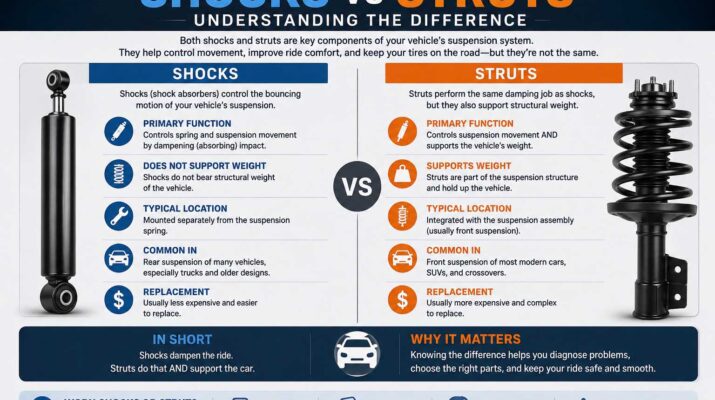
If you’ve ever been told your vehicle needs new suspension parts, you may have wondered about the difference between shocks and struts. Although the terms are often used interchangeably, they are not the same. Both help provide a smoother ride and improve vehicle stability, but they serve different functions within the suspension system.
Understanding the differences can help you make informed maintenance decisions, recognize signs of wear, and communicate more confidently with a repair shop. This guide explains how shocks and struts work, how they differ, and why each plays an important role in vehicle handling and safety.
What Are Shocks?
Shock absorbers, commonly called shocks, are hydraulic dampers designed to control the movement of a vehicle’s suspension.
When your car drives over bumps, potholes, or uneven pavement, the springs compress and rebound. Without shocks, those springs would continue bouncing long after the obstacle was passed.
Shocks help by:
- Reducing excessive bouncing
- Improving tire contact with the road
- Increasing ride comfort
- Supporting braking stability
- Improving handling during turns
It’s important to remember that shocks do not support the vehicle’s weight. Instead, they manage spring movement.
What Are Struts?
A strut combines several suspension components into a single structural assembly.
Unlike a shock absorber, a strut is part of the vehicle’s suspension framework.
A typical suspension strut includes:
- Shock absorber
- Coil spring
- Upper mounting assembly
- Structural housing
Because struts are structural components, they influence wheel alignment and steering geometry in addition to ride comfort.
Difference Between Shocks and Struts Explained
The easiest way to understand the difference between struts and shocks is by comparing their roles.
Shocks primarily dampen suspension movement.
Struts both dampen movement and serve as part of the suspension’s structural support.
This distinction affects maintenance, repair costs, and vehicle design.
Comparison Table
| Feature | Shock Absorber | Strut |
|---|---|---|
| Primary Purpose | Dampens suspension movement | Supports suspension and dampens movement |
| Structural Component | No | Yes |
| Contains Coil Spring | No | Usually yes |
| Affects Wheel Alignment | No | Yes |
| Replacement Complexity | Lower | Higher |
| Typical Replacement Cost | Generally lower | Generally higher |
This comparison highlights why replacing struts often requires more labor than replacing standard shock absorbers.
How Shocks Work
Inside a shock absorber is hydraulic fluid and a piston.
As the suspension moves:
- The piston travels through hydraulic fluid.
- Fluid passes through small internal valves.
- Resistance slows spring movement.
- Excess energy converts into heat.
Instead of allowing repeated bouncing, the shock smooths suspension motion after each road impact.
This simple process greatly improves vehicle control.
How Struts Work
A strut performs the same damping function while also supporting the vehicle’s suspension.
Since the coil spring is mounted directly around or alongside the strut, the assembly helps:
- Support vehicle weight
- Maintain wheel position
- Control suspension movement
- Improve steering precision
Because of this design, removing a strut often requires compressing the spring using specialized tools.
Why Modern Vehicles Use Struts
Many manufacturers choose struts because they simplify suspension design while saving space.
Advantages include:
- Reduced overall weight
- Compact packaging
- Improved steering integration
- Lower manufacturing complexity
MacPherson struts, one of the most common suspension designs, appear in millions of passenger vehicles worldwide.
What’s the Difference Between Shocks and Struts in Everyday Driving?
If you’re asking what’s the difference between shocks and struts, the answer becomes easier to understand behind the wheel.
Both improve comfort, but worn components affect driving differently.
Faulty shocks often cause:
- Excessive bouncing
- Longer stopping distances
- Reduced tire grip
- Poor ride quality
Worn struts may also produce those symptoms while adding:
- Steering instability
- Uneven tire wear
- Alignment problems
- Increased body roll
Because struts support suspension geometry, their condition has a broader impact on vehicle handling.
Which Vehicles Use Shocks or Struts?
Some vehicles use:
- Four shocks
- Four struts
- Front struts with rear shocks
- Independent suspension combinations
The design depends on the manufacturer rather than the vehicle’s age or price.
Pickup trucks and larger SUVs often use different suspension layouts than compact passenger cars.
Just as understanding what’s the difference between AWD and 4WD helps explain how vehicles deliver power to the wheels, learning the suspension layout helps explain why different vehicles handle bumps and corners differently.
Benefits of Properly Functioning Suspension Components
Healthy suspension components improve much more than ride comfort.
They help:
- Maintain consistent tire contact
- Improve emergency braking
- Reduce body roll
- Increase steering response
- Protect suspension parts from excessive wear
Drivers often notice improved confidence during cornering and highway driving after replacing worn shocks or struts.
Difference Between Shocks and Struts Maintenance
Routine inspection helps identify suspension problems before they become severe.
Although shocks and struts require little regular maintenance, they should be inspected periodically for:
- Hydraulic fluid leaks
- Damaged mounts
- Bent components
- Worn bushings
- Corrosion
Many manufacturers recommend inspection during tire replacement, brake service, or major maintenance visits.
Can You Replace Just One?
Technically, yes.
In practice, mechanics usually recommend replacing shocks or struts in pairs on the same axle.
Replacing both sides helps maintain:
- Balanced handling
- Even braking
- Consistent suspension response
- Predictable steering
Installing one new component alongside one heavily worn component may lead to uneven performance.
Common Signs That Suspension Components Need Attention
Drivers often notice small changes before complete failure occurs.
Watch for symptoms such as:
- Rough ride quality
- Vehicle bouncing after bumps
- Nose-diving during braking
- Excessive body roll
- Steering that feels less stable
- Uneven tire wear
These symptoms don’t always confirm worn shocks or struts, but they usually indicate the suspension deserves inspection.
When Should Shocks and Struts Be Replaced?
There isn’t a universal replacement interval because wear depends on driving conditions, road quality, vehicle weight, and driving habits.
For many passenger vehicles, suspension components begin showing noticeable wear after tens of thousands of miles. Even if they haven’t completely failed, their performance may gradually decline.
You should have them inspected if you notice:
- Increased bouncing after bumps
- Poor handling on uneven roads
- Longer braking distances
- Steering instability
- Uneven tire wear
Regular inspections are often more useful than replacing parts based only on mileage.
Troubleshooting Suspension Problems
Not every rough ride means your shocks or struts need replacement.
Other suspension or steering components can create similar symptoms.
| Symptom | Possible Cause |
|---|---|
| Vehicle bounces excessively | Worn shocks or struts |
| Clunking noise over bumps | Loose mounts or suspension bushings |
| Uneven tire wear | Worn struts, poor alignment, or suspension damage |
| Steering pulls to one side | Alignment issue or suspension component wear |
| Front end dives while braking | Weak front shocks or struts |
| Excessive body roll | Suspension wear or damaged stabilizer components |
A professional inspection helps identify the exact cause before replacing parts unnecessarily.
Can You Drive With Worn Shocks or Struts?
A vehicle with worn suspension components may still be drivable, but performance can gradually decline.
Possible effects include:
- Reduced steering precision
- Longer stopping distances
- Poor traction on uneven roads
- Faster tire wear
- Less comfortable ride
Ignoring suspension problems for too long may also increase wear on other components, including tires and steering parts.
How Replacement Affects Vehicle Performance
Many drivers don’t realize how much their suspension has deteriorated until new parts are installed.
Replacing worn shocks or struts can improve:
- Ride comfort
- Cornering stability
- Tire contact with the road
- Braking performance
- Steering response
The improvement is usually most noticeable on rough roads or during emergency maneuvers.
Common Myths About Shocks and Struts
Several misconceptions continue to cause confusion.
Myth: They’re the Same Part
Although they perform similar damping functions, shocks and struts have different designs and responsibilities.
Struts support part of the suspension structure, while shocks do not.
Myth: They Only Affect Comfort
Ride comfort is only one benefit.
Healthy suspension components also improve braking, steering, stability, and tire life.
Myth: If One Side Fails, Replace Only One
Replacing components in pairs generally provides more balanced handling and predictable suspension performance.
Choosing Replacement Parts
If your vehicle needs new suspension components, consider more than price alone.
Look for:
- Compatibility with your vehicle
- Quality construction
- Manufacturer reputation
- Warranty coverage
- Intended driving conditions
Original equipment (OE) replacement parts are often a good choice for restoring factory ride quality, while aftermarket options may offer different performance characteristics.
Suspension and Other Vehicle Systems
Modern vehicles rely on multiple systems working together.
For example, electronic driver-assistance features operate best when suspension components maintain stable tire contact with the road.
Similarly, understanding how does cruise control work helps explain why maintaining steady vehicle control depends on more than just engine and braking systems. Stable suspension improves the overall driving experience, especially during long highway trips.
Suspension design also varies across different vehicles. Riders exploring the various types of motorcycles will notice that motorcycles use completely different suspension layouts than passenger cars, yet the goal remains the same: improving stability, comfort, and traction.
Maintenance Tips to Extend Suspension Life
While normal wear is unavoidable, good driving habits can help suspension components last longer.
Helpful practices include:
- Slow down over potholes and speed bumps.
- Maintain proper tire pressure.
- Rotate tires at recommended intervals.
- Keep wheels properly aligned.
- Avoid consistently overloading the vehicle.
- Have the suspension inspected during routine service.
Small habits can reduce unnecessary stress on the suspension over time.
Frequently Asked Questions
What is the difference between shocks and struts?
Shocks are designed to control spring movement and reduce bouncing. Struts perform that same function while also serving as a structural part of the suspension system.
Can my vehicle have both shocks and struts?
Yes. Many vehicles use front struts and rear shocks, while others use four shocks or four struts depending on the suspension design.
Are struts more expensive than shocks?
In many cases, yes. Struts typically require more labor to replace because they are integrated into the suspension assembly and often require wheel alignment afterward.
Do worn shocks affect tire wear?
Yes. Poor suspension control can allow tires to bounce or lose consistent contact with the road, leading to uneven tread wear.
Should wheel alignment be performed after replacing struts?
Yes. Since struts affect suspension geometry, a wheel alignment is generally recommended after replacement to help ensure proper handling and tire wear.
Key Takeaways
Understanding the difference between shocks and struts makes it easier to recognize suspension issues and make informed maintenance decisions. Although both components improve ride comfort and vehicle control, they perform different roles. Shocks mainly absorb and dampen suspension movement, while struts combine that function with structural support for the suspension and steering system.
If your vehicle starts bouncing more than usual, feels unstable in corners, or shows uneven tire wear, it’s worth having the suspension inspected. Replacing worn shocks or struts at the right time can improve handling, braking, and overall driving confidence while helping protect other suspension components from unnecessary wear.