
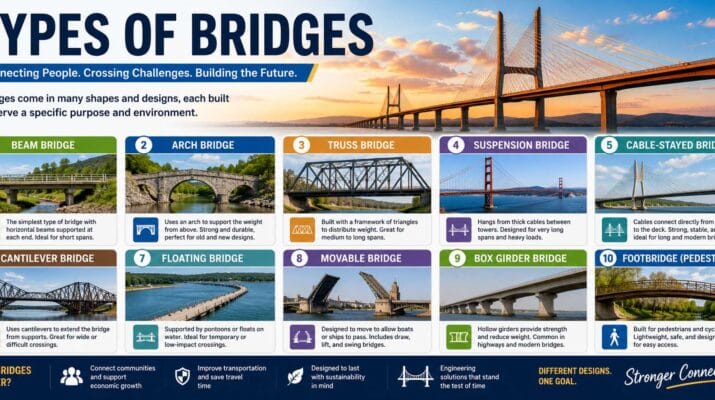
Bridges are among the most impressive engineering achievements ever built. Whether they span rivers, valleys, highways, or railways, the types of bridges used around the world solve different structural challenges. In fact, each bridge type spreads weight in its own way, so certain designs suit specific places, distances, and loads better than others.
From simple beam bridges to huge suspension bridges stretching across bays, understanding how these structures work explains why engineers pick one design over another. In this guide, you’ll learn about the most common bridge types, their pros and cons, and where people use them.
What Are Bridges and Their Types?
A bridge is a structure that gives a safe crossing over an obstacle such as water, roads, railways, or deep valleys. Britannica’s guide to bridge engineering also groups bridges by how they carry their loads.
Although every bridge serves the same basic purpose, no single design fits every situation. For example, terrain, weather, and traffic volume all affect the choice. In addition, the budget and future maintenance needs shape which bridge engineers pick.
If you’ve ever wondered what do engineers do, bridge design is a perfect example of how engineering combines math, materials science, and practical problem-solving.
Main Types of Bridges
The world’s bridges fall into several major groups based on how they support loads.
| Bridge Type | Best For | Typical Span |
|---|---|---|
| Beam Bridge | Short distances | Up to 80 m |
| Arch Bridge | Medium spans | 50–250 m |
| Truss Bridge | Heavy loads | 50–500 m |
| Suspension Bridge | Very long spans | 500 m+ |
| Cable-Stayed Bridge | Long spans | 200–1,100 m |
| Cantilever Bridge | Heavy traffic | 150–550 m |
As you can see, each design has strengths that make it ideal for certain projects.
Beam Bridges
Beam bridges are the simplest and oldest bridge design. A flat horizontal beam rests on supports called piers. As vehicles cross, the beam bends slightly while the piers pass the load into the ground.
On the plus side, beam bridges are simple, cheap, and fast to build. Moreover, they are easy to maintain. However, their spans are short, so they need many support columns. As a result, they don’t suit very wide rivers or valleys.
For this reason, you’ll mostly find beam bridges on highways, local roads, and rail crossings.
Arch Bridges
People have built arch bridges for thousands of years. Instead of relying mainly on straight beams, they push weight outward through curved arches into strong supports at each end.
In fact, stone arch bridges built centuries ago are still in use today, because this shape handles squeezing (compression) forces naturally.
On the plus side, arch bridges are very durable and attractive. In addition, they spread loads well and last a long time. On the other hand, they cost more to build and need strong foundations. Also, larger spans require complex engineering.
Many historic European bridges use this design. Today, modern versions often use reinforced concrete or steel.
Types of Truss Bridges
A truss is a frame of connected triangles that spreads loads across the whole structure. As a result, the triangle shape adds strength while using less material.
Several types of truss bridges are widely used. For example, the Pratt truss puts its diagonal members in tension and its vertical members in compression. Therefore, it works well for railway bridges and busy highways.
Next, the Warren truss uses repeating equal-sided triangles. Because it has fewer parts, it’s often simpler to build while staying strong.
In contrast, the Howe truss reverses the load pattern of the Pratt design. Historically, builders often used it for timber bridges. Finally, the K truss splits vertical members into smaller sections, which improves stability and reduces stress.
Overall, these different types of truss bridges each offer unique benefits, depending on span length and expected traffic.
Truss bridges are very strong and use material efficiently. Besides, they handle heavy loads and last a long time. However, they need more maintenance, since they have many individual parts that are complex to make.
Suspension Bridges
Suspension bridges are famous for their huge main spans. Large cables stretch between towers, while smaller vertical cables hold up the roadway below. Then, the towers pass most of the weight into massive foundations.
For example, the Golden Gate Bridge, the Akashi Kaikyō Bridge, and the Brooklyn Bridge all use this design.
On the plus side, suspension bridges cover extremely long spans and flex during wind and earthquakes. Also, they need very few supports in the water. However, they are very expensive, complex to build, and need a lot of maintenance.
Even so, they remain the top choice for crossing very wide waterways.
Cable-Stayed Bridges
Cable-stayed bridges look like suspension bridges, but they use a different structural system. Instead of one main cable holding smaller hangers, many cables run straight from the towers to the bridge deck.
As a result, they look cleaner and are simpler to build for medium-to-long spans. In addition, they are strong, efficient, modern-looking, and cheaper than suspension bridges.
However, they aren’t ideal for the world’s longest spans, and their towers need careful engineering. Still, many modern city bridges use this design, because it balances strength, cost, and looks.
Cantilever Bridges
Cantilever bridges reach outward from support piers and then join in the center. Because of this, workers can build much of the structure without many temporary supports underneath.
Therefore, cantilever bridges are useful over busy waterways or deep valleys. In particular, they work well where building scaffolding below would be difficult.
Types of Movable Bridges
Some bridges must let ships pass. So, instead of staying fixed, these bridges can open when needed.
For example, bascule bridges lift up like a drawbridge, while swing bridges turn sideways. Similarly, vertical lift bridges raise the whole deck straight up. As a result, you’ll often see them near ports and busy rivers.
Materials Used in Different Types of Bridges
Bridge materials have changed a lot over time. Today, builders commonly use reinforced concrete, structural steel, and prestressed concrete. In addition, they use composite materials and high-strength cables.
For example, our comparison of wrought iron vs cast iron explains why modern bridges favor advanced steel alloys over older iron materials.
How Engineers Choose Between Types of Bridges
Choosing among the different types of bridges means balancing several factors.
First, engineers look at span length, soil conditions, and traffic volume. Next, they weigh the construction budget, weather exposure, and earthquake risk. Finally, they consider maintenance costs and environmental impact.
In other words, no bridge design is automatically better than another. Instead, the best choice depends entirely on the project’s needs.
Forces Acting on Bridges
Every bridge faces several mechanical forces during its lifetime.
First, compression pushes materials together. For example, arch bridges are excellent at handling compression.
Second, tension stretches structural members. In fact, suspension bridge cables carry huge tension loads. If you’re interested in structural forces, understanding what is thrust helps explain how sideways forces affect arches and foundations.
Third, shear forces try to slide one part of a structure past another. Fortunately, proper reinforcement keeps these stresses low.
Finally, torsion happens when uneven loads twist bridge parts. Thankfully, modern engineering software predicts these effects before construction starts.
Bridge Construction Technologies
Today’s bridge projects rely on advanced technology. For example, engineers use 3D modeling, computer simulations, and structural analysis software. In addition, they use GPS surveying, drone inspections, laser scanning, and Building Information Modeling (BIM).
As a result, these tools have changed civil engineering by improving accuracy and lowering construction risks.
Heavy lifting gear and special types of machines also play a major role, especially when crews place massive steel beams or precast concrete sections.
Types of Bridges Compared
| Bridge Type | Cost | Maintenance | Maximum Span | Heavy Traffic |
| Beam | Low | Low | Short | Moderate |
| Arch | Medium | Low | Medium | High |
| Truss | Medium | Medium | Long | Excellent |
| Suspension | Very High | High | Very Long | Excellent |
| Cable-Stayed | High | Medium | Long | Excellent |
| Cantilever | High | Medium | Long | Excellent |
In short, each bridge type fills a different role in transportation.
Types of Dental Bridges: A Different Meaning
When you search online, you may also come across types of dental bridges.
Although they share the same name, dental bridges have nothing to do with civil engineering. Instead, they are dental devices that replace missing teeth, while structural bridges connect places split by obstacles.
Therefore, checking the context helps you avoid confusion when researching bridge topics.
Bridges and Water Management
Not every structure over water is a bridge. For example, people sometimes confuse bridges with water-control structures.
Learning what is a weir helps you tell them apart, since weirs control water flow rather than carrying vehicles or people.
Frequently Asked Questions
What is the strongest type of bridge?
There isn’t one strongest bridge type for every situation. Instead, suspension, cable-stayed, and truss bridges each excel in different conditions.
Which bridge is the cheapest to build?
Beam bridges are usually the cheapest, because their design is so simple.
Why are triangles used in truss bridges?
Triangles spread loads efficiently. As a result, they resist bending out of shape better than most other shapes.
Which bridge lasts the longest?
With proper maintenance, stone arch bridges and modern reinforced concrete bridges can stay in service for well over 100 years.
What is the most common bridge type?
Beam bridges are the most common, since they are affordable, simple, and suitable for short spans.
Why Understanding Types of Bridges Matters
Bridges shape the way people travel, move goods, and connect communities. In fact, each design reflects a careful balance of physics, materials, cost, and local conditions. From small beam bridges on neighborhood roads to huge suspension bridges linking distant shores, every structure solves a unique engineering challenge.
Ultimately, by understanding the different types of bridges, you’ll better appreciate the technology behind these everyday structures and the engineering choices that keep millions of people moving safely every day.