
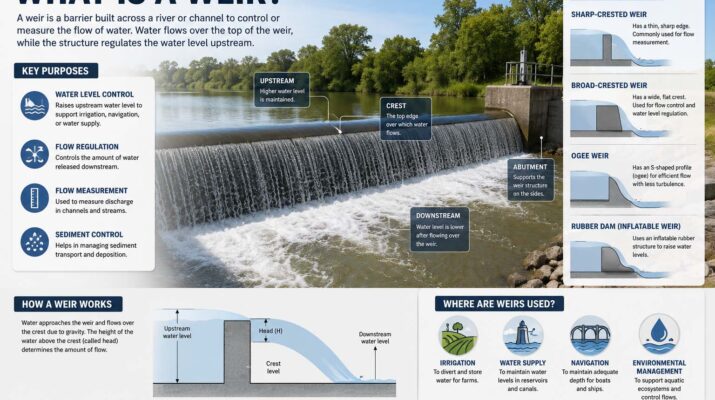
Water management is one of the most important aspects of civil engineering, environmental technology, and industrial infrastructure. Among the many tools used to control and measure water flow, the weir remains one of the simplest and most effective solutions.
Many people ask, “what is a weir?” because the term appears in discussions about rivers, dams, wastewater systems, irrigation projects, and flow measurement technologies.
What Is a Weir and How Does It Work?
A weir works by partially obstructing water flow.
As water approaches the structure, it rises to a certain level before flowing over the top edge known as the crest.
Engineers can measure the height of water above the crest and use mathematical formulas to estimate flow rates accurately. This process is similar to what is dimensional analysis, where accurate measurements and calculations are used to produce reliable engineering results.
The basic process works like this:
- Water approaches the weir.
- The barrier restricts flow.
- Water level increases upstream.
- Water flows over the crest.
- Flow measurements are calculate.
This simple mechanism makes weirs useful in both small and large water systems.
Why Are Weirs Important?
Weirs serve multiple purposes in modern infrastructure.
They help:
- Control river levels.
- Measure water flow.
- Support irrigation systems.
- Manage stormwater.
- Improve wastewater treatment.
- Protect downstream environments.
Without weirs, many water management systems would be more difficult and expensive to operate.
What Is a Weir Dam?
One of the most common questions is what is a weir dam.
A weir dam is a low-height barrier built across a river or stream to regulate water levels while allowing water to flow over the structure continuously.
Unlike large reservoirs that store significant amounts of water, weir dams typically focus on:
- Flow regulation.
- Water diversion.
- Water level control.
- Environmental management.
Many cities use weir dams to maintain stable water conditions for municipal and industrial purposes. Similar water-control principles are also important in what is desalination, where water movement and treatment are carefully managed to produce fresh water.
What Is a Weir Plate?
A weir plate is a specially shaped metal or plastic plate used in flow measurement systems.
The plate contains a precisely designed opening that allows engineers to measure water flow accurately.
Common shapes include:
- Rectangular openings.
- V-shaped notches.
- Trapezoidal openings.
The shape affects how water flows and how calculations are perform.
Weir plates are commonly installed in:
- Laboratories.
- Industrial plants.
- Wastewater treatment facilities.
- Environmental monitoring stations.
What Is a Trap Weir?
A trap weir is a specialized structure designed to capture, monitor, or control the movement of water and sometimes aquatic organisms.
In environmental applications, trap weirs may be used to:
- Monitor fish migration.
- Study wildlife movement.
- Control water flow.
- Collect environmental data.
Researchers often use trap weirs to gather information about river ecosystems without causing major disruptions to natural habitats.
Common Types of Weirs
Several designs are used depending on the application.
Rectangular Weir
One of the simplest and most widely used designs.
Suitable for general flow measurement.
V-Notch Weir
Features a triangular opening.
Provides accurate measurements at lower flow rates.
Cipolletti Weir
Uses a trapezoidal shape.
Designed to improve measurement accuracy.
Broad-Crested Weir
Features a wide, flat crest.
Often used in large-scale water control projects.
Each design offers advantages for specific flow conditions.
Applications of Weirs in Technology
Modern engineering relies heavily on weirs for water-related systems.
Water Treatment Plants
Weirs help regulate and measure water movement during treatment processes.
Wastewater Facilities
Flow monitoring is critical for compliance and operational efficiency.
Irrigation Systems
Farmers use weirs to distribute water effectively.
Environmental Monitoring
Scientists track river and stream conditions using weir structures. Many modern monitoring stations combine weirs with what is telemetry systems to transmit water-level and flow data in real time.
Flood Control
Weirs help manage water levels during heavy rainfall events.
These applications demonstrate the versatility of weir technology.
How Engineers Measure Flow Using a Weir
Flow measurement is one of the most valuable functions of a weir.
The process typically includes:
- Installing a structure.
- Measuring water height above the crest.
- Applying standardized flow equations.
- Calculating discharge rates.
- Monitoring changes over time.
This method remains popular because it provides reliable results with relatively simple equipment. Accurate measurements are often supported by what is instrumentation, which involves devices used to monitor and control engineering systems.
Weir vs Dam: What Is the Difference?
Many people confuse weirs and dams.
| Feature | Weir | Dam |
|---|---|---|
| Main Purpose | Flow control and measurement | Water storage |
| Height | Usually low | Often large |
| Water Storage | Limited | Significant |
| Cost | Generally lower | Usually higher |
| Flow Characteristics | Water flows over the crest | Water is often retained |
While both structures influence water movement, their engineering goals are quite different.
Advantages of Weirs
Several factors contribute to the popularity of weirs.
Simple Design
Most weirs are relatively easy to construct and maintain.
Cost Effective
Construction and maintenance costs are often lower than alternative flow-control systems.
Accurate Flow Measurement
Properly designed weirs provide dependable flow data for engineers and environmental specialists.
Long Service Life
Many weirs operate effectively for decades with routine maintenance.
Versatile Applications
They can be used in rivers, canals, treatment plants, industrial facilities, and irrigation networks.
Common Problems With Weirs
Although reliable, weirs can experience operational issues.
Typical challenges include:
- Sediment buildup
- Debris accumulation
- Structural damage
- Erosion around foundations
- Measurement inaccuracies
Regular inspections help prevent many of these problems.
Troubleshooting Weir Performance Issues
When a weir stops performing properly, engineers typically follow several troubleshooting steps.
Inspect for Debris
Remove leaves, branches, and accumulated material that may restrict water flow.
Check Crest Condition
Damaged crests can reduce measurement accuracy and should be repaired promptly.
Verify Water Levels
Incorrect readings may indicate calibration or equipment issues.
Examine Structural Integrity
Look for cracks, erosion, or foundation movement that could affect performance.
Monitor Sediment Accumulation
Excess sediment can alter flow characteristics and reduce measurement accuracy.
Routine maintenance significantly improves long-term reliability and ensures consistent operation.
Future of Weir Technology
Although weirs are ancient engineering structures, modern technology continues improving their performance.
Recent innovations include:
- Digital monitoring systems
- Remote water-level sensors
- Automated flow calculations
- Smart environmental tracking
- Real-time reporting platforms
These advancements help engineers gather more accurate data while reducing manual inspections. Maintaining continuous data collection also depends on what is continuity, ensuring monitoring systems remain reliable even during changing environmental conditions.
Environmental Benefits of Weirs
Well-designed weirs can contribute to environmental protection.
Benefits may include:
- Better water management
- Improved flood control
- Enhanced monitoring of ecosystems
- Support for sustainable resource use
However, engineers must also consider ecological impacts when designing new structures to minimize disruption to aquatic habitats and natural river systems.
FAQ About What Is a Weir
What is a weir?
A weir is a barrier built across a channel or river to control or measure water flow.
What is a weir dam?
A weir dam is a low structure that regulates water levels while allowing water to flow over it continuously.
What is a weir plate?
A weir plate is a shaped plate used to measure water flow in channels and treatment systems.
What is a trap weir?
A trap weir is a specialized structure used for monitoring water flow, fish migration, or environmental conditions.
How does a weir measure flow?
Engineers measure water height above the crest and use standardized hydraulic formulas to calculate flow rates accurately.
Conclusion
Understanding what is a weir is essential for anyone interested in water engineering, environmental technology, or infrastructure management. These simple yet highly effective structures help regulate water levels, measure flow rates, support irrigation systems, and improve environmental monitoring. Their reliability, cost-effectiveness, and adaptability make weirs an important component of modern water management around the world.