
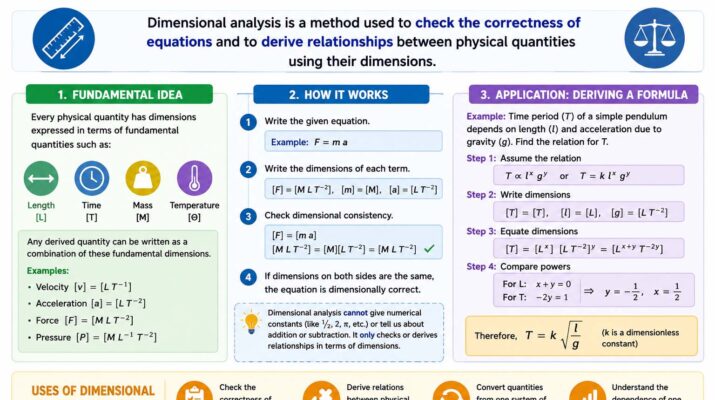
If you have ever converted miles to kilometers, inches to centimeters, or grams to kilograms, you have already used a basic form of dimensional analysis. This powerful problem-solving method is widely used in science, technology, engineering, mathematics, and chemistry to convert units and verify calculations.
Many students and professionals ask, what is dimensional analysis and why it is so important. The answer lies in its ability to simplify complex calculations while reducing errors.
What Is Dimensional Analysis?
Dimensional analysis is a mathematical technique used to convert one unit of measurement into another while ensuring that equations remain consistent and accurate.
The method relies on conversion factors that allow units to cancel out correctly.
For example:
- Meters to feet
- Kilograms to pounds
- Seconds to hours
- Liters to milliliters
The primary goal is to ensure that the final answer is expressed in the desired unit.
The calculation method is often taught in physics, chemistry, engineering, and technology courses because it provides a structured approach to solving measurement-related problems. Engineers frequently combine this method with a free body diagram to analyze forces while keeping calculations dimensionally consistent.
What Is a Dimensional Analysis?
A common question is, what is a dimensional analysis and how does it differ from ordinary calculations?
A the method is a process that examines the dimensions or units involved in a calculation.
Instead of focusing only on numbers, it also tracks the units attached to those numbers.
For example:
If a distance is measured in kilometers and time is measured in hours, the method helps determine whether the resulting calculation should be expressed in kilometers per hour.
This makes it easier to identify mistakes before they become serious problems.
Why Is Dimensional Analysis Important?
The calculation method plays an important role in many technical and scientific applications.
Benefits include:
Improved Accuracy
Tracking units throughout calculations helps reduce errors.
Easier Unit Conversion
Converting between measurement systems becomes more straightforward.
Verification of Equations
Scientists and engineers often use the method to check whether formulas make sense.
Better Problem Solving
Complex calculations become easier when broken into smaller conversion steps.
What Is Dimensional Analysis Used For?
Many people wonder, what is dimensional analysis used for in real-world situations.
The answer is that it is used almost everywhere measurements matter.
Engineering
Engineers use the method to verify formulas and design systems accurately. Understanding what do engineers do also highlights why precise unit conversion is essential in everything from structural design to product development.
Technology
Technology professionals use unit conversions in software, hardware, manufacturing, and data analysis.
Physics
The calculation method helps confirm that equations follow physical laws.
Healthcare
Medical professionals convert doses, measurements, and treatment calculations.
Manufacturing
Factories use the method to maintain product consistency and quality.
Step-by-Step Guide to Dimensional Analysis
Understanding the process is easier with a simple example.
Suppose you want to convert 100 centimeters into meters.
Step 1: Identify the Starting Value
Starting value:
100 centimeters
Step 2: Determine the Conversion Factor
Since:
1 meter = 100 centimeters
The conversion factor is:
1 meter / 100 centimeters
Step 3: Set Up the Equation
100 cm × (1 m / 100 cm)
Step 4: Cancel Units
The centimeter units cancel out.
Step 5: Calculate the Result
100 ÷ 100 = 1
Final answer:
1 meter
This simple process demonstrates how the method converts units while maintaining accuracy.
What Is Dimensional Analysis in Chemistry?
A frequently searched question is what is dimensional analysis in chemistry.
Chemistry relies heavily on unit conversions because scientists often work with:
- Mass
- Volume
- Density
- Moles
- Concentration
For example, chemists may need to convert grams into moles to determine how much of a substance participates in a reaction. Understanding what are valence electrons is equally important because electron behavior directly influences many chemical calculations and reactions.
Dimensional analysis allows these calculations to be performed systematically.
Without proper unit conversion, chemistry calculations could easily become inaccurate.
Dimensional Analysis vs Unit Conversion
Although the terms are often used interchangeably, there are slight differences.
| Feature | Dimensional Analysis | Basic Unit Conversion |
|---|---|---|
| Uses Units | Yes | Yes |
| Verifies Equations | Yes | Usually No |
| Solves Complex Problems | Yes | Limited |
| Common in Science | Yes | Yes |
Unit conversion is often one part of this technique.
Dimensional analysis goes further by checking the relationships between dimensions and ensuring equations remain valid.
Applications in Modern Technology
Technology professionals frequently use this technique in areas such as:
Software Development
Programs handling measurements often require accurate unit conversions to ensure calculations remain consistent across different systems.
Robotics
Engineers convert distances, speeds, and forces during system design to improve accuracy and reliability.
Artificial Intelligence
Data scientists sometimes use dimensional consistency checks when analyzing datasets and validating computational models.
Aerospace Technology
Spacecraft calculations depend on precise measurements and unit consistency. Modern aerospace systems also rely on what is telemetry to collect and transmit real-time performance data, making accurate dimensional calculations essential for mission success.
One famous example involved a spacecraft mission that failed due to incorrect unit conversions, demonstrating the importance of the method in engineering projects.
Common Mistakes When Using Dimensional Analysis
Beginners often encounter a few challenges.
Using the Wrong Conversion Factor
Choosing the wrong ratio prevents units from canceling properly and produces incorrect results.
Ignoring Units
Many people focus only on numbers and forget to track units throughout the calculation.
Mixing Measurement Systems
Combining metric and imperial units without proper conversion can create significant errors.
Rounding Too Early
Premature rounding may reduce accuracy in complex calculations involving multiple conversion steps.
Troubleshooting Dimensional Analysis Problems
If your answer seems incorrect, check the following:
Verify Unit Cancellation
Every unwanted unit should cancel properly before reaching the final answer.
Check Conversion Factors
Ensure the conversion factor is written in the correct orientation so the unwanted units cancel.
Review Calculation Steps
Small arithmetic errors can affect the final result.
Confirm Desired Units
Make sure the final answer is expressed in the unit requested in the problem.
These troubleshooting steps help identify and correct mistakes quickly.
Benefits for Students and Professionals
Dimensional analysis offers advantages beyond the classroom.
Better Critical Thinking
It encourages logical and systematic problem-solving.
Stronger Mathematical Skills
Regular use improves calculation accuracy and confidence.
Practical Career Applications
Many technical careers require measurement conversions. Whether engineers are selecting what is the strongest metal for a particular application or scientists are performing laboratory calculations, the method helps ensure reliable and accurate results.
Increased Confidence
Understanding the method makes scientific calculations much less intimidating for students and professionals alike.
FAQ
What is dimensional analysis?
Dimensional analysis is a method used to convert units and verify that equations are mathematically and physically consistent.
Why is this technique important?
It helps reduce errors, simplify calculations, and ensure measurement accuracy.
What is this technique in chemistry?
In chemistry, the method is used to convert units such as grams, moles, liters, and concentrations during calculations.
What is dimensional analysis used for?
It is used in science, engineering, healthcare, technology, manufacturing, and education.
Is dimensional analysis difficult to learn?
No. Once you understand conversion factors and unit cancellation, the process becomes much easier.
Conclusion
Understanding what is dimensional analysis is essential for anyone working with measurements, calculations, or scientific data. This powerful method helps convert units, verify equations, and improve accuracy across a wide range of fields.
Whether you are learning what is a dimensional analysis, exploring what is dimensional analysis in chemistry, or wondering what is dimensional analysis used for, the core principle remains the same: use conversion factors to ensure units are consistent and calculations are correct.