
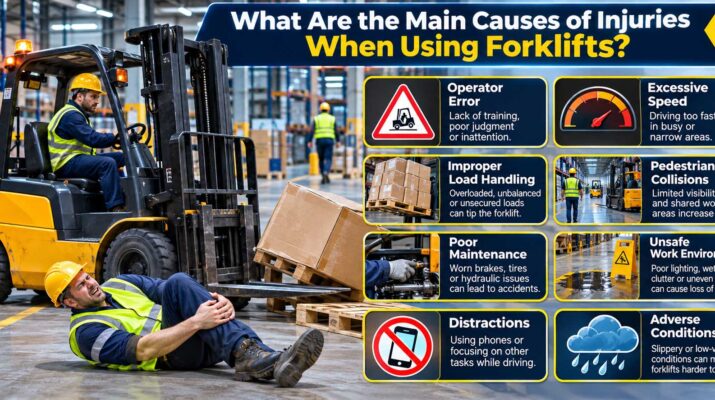
Picture a busy warehouse: a loaded forklift turns a corner a little too fast, the load shifts, and the whole truck starts to lean. In seconds, a normal shift turns dangerous. So, what are the main causes of injuries when using forklifts? In short, most injuries come from tip-overs, workers getting struck or crushed, falling loads, speeding, poor training and skipped safety checks.
In this guide, we break down each cause in plain English. Also, we cover the simple habits and safety tech that help keep operators and coworkers safe.
What Are the Main Causes of Injuries When Using Forklifts?
Forklifts look simple, but they behave very differently from cars. For example, they steer from the rear, carry heavy loads high off the ground and have big blind spots. As a result, small mistakes can quickly turn serious.
Here is a quick look at the most common causes:
- Tip-overs and rollovers: These happen when the truck loses balance, often during sharp turns or on slopes.
- Pedestrian strikes: Operators may hit coworkers who walk into their path or stand in blind spots.
- Falling loads: Poorly stacked or overloaded pallets can slide off the forks.
- Speeding and sudden moves: Fast driving and hard braking make the truck unstable.
- Lack of training: Untrained drivers often misjudge loads, turns and stopping distance.
- Poor maintenance: Worn brakes, steering or hydraulics can fail without warning.
- Unsafe work areas: Wet floors, uneven ground, loading docks and clutter add extra risk.
Forklift Injuries by the Numbers
The Occupational Safety and Health Administration (OSHA) regulates forklifts under its powered industrial truck rules. In the past, OSHA has estimated about 85 forklift deaths and roughly 34,900 serious injuries each year in the United States. Similarly, Bureau of Labor Statistics data showed between 75 and 94 forklift-related deaths per year from 2011 to 2017.
Also, older OSHA figures point to tip-overs that crush the operator as the most common type of fatal forklift accident. So, even though numbers vary from year to year, the pattern stays the same: most injuries are preventable.
Tip-Overs: The Biggest Danger
A forklift balances on three points, which experts call the stability triangle. Basically, the two front wheels and the center of the rear axle form this triangle. As long as the combined center of gravity of the truck and its load stays inside it, the forklift stays upright.
However, lifting a load high, turning sharply or driving on a slope can push that center of gravity outside the triangle. Then, the forklift tips. If you want to picture how these forces work, a simple free body diagram shows how weight, lift and turning forces act on an object.
When a forklift does start to tip, the safest move is usually to stay inside. For example, operators should keep their seatbelt on, hold the steering wheel firmly, brace their feet and lean away from the direction of the fall. In contrast, jumping out often leads to being crushed by the overhead guard.
Workers Struck or Crushed
Pedestrians face real danger around forklifts. Often, a worker steps into an aisle just as a forklift backs up or turns. Because the rear end swings wide during turns, people standing beside the truck can get hit too.
Also, workers can get pinned between a forklift and a wall, rack or another vehicle. Meanwhile, feet are especially at risk, since forklifts can roll over toes in tight spaces. Therefore, clear walkways and good communication matter just as much as driving skill.
Other Main Causes of Injuries When Using Forklifts
Beyond tip-overs and pedestrian strikes, several other problems lead to injuries. In fact, many accidents happen when two or more of these causes stack up.
Falling Loads
Loads can fall when they sit unevenly on the forks, go over the rated capacity or stack too high. For instance, a pallet lifted to the top rack can slide off if the mast tilts forward. As a result, workers below can suffer serious head or body injuries.
Speeding and Sharp Turns
Forklifts are not built for speed. So, fast driving, quick turns and sudden stops can throw loads or tip the truck. Many companies now track driving habits with telematics systems, which send speed and impact data to managers in real time. If that idea is new to you, our guide on what is telemetry explains how remote data monitoring works.
Poor or Missing Training
Untrained drivers make up a big share of forklift accidents. That’s why OSHA requires employers to train and evaluate operators before they drive. Also, operators need a performance evaluation at least every three years, plus refresher training after an accident, a near miss or unsafe driving.
Skipped Inspections and Poor Maintenance
Worn brakes, leaking hydraulics, bad tires or broken horns all raise the risk of an accident. So, OSHA requires forklifts to be checked before use, at least daily, and taken out of service if they are unsafe. Even so, rushed shifts often lead to skipped checks.
Unsafe Work Areas
The work area can cause trouble too. For example, wet or oily floors reduce traction, while potholes and ramps affect balance. Meanwhile, loading docks pose a fall risk if a trailer moves or the forklift drives too close to the edge. Also, poor lighting and cluttered aisles make blind spots worse.
Riding or Lifting People
Sometimes, workers ride on the forks or stand on a pallet to reach high shelves. However, forklifts are not designed for this unless they have an approved work platform. As a result, falls from height are a common and serious injury.
Technology That Helps Reduce Forklift Accidents
Modern forklifts and warehouses use smart tools to lower risk. For example:
- Proximity warning systems: These alert operators when people or objects get too close.
- Blue spotlights and red zone lights: They project warning light on the floor so pedestrians see a forklift coming.
- Speed limiters: These cap top speed, especially in busy zones.
- Load and tilt monitors: They warn drivers when a load is too heavy or the mast angle is unsafe.
- Backup cameras: These help drivers see blind spots behind the truck.
Most of these tools rely on ultrasonic, radar, RFID or camera-based detection. To understand how each one works, our overview of the types of sensors explains them in simple terms.
Still, technology is a helper, not a replacement. In other words, trained operators and good habits remain the strongest line of defense.
How to Prevent the Main Causes of Injuries When Using Forklifts
Preventing accidents comes down to people, equipment and the work area. So, use this quick safety checklist:
- First, train every operator. Only trained and evaluated workers should drive forklifts.
- Next, inspect before each shift. Check brakes, steering, tires, forks, horn, lights and hydraulics.
- Then, respect load limits. Read the capacity plate, and keep loads centered and low.
- Also, drive slowly. Slow down at corners, on ramps and in busy areas.
- After that, keep forks low. Travel with forks a few inches off the ground and tilted back.
- Separate people and forklifts. For instance, use marked walkways, barriers and mirrors.
- Wear the seatbelt. It keeps the operator inside the protective cage during a tip-over.
- Finally, never give rides. Only lift people on approved platforms built for the job.
FAQs About the Main Causes of Injuries When Using Forklifts
Are tip-overs one of the main causes of injuries when using forklifts?
Yes, they are. In fact, tip-overs have long been linked to many forklift deaths, especially when operators are not wearing a seatbelt.
Who is most at risk around forklifts?
Both operators and nearby workers face risk. However, pedestrians often suffer serious injuries because they have no protection if a forklift hits them.
How often do forklift operators need training?
Under OSHA rules, operators need training before driving, an evaluation at least every three years and refresher training after accidents, near misses or unsafe driving.
Can good maintenance really prevent injuries?
Of course. Daily checks catch problems like weak brakes or leaking hydraulics before they cause an accident.
Key Takeaways on the Main Causes of Injuries When Using Forklifts
To sum up, most forklift injuries come from tip-overs, pedestrian strikes, falling loads, speeding, poor training, skipped inspections and unsafe work areas. Thankfully, almost all of them are preventable.
So, train every driver, inspect trucks daily, keep loads within limits and separate people from moving equipment. Above all, build a culture where anyone can speak up about unsafe driving, because that simple habit can stop an accident before it starts.