
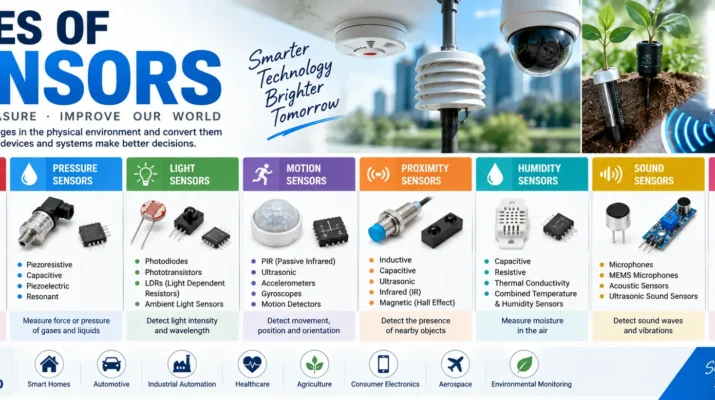
Modern devices constantly collect information about the world around them, often without users noticing. The types of sensors inside smartphones, cars, appliances, security systems, factories, and smart homes can detect everything from temperature and pressure to motion, light, speed, and distance. A sensor essentially detects a physical condition or change and converts it into information that another electronic or mechanical system can process.
Some sensors are remarkably simple, while others combine electronics, software, and digital communication. Understanding the major sensor categories makes it easier to see how automated systems measure their surroundings and make decisions.
What Is a Sensor?
A sensor is a device or component that detects a physical property or environmental change and produces a corresponding output.
For example, a temperature sensor detects changes in heat. Meanwhile, a proximity sensor determines whether an object is nearby. Similarly, a pressure sensor measures force applied over an area.
The sensor’s output may be electrical, digital, optical, or another form that a controller can interpret. Once processed, that information can trigger an action, appear on a display, or become part of a larger data set.
Consider an automatic door. First, a sensor detects a person approaching. Next, the control system interprets that signal. Then, an actuator opens the door.
So, although sensors collect information, other system components usually decide what to do with it.
Different Types of Sensors and Their Uses
Engineers choose sensors according to what needs to be measured, the required accuracy, operating environment, response speed, cost, and system design.
The following are some of the most common categories.
| Sensor Type | What It Detects | Common Applications |
|---|---|---|
| Temperature | Temperature changes | HVAC, appliances, electronics |
| Pressure | Gas or liquid pressure | Vehicles, industrial equipment |
| Proximity | Nearby objects | Phones, automation, parking systems |
| Motion | Movement | Security, lighting, smart homes |
| Light | Light intensity | Displays, cameras, lighting |
| Humidity | Moisture in air | HVAC, weather systems |
| Ultrasonic | Distance using sound | Parking, robotics, level sensing |
| Infrared | Infrared radiation | Remotes, motion detection |
| Speed | Rotational or linear speed | Vehicles, machinery |
| Water/leak | Presence of water | Homes, data centers, equipment |
While these categories provide a useful overview, many modern devices combine several sensors to improve reliability.
Types of Sensors for Temperature Measurement
Temperature sensors appear in electronics, vehicles, manufacturing equipment, heating systems, refrigerators, and countless other technologies.
Thermocouples
A thermocouple uses two dissimilar metals joined together. When the junction experiences a temperature difference, it generates a small voltage that can be measured and converted into a temperature reading.
Because thermocouples can operate across broad temperature ranges, they are common in industrial systems, furnaces, engines, and scientific equipment.
Thermistors
Thermistors change electrical resistance as temperature changes. Therefore, electronics can calculate temperature by measuring that resistance.
They are inexpensive and sensitive, so manufacturers frequently use them in appliances, battery systems, thermostats, and electronic devices.
Resistance Temperature Detectors
Resistance temperature detectors, or RTDs, also use resistance changes. However, they commonly use metals such as platinum and can provide stable, accurate measurements in industrial applications.
Consequently, the best temperature sensor depends on factors such as range, accuracy, response time, and operating conditions.
Types of Pressure Sensors
The types of pressure sensors vary according to how pressure is measured and what reference point the system uses.
Absolute pressure sensors compare pressure with a vacuum reference. In contrast, gauge pressure sensors compare it with atmospheric pressure. Differential pressure sensors measure the difference between two pressure points.
Different sensing technologies can then convert that pressure into an electrical signal. Common approaches include piezoresistive, capacitive, and piezoelectric sensing.
These sensors appear in industrial equipment, medical devices, HVAC systems, hydraulic machinery, and vehicles.
A familiar automotive example is tire pressure sensors, which help a vehicle monitor tire inflation and alert the driver when pressure falls below a defined threshold.
Motion and Proximity Sensors
Motion and proximity sensors answer slightly different questions. A motion sensor primarily identifies movement, whereas a proximity sensor detects whether an object is near the sensing area.
Passive infrared, or PIR, sensors are widely used for detecting changes in infrared energy associated with people and other warm objects. Consequently, they commonly appear in security systems and automatic lighting.
Capacitive proximity sensors can detect changes in an electric field. Meanwhile, inductive sensors are particularly useful for detecting metallic objects.
Phones also use proximity sensing. For example, a smartphone may switch off its display when it detects that the device is close to your face during a call.
Because these technologies operate differently, engineers select them according to the target material, required range, environment, and response characteristics.
Light and Optical Sensors
Light sensors detect the intensity or characteristics of light. As a result, they appear in smartphones, cameras, displays, lighting systems, solar equipment, and industrial automation.
A phone can use an ambient light sensor to adjust screen brightness automatically. Meanwhile, a camera relies on sophisticated light-sensitive components to create digital images.
Photoresistors, photodiodes, and phototransistors are examples of light-sensitive components. However, each technology has different response characteristics.
Optical sensors can also do more than measure brightness. For instance, industrial optical systems may detect objects, count products, inspect surfaces, or determine position without physical contact.
Infrared Sensors and Their Everyday Uses
Infrared sensors detect infrared radiation, which lies outside the visible portion of the electromagnetic spectrum.
Active infrared systems emit infrared energy and detect its reflection. In contrast, passive infrared sensors detect infrared energy coming from objects within their field of view.
Remote controls provide a familiar example. A television remote sends coded infrared pulses toward a receiver in the television.
People searching for types of IR sensors used in LCD TVs are usually dealing with the television’s infrared receiver rather than a broad collection of environmental sensors. Depending on the design, the receiver module detects the remote’s modulated infrared signal and passes the decoded information to the TV’s control electronics.
Infrared technology also appears in proximity detection, thermal measurement, security equipment, and industrial sensing.
Sensors Used in Home Security and Automation
Smart homes rely heavily on sensors because automation needs information about what is happening around the property.
Door and window security devices commonly detect whether an entry point is open or closed. Many window alarm sensors use a magnetic contact arrangement in which separating the magnet from the sensor changes the circuit state and triggers the security system.
There are also several types of window alarm sensors, including basic magnetic contacts, vibration sensors, and glass-break detection systems. Therefore, the appropriate design depends on whether the goal is to detect opening, physical impact, or breaking glass.
Meanwhile, automated entrances use another category of safety technology. For instance, garage door sensors can detect an obstruction in the closing path so that a compatible door system can respond appropriately.
These examples show how sensors can support both convenience and safety without requiring constant manual monitoring.
Water, Humidity, and Environmental Sensors
Environmental sensors measure conditions such as humidity, moisture, air quality, water presence, temperature, and gas concentration.
Humidity sensors, for example, measure moisture in the air. Therefore, they are useful in HVAC equipment, weather stations, storage areas, agriculture, and manufacturing.
Water detection works differently. Many water sensors for home applications place sensing contacts or probes near appliances, pipes, water heaters, or other leak-prone areas. Once water bridges or reaches the sensing elements, the device can trigger an alarm or smart-home notification.
More advanced systems may connect leak detection with an automatic shutoff valve. Consequently, the controller can respond to a detected leak rather than merely sounding an alarm.
However, the exact capabilities depend on the specific sensor and connected control system.
Automotive Sensors
Modern vehicles use numerous sensors to manage engine operation, emissions, braking, safety systems, tire monitoring, and driver-assistance features.
Temperature sensors monitor fluids and components. Meanwhile, oxygen sensors help engine-management systems evaluate exhaust conditions. Pressure sensors can monitor intake systems, fuel systems, and tires.
Vehicle speed measurement provides another clear example. Wheel speed sensors measure wheel rotation and provide data used by systems such as anti-lock braking. Depending on the vehicle, related control systems may also use wheel-speed information for traction and stability functions.
Other automotive sensing technologies can monitor steering position, acceleration, crankshaft position, parking distance, and environmental conditions.
As vehicles become increasingly computerized, reliable sensor data remains fundamental to many control functions.
Ultrasonic Sensors
Ultrasonic sensors measure distance by transmitting high-frequency sound waves and detecting their reflections.
The basic process is straightforward. First, the sensor emits an ultrasonic pulse. Then, the pulse travels toward an object and reflects. Finally, the system measures the travel time and calculates distance based on the speed of sound.
Because this method does not require physical contact, ultrasonic sensors are useful in robotics, parking assistance, liquid-level measurement, manufacturing, and obstacle detection.
Still, performance can vary with object shape, material, temperature, airflow, and environmental conditions. Therefore, ultrasonic sensing is not ideal for every application.
Accelerometers and Gyroscopes
Smartphones, drones, wearables, vehicles, and gaming controllers frequently use accelerometers and gyroscopes.
As a result, a device can detect movement, orientation changes, or vibration.
A gyroscope measures rotational motion or angular velocity. When devices combine accelerometer and gyroscope data, they can estimate movement and orientation more effectively than either sensor could alone.
For example, a smartphone can use these measurements when rotating the screen, tracking movement, or supporting motion-based applications.
Similarly, drones use motion-sensing data as part of their flight-control systems.
How Sensors Work With Controllers and Actuators
A sensor normally forms one part of a larger control system.
A simple workflow looks like this:
Physical condition → Sensor → Signal processing → Controller → Decision → Actuator or output
Suppose an automated cooling system detects rising temperature. First, the temperature sensor generates a signal. Next, the controller compares that measurement with a target value. If cooling is needed, the controller can command a fan, compressor, or another actuator to operate.
This feedback principle appears throughout automation, robotics, vehicles, manufacturing, and consumer electronics.
Therefore, sensors are sometimes described as the “eyes and ears” of automated systems, although they may measure far more than sight and sound.
Analog vs. Digital Sensors
Sensors can also be categorized according to their output.
Analog sensors provide a continuously varying signal related to the measured quantity. For example, the voltage may rise as temperature increases.
Digital sensors, meanwhile, provide information in a digital form that electronic systems can process directly. Some include built-in conversion, calibration, or communication features.
Neither approach is automatically superior. Instead, designers consider accuracy, noise, processing requirements, communication distance, cost, and system architecture.
Modern Internet of Things devices often favor digital interfaces because microcontrollers can communicate directly with compatible sensors.
How to Choose Between Different Types of Sensors
Choosing between the different types of sensors requires more than identifying what needs to be measured.
First, determine the measurement range. A temperature sensor designed for a living room, for example, may be unsuitable for an industrial furnace.
Next, consider accuracy and resolution. Accuracy describes how close a reading is to the actual value, while resolution describes the smallest change a system can distinguish.
Response time matters as well. A safety system may need extremely fast detection, whereas a slowly changing environmental measurement may tolerate a slower response.
You should also consider operating temperature, moisture, vibration, electrical interference, power consumption, physical size, calibration requirements, expected lifetime, and cost.
Finally, check compatibility with the controller. A technically excellent sensor provides little value if its electrical output or communication protocol cannot integrate with the rest of the system.
Common Sensor Problems and Troubleshooting
Sensors can fail, but the sensing element itself is not always responsible.
For instance, damaged wiring, loose connectors, dirt, corrosion, poor alignment, weak batteries, blocked sensing surfaces, or software configuration errors can produce incorrect readings.
When troubleshooting, start with the simplest checks. Inspect the sensor and connections for obvious physical problems. Then, confirm power and configuration settings where appropriate.
Next, compare readings against a known reference if the device supports calibration or testing.
Avoid bypassing safety sensors simply to make equipment operate. Instead, follow the manufacturer’s testing procedure or use a qualified technician when the sensor controls safety-related equipment.
FAQs About Types of Sensors
What are the most common types of sensors?
Common categories include temperature, pressure, proximity, motion, light, humidity, infrared, ultrasonic, speed, acceleration, gas, and water sensors. However, specialized applications use many more.
What is the difference between a sensor and an actuator?
A sensor detects or measures a condition. In contrast, an actuator performs a physical action based on a command, such as moving a valve, turning a motor, or opening a mechanism.
Which sensors are commonly used in smartphones?
Smartphones may include accelerometers, gyroscopes, proximity sensors, ambient light sensors, magnetometers, cameras, microphones, and biometric sensing hardware. However, the exact combination varies by model.
Are all sensors electronic?
No. Sensors can use mechanical, optical, chemical, magnetic, thermal, and other physical principles. However, modern control systems often convert sensor measurements into electrical or digital signals for processing.
Why do sensors need calibration?
Calibration compares sensor output with a known reference so the system can identify and correct measurement error. Depending on the technology, calibration may occur during manufacturing, installation, maintenance, or normal operation.
Understanding Sensors in Modern Technology
The many types of sensors share one basic purpose: turning information from the physical world into signals that a system can understand. However, the way they achieve that goal varies widely.
Temperature sensors monitor heat, pressure sensors measure force, infrared devices detect radiation, and ultrasonic sensors estimate distance using sound. Meanwhile, automotive, security, environmental, and smart-home systems combine multiple sensing technologies to make automated decisions.
When comparing sensors for a project, focus on what must be measured, the required range and accuracy, environmental conditions, response time, and compatibility with the controller. That approach makes it much easier to select a sensor based on practical requirements rather than simply choosing the most advanced technology available.