
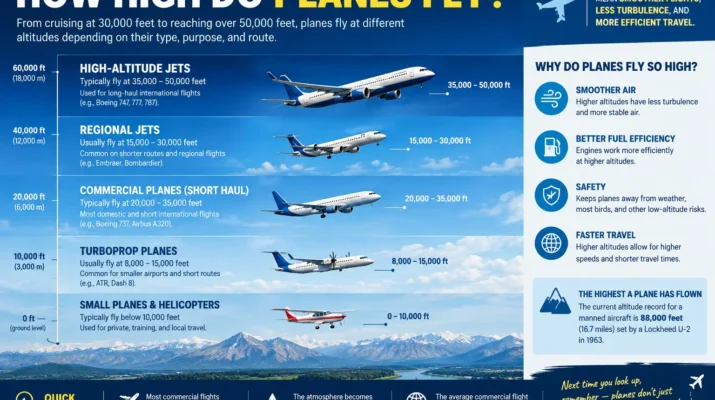
If you have ever looked up at a tiny aircraft crossing the sky, you may have wondered: how high do planes fly? Most commercial passenger jets cruise at roughly 30,000 to 42,000 feet above sea level. That equals about 5.7 to 8 miles, although many airline flights spend much of their cruising time around 35,000 to 39,000 feet.
However, aircraft do not all fly at the same altitude. Instead, their ideal height depends on aircraft design, weight, weather, route, air traffic, engine performance, and flight direction. Meanwhile, smaller propeller planes usually remain much lower, while some business jets can climb higher than standard airliners.
Understanding those differences explains not only how high aircraft travel but also why modern jets perform so well several miles above Earth.
How High Do Planes Fly During a Normal Flight?
A typical commercial jet often cruises between 30,000 and 42,000 feet. For example, an altitude of 35,000 feet equals about 6.6 miles or 10.7 kilometers above sea level.
Pilots and air traffic controllers commonly describe altitude using flight levels once an aircraft reaches higher-altitude airspace. For instance, Flight Level 350, written as FL350, represents a pressure altitude of approximately 35,000 feet under the standard altimeter setting.
However, the cruising altitude is not the aircraft’s altitude for the entire journey. Instead, a normal flight moves through several phases.
After takeoff, the aircraft climbs progressively toward its assigned cruising level. Next, it may remain at cruising altitude for most of the route. Later, it descends gradually as it approaches its destination.
Consequently, the answer to how high up do planes fly changes throughout a journey. A passenger jet might be only a few thousand feet above the ground shortly after departure but reach more than 35,000 feet during cruise.
How High Do Commercial Planes Fly?
When people ask how high do commercial planes fly, they are usually referring to large passenger aircraft operated by airlines. These jets generally cruise within the following range:
| Aircraft category | Typical altitude range |
|---|---|
| Small light aircraft | Around 2,000–12,000 ft |
| Turboprop passenger aircraft | Around 15,000–30,000 ft |
| Commercial passenger jets | Around 30,000–42,000 ft |
| Some business jets | Around 40,000–51,000 ft |
These figures are general ranges rather than fixed limits. In practice, a specific aircraft may fly lower or higher depending on its certification, route, operating conditions, and air traffic instructions.
Commercial jets can operate efficiently at high altitude partly because their engines and aerodynamic designs are built for high-speed flight through thinner air. If you want to understand the force that pushes an aircraft forward, what is thrust provides useful background on how aircraft engines overcome drag and maintain flight.
How High Do Planes Fly in Miles?
Because aviation normally measures altitude in feet, a figure such as 37,000 feet can sound difficult to visualize. Converting the number to miles makes it easier.
There are 5,280 feet in one mile. Therefore:
- 30,000 feet is about 5.7 miles.
- 35,000 feet is about 6.6 miles.
- 40,000 feet is about 7.6 miles.
- 42,000 feet is about 8 miles.
- 50,000 feet is about 9.5 miles.
So, if you are wondering how high do planes fly in miles, a typical commercial jet usually cruises roughly 6 to 8 miles above sea level.
Similarly, the answer to how many miles high do planes fly depends on the aircraft. A small general-aviation plane may remain only one or two miles above sea level, whereas a high-performance business jet can operate close to 10 miles high.
Why Do Passenger Jets Fly So High?
Flying several miles above Earth may seem unnecessary at first. However, high-altitude cruising offers several practical advantages.
Thinner Air Can Reduce Drag
As altitude increases, air density decreases. Consequently, an aircraft experiences less aerodynamic drag than it would encounter in denser air closer to the surface.
Lower drag can help a jet maintain high cruising speeds efficiently. However, thinner air also provides less lift and contains less oxygen for combustion. Therefore, aircraft designers must balance aerodynamics, engine performance, speed, and altitude.
Modern jet engines and wings are designed specifically to operate effectively within this environment.
High Altitudes Can Improve Fuel Efficiency
Commercial aviation consumes a large amount of fuel, so efficiency matters on every flight. Once a jet reaches an appropriate cruising altitude, thinner air can reduce resistance and help the aircraft travel efficiently over long distances.
However, climbing also consumes fuel. As a result, pilots and flight-planning systems select altitudes based on aircraft weight, distance, winds, weather, and other operational factors rather than simply climbing as high as possible.
Aircraft Can Avoid Some Weather
Many everyday weather conditions occur lower in the atmosphere. Therefore, cruising high can allow aircraft to operate above some clouds and weather systems.
Still, high altitude does not eliminate weather concerns. Thunderstorms can extend above normal cruising levels, while strong winds and clear-air turbulence may also occur at altitude. As a result, crews may change course or altitude when conditions require it.
How Aircraft Know Their Altitude
Modern aircraft need precise altitude information because thousands of flights can share busy airspace.
Aircraft primarily determine altitude through their air-data and altimeter systems, which use atmospheric pressure. Meanwhile, satellite navigation, radar-based systems, and other avionics provide complementary positioning and situational information.
Air traffic control then assigns suitable flight levels so aircraft remain safely separated.
Communication and automated data exchange also play major roles in modern aviation. For readers interested in how machines transmit measurements and operational information remotely, what is telemetry helps explain the broader technology behind sending data from one system to another.
Because atmospheric pressure changes, aviation uses standardized procedures for altimeter settings. At higher levels, aircraft use a common standard pressure reference. Consequently, aircraft operating in the same airspace can maintain consistent vertical separation.
Why Don’t Commercial Planes Fly Even Higher?
If thinner air reduces drag, it might seem logical for airlines to fly as high as possible. However, every aircraft has operating limits.
First, wings need airflow to produce sufficient lift. Since the atmosphere becomes progressively thinner with altitude, maintaining lift becomes more challenging.
Second, engines have performance limits. Although jet engines work well at high altitude, extremely thin air eventually limits their ability to generate the required performance.
Third, cabin pressurization becomes more demanding as the difference between cabin pressure and outside atmospheric pressure increases.
Finally, aircraft certification defines a maximum operating altitude. Pilots must remain within those limits regardless of whether the aircraft could physically climb higher under certain conditions.
Therefore, the best cruising altitude is a carefully calculated operating point rather than simply the highest altitude an aircraft can reach.
Does a Plane Stay at One Altitude for the Whole Cruise?
Not necessarily. In fact, a long-distance aircraft may gradually climb higher as it burns fuel.
At the beginning of a long flight, the plane carries large quantities of fuel and is relatively heavy. Therefore, a lower cruising level may initially provide better performance.
Later, the aircraft becomes lighter as fuel is consumed. At that point, air traffic conditions permitting, pilots may climb to a higher flight level.
This technique is commonly called a step climb.
For example, an aircraft might initially cruise at 33,000 feet and later climb to 35,000 or 37,000 feet. As a result, asking how high do planes fly does not always produce one altitude even for a single flight.
How High Do Small Planes and Drones Fly?
Small piston-engine airplanes generally operate much lower than large passenger jets. Depending on the aircraft and journey, many fly at only a few thousand feet, although capable general-aviation aircraft can operate considerably higher.
Turboprop aircraft can often fly higher than small piston aircraft but generally cruise below major passenger jets.
Meanwhile, unmanned aircraft represent a very different category. Consumer drones normally operate at comparatively low heights and are subject to aviation regulations that vary by country and type of operation. Therefore, someone learning what is a drone should distinguish between small consumer drones and much larger unmanned aircraft systems designed for specialized aviation roles.
Some military and research aircraft can also operate far above normal airline traffic. However, those specialized aircraft do not represent the typical experience of passenger aviation.
What Determines a Plane’s Cruising Altitude?
Pilots and flight-planning systems consider several variables before selecting an altitude.
Aircraft weight plays a major role because a heavily loaded plane may initially perform better at a lower level. Meanwhile, winds can make one altitude more efficient than another.
Weather matters as well. For example, crews may request a different altitude to avoid turbulence or unsuitable atmospheric conditions.
Air traffic control can also affect the final choice. Even if one altitude would be ideal for fuel efficiency, another aircraft may already occupy that level along the route.
The aircraft itself sets another boundary. Each model has certified operating limits and performance characteristics that determine where it can safely and efficiently fly.
Therefore, cruising altitude is dynamic rather than universal.
Can Passengers Breathe Normally at 35,000 Feet?
Yes, because passengers are inside a pressurized cabin.
Outside the aircraft at 35,000 feet, atmospheric pressure and available oxygen are far below the conditions humans normally experience at sea level. Consequently, an unpressurized passenger cabin would not be suitable for normal airline operations at those altitudes.
Instead, the aircraft’s environmental control and pressurization systems maintain cabin conditions equivalent to a much lower altitude. Passengers can therefore breathe normally even while the plane itself is more than six miles above sea level.
Aircraft also carry emergency oxygen systems for situations involving significant cabin-pressure loss.
Frequently Asked Questions
What altitude do most passenger planes fly at?
Most commercial passenger jets typically cruise somewhere around 30,000 to 42,000 feet. However, the exact altitude varies according to aircraft type, weight, route, weather, winds, and air traffic.
How high do planes fly in miles above Earth?
Commercial aircraft generally cruise roughly 6 to 8 miles above sea level. For perspective, 35,000 feet is approximately 6.6 miles.
Why do planes often fly around 35,000 feet?
Around this altitude, many jet aircraft can achieve an effective balance between aerodynamic efficiency, engine performance, speed, and fuel consumption. However, 35,000 feet is not a universal cruising altitude.
Can planes fly above 40,000 feet?
Yes. Some commercial aircraft can operate above 40,000 feet, while certain business, military, and specialized aircraft can fly substantially higher. However, each aircraft must remain within its certified operating limits.
Do planes fly above clouds?
Often, yes. Many common cloud layers occur below airline cruising altitude. However, some large storm clouds can reach or exceed normal cruising levels, so pilots route around hazardous weather rather than simply flying over every cloud.
A Simple Way to Remember Plane Altitudes
For everyday passenger travel, the easiest rule of thumb is that commercial jets normally cruise at around 30,000 to 42,000 feet, or approximately 6 to 8 miles above sea level.
Still, altitude changes according to the aircraft and conditions. Small airplanes generally stay much lower, while some business and specialized jets can travel higher. Meanwhile, commercial flight computers, pilots, and air traffic controllers continuously account for weight, weather, traffic, winds, and aircraft performance.
So, the next time you see a tiny jet crossing the sky, remember that it may be traveling more than six miles above you while moving through some of the most carefully managed airspace in modern transportation.