
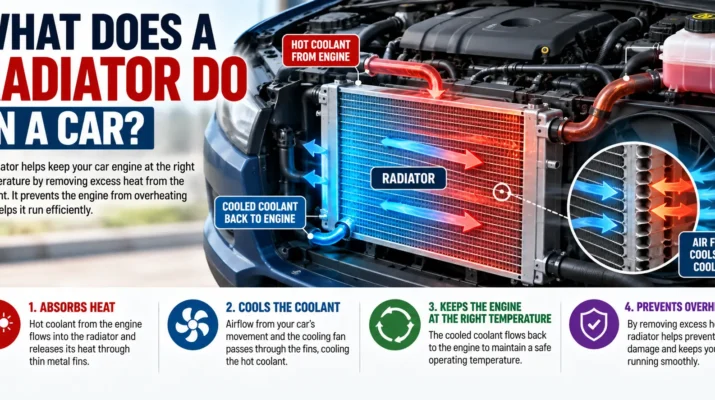
If you have ever wondered what does a radiator do in a car, its main job is simple: the radiator helps remove excess heat from the engine by cooling the liquid coolant circulating through the engine’s cooling system. The coolant absorbs heat from the engine, flows through the radiator, releases much of that heat into the surrounding air, and then returns to continue the cycle.
Without effective cooling, engine temperatures can rise beyond their intended operating range. As a result, overheating can lead to poor operation and potentially serious engine damage if the underlying problem is not addressed.
However, the radiator does not work alone. Instead, it is one part of a complete cooling system that typically includes coolant passages, hoses, a water pump, thermostat, cooling fans, pressure cap, and expansion or overflow reservoir.
What Does a Radiator Do in a Car?
A car engine produces a large amount of heat while operating. Although some heat leaves through the exhaust and surrounding components, the cooling system must manage the remaining thermal energy.
The radiator acts as a heat exchanger. Hot coolant enters it and travels through narrow internal tubes or passages. Meanwhile, thin metal fins provide a large surface area that allows heat to transfer to the surrounding air.
As the vehicle moves, outside air passes through the radiator. When natural airflow is insufficient, such as during slow traffic or while idling, electric or mechanically driven cooling fans can increase airflow.
After losing heat, the coolant leaves the radiator and continues through the cooling circuit.
Therefore, when someone asks what does the radiator do in a car, the clearest answer is that it transfers heat from engine coolant into the surrounding air.
How Does a Car Radiator Work?
Understanding the radiator becomes easier when you follow the coolant around the system.
First, the engine heats up as fuel burns and moving components operate. Meanwhile, coolant flowing through passages in and around the engine absorbs some of that heat.
Next, the water pump keeps coolant circulating through the cooling system. Depending on engine temperature and thermostat position, heated coolant can then travel toward the radiator.
Inside the radiator, the coolant passes through small channels surrounded by cooling fins. Air moving across those fins carries heat away.
Finally, the cooler liquid circulates back toward the engine, where the process repeats.
The pump is therefore an essential partner to the radiator. If you are interested in the broader engineering principles behind fluid movement, learning about types of pumps can help explain why pumps are designed differently depending on the fluid, pressure, flow rate, and application involved.
What Does the Radiator in a Car Do With Coolant?
Coolant is the working fluid that carries heat between the engine and radiator.
Modern cooling systems generally use a specified mixture based on antifreeze/coolant and water rather than plain water alone. However, the correct coolant specification and mixture depend on the vehicle, so owners should follow the manufacturer’s requirements.
As coolant passes through the engine, its temperature rises. It then moves toward the radiator when the cooling circuit allows it.
Once inside the radiator, heat moves from the coolant into the radiator’s metal structure. Air passing through the fins then carries that heat away.
The coolant itself is not supposed to be consumed during normal operation in a sealed, healthy system. Therefore, repeatedly needing to add coolant can indicate a leak or another cooling-system problem that needs investigation.
The Main Parts That Work With the Radiator
A radiator cannot control engine temperature by itself. Several components work together, and a problem with any one of them can cause symptoms that appear to involve the radiator.
Thermostat
The thermostat regulates coolant flow based largely on temperature. When the engine is cold, restricting circulation through the radiator helps the engine reach its intended operating temperature.
As temperature rises, the thermostat opens according to its design and allows greater coolant flow through the radiator.
A thermostat that fails to operate correctly can therefore contribute to overheating or an engine that runs cooler than intended.
Water Pump
The water pump circulates coolant through the engine and cooling system.
If circulation becomes inadequate, the radiator may be perfectly clean and functional yet still be unable to remove enough engine heat because hot coolant is not moving through the system properly.
Cooling Fan
At highway speeds, the vehicle’s forward movement provides substantial airflow through the radiator.
However, a stationary or slow-moving vehicle receives much less natural airflow. Therefore, cooling fans move air through the radiator when necessary.
A fan problem can sometimes cause a vehicle to run normally at higher road speeds yet become too hot in slow traffic.
Temperature Sensors
Modern vehicles use sensors and electronic controls to monitor operating conditions.
Although a traditional what is a thermocouple explanation describes one method of measuring temperature, automotive systems can use different sensor technologies to report coolant temperature to engine-control electronics and dashboard instruments.
The vehicle can then use temperature information for functions such as fan control, fuel-management strategies, warning indicators, and other engine-management tasks.
Why Does the Engine Need a Cooling System?
Internal combustion engines depend on controlled combustion, friction management, lubrication, and carefully designed clearances between components.
Excessive heat can interfere with those conditions.
For example, very high temperatures can degrade oil performance, stress gaskets and seals, distort components, and contribute to serious engine problems.
Yet an engine should not simply operate as cold as possible. Engineers design it to work within a suitable temperature range.
Therefore, the cooling system manages temperature rather than continuously trying to create the lowest possible temperature.
Engine operating speed also affects conditions inside the powertrain. If you are unfamiliar with engine-speed measurements, understanding what is rpm can make dashboard readings and basic engine discussions easier to follow.
What Does Radiator Do in a Car When You’re Driving?
Radiator operation changes with driving conditions.
When you are traveling at road speed, air naturally flows through the grille and radiator. Consequently, the radiator can transfer heat efficiently without relying entirely on the cooling fan.
When the vehicle stops in traffic, however, natural airflow drops sharply. The cooling fan may then switch on to maintain airflow.
Engine load also matters. Climbing a steep hill, towing within the vehicle’s rated limits, driving in hot weather, or operating under demanding conditions can increase the amount of heat the cooling system needs to manage.
As a result, radiator size, airflow, coolant capacity, fan performance, and other cooling-system specifications are matched to the vehicle’s engineering requirements.
What Happens When a Radiator Goes Bad?
A damaged or restricted radiator can reduce the cooling system’s ability to control temperature.
However, overheating does not automatically mean the radiator itself has failed.
Possible cooling-system problems include:
- Low coolant
- Coolant leaks
- Damaged radiator hoses
- A faulty thermostat
- Poor water-pump circulation
- A blocked radiator
- Damaged radiator fins
- Cooling-fan problems
- Pressure-cap problems
- Air trapped in the cooling system
- Internal engine problems
Therefore, diagnosis matters. Replacing the radiator without confirming the cause may fail to solve the overheating problem.
Common Signs of Radiator or Cooling-System Trouble
An unusually high temperature gauge is one of the most obvious warning signs. Likewise, a dashboard temperature warning should not be ignored.
Coolant underneath the vehicle can also indicate a leak. However, the leak might come from the radiator, a hose, a connection, the water pump, the reservoir, or another component.
You might also notice a sweet-smelling odor associated with some coolant formulations. Meanwhile, visible steam from the engine compartment can indicate a serious overheating or coolant-loss situation.
Another warning sign is repeatedly low coolant. Since a healthy closed system should not routinely lose significant coolant, frequent topping up deserves investigation.
Never remove a radiator or cooling-system pressure cap while the system is hot. Pressurized hot coolant can escape suddenly and cause severe burns. Instead, follow the vehicle manufacturer’s cooling-system inspection procedures.
Radiator vs. Intercooler: Are They the Same Thing?
Radiators and intercoolers can look similar because both commonly use tubes, fins, and moving air to remove heat. However, they perform different jobs.
The radiator primarily cools the engine coolant.
An intercooler, by contrast, is commonly used with turbocharged or supercharged engines to reduce the temperature of compressed intake air before it reaches the engine.
Compression heats air, so cooling the compressed charge can improve the conditions under which the engine receives it.
If you want to understand why compressed intake air is involved in the first place, how does a turbo work provides useful background on how exhaust energy can drive a compressor that forces more air into an engine.
Although the radiator and intercooler may sit near one another at the front of a vehicle, they should not be treated as interchangeable components.
Do Hybrid Cars Have Radiators?
Many hybrid vehicles still use liquid cooling systems, although their thermal-management architecture can differ from that of a conventional gasoline-only vehicle.
A hybrid may need to manage heat from an internal combustion engine as well as electrical components. Depending on the design, separate cooling circuits may serve the engine, power electronics, electric motors, or battery-related systems.
Consequently, seeing a radiator-like heat exchanger does not necessarily mean it serves only one component.
Readers learning what is a hybrid car can benefit from understanding this distinction because hybrid vehicles combine an internal combustion power source with electric propulsion components in different configurations.
Electric vehicles also require thermal management, although their systems differ because they do not have a conventional combustion engine producing heat in the same way.
Can You Drive With a Bad Radiator?
Driving with a confirmed cooling-system problem can be risky because an overheating engine can suffer expensive damage.
If the temperature gauge rises unusually high or an overheating warning appears, follow the vehicle manufacturer’s guidance. Continuing to drive while the engine temperature is excessive can make a relatively manageable cooling-system fault much more serious.
Likewise, do not assume that adding water or coolant permanently solves the problem. If coolant escaped, there is usually a reason.
A qualified technician can pressure-test the system, inspect for leaks, verify fan operation, evaluate coolant circulation, and investigate other possible causes.
How to Help Keep a Car Radiator Working Properly
Radiators do not require constant attention, but routine cooling-system maintenance can reduce the chance of unexpected problems.
First, use the coolant type specified by the vehicle manufacturer. Mixing incompatible coolant formulations can cause problems, so color alone should not be used to identify compatibility.
Next, inspect the coolant level according to the owner’s manual and only when it is safe to do so.
Also, watch for leaks around hoses, connections, the radiator, and the area beneath the vehicle.
At the front of the car, leaves, dirt, insects, or physical damage can restrict airflow through heat exchangers. However, delicate radiator fins can bend easily, so cleaning should be performed carefully.
Finally, follow the manufacturer’s coolant replacement schedule. Coolant condition changes with time, so replacement intervals can vary significantly among vehicles.
FAQs About Car Radiators
What does a radiator in a car do?
A radiator transfers heat from hot engine coolant to the surrounding air. The cooled liquid then circulates back through the cooling system to absorb more engine heat.
Does the radiator cool the engine directly?
Not exactly. Coolant absorbs heat while flowing through the engine. The radiator then removes heat from that coolant, so the complete system controls engine temperature.
Does a radiator use water?
Automotive cooling systems typically use a specified coolant mixture rather than relying on plain water for normal long-term operation. The correct formulation varies by manufacturer and vehicle.
Why does a radiator have a fan?
The fan creates airflow through the radiator when vehicle movement does not provide enough natural airflow. This is especially useful while idling or driving slowly.
Can a bad radiator cause overheating?
Yes, a leaking, damaged, or internally restricted radiator can contribute to overheating. However, thermostat problems, low coolant, fan failures, water-pump problems, and other faults can produce similar symptoms.
Is the radiator part of the air conditioning system?
No. The engine radiator belongs primarily to the cooling system. The air-conditioning condenser is a separate heat exchanger, although it is often mounted near the radiator at the front of the vehicle.
Keeping Engine Temperature Under Control
So, what does a radiator do in a car? It provides a place for heat carried by the engine coolant to transfer into the surrounding air. From there, the cooled liquid returns through the system and continues managing engine temperature.
However, the radiator depends on the water pump, thermostat, fans, coolant, hoses, sensors, and other components to perform effectively. Therefore, an overheating problem should be treated as a cooling-system issue until the actual cause has been identified.
For everyday drivers, the most useful approach is simple: watch the temperature gauge, use the correct coolant, investigate leaks promptly, and follow the manufacturer’s maintenance schedule. A properly functioning cooling system quietly controls heat every time the engine runs, which is exactly what allows the vehicle to operate within its intended temperature range.