
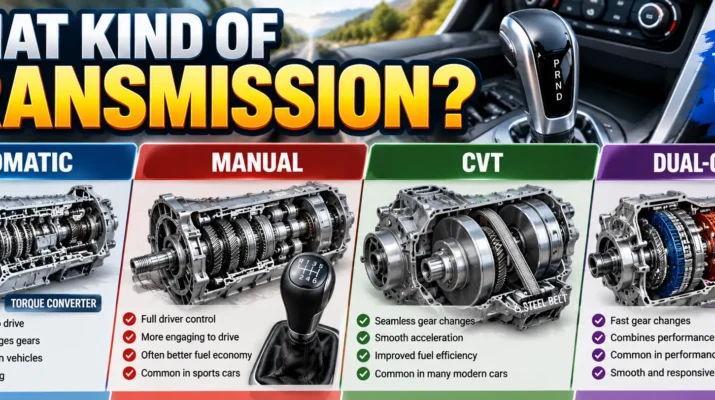
If you are asking what kind of transmission your vehicle has, you can usually find the answer through the owner’s manual, VIN-based vehicle information, transmission identification codes, or the way the vehicle operates. Modern cars may use a traditional automatic, manual, continuously variable transmission (CVT), dual-clutch (DCT), or an electrified drivetrain with a different type of gear system. Identifying the exact matters because fluid requirements, maintenance procedures, replacement parts, and driving characteristics can vary significantly between designs.
Knowing only that your car is “automatic” may not be enough. Two vehicles from the same manufacturer can use completely different transmissions depending on the model year, engine, trim, drivetrain, and market. Therefore, accurate identification should come before buying fluid, filters, sensors, or other -related parts.
What Kind of Transmission Do I Have?
The quickest starting point is your vehicle’s owner’s manual. Look under sections such as specifications, drivetrain, , maintenance, or fluids.
However, the manual may cover several configurations. Therefore, you may need your vehicle identification number, commonly called the VIN, to determine the exact unit installed in your car.
You can also check:
- Vehicle build labels
- Manufacturer parts catalogs
- Service documentation
- Transmission identification tags
- Dealership service departments
- Reputable VIN-based parts systems
If you are buying replacement components, use the exact year, make, model, engine, and drivetrain whenever possible. For example, front-wheel-drive and all-wheel-drive versions of the same vehicle may not always use identical drivetrain hardware.
Likewise, understanding what’s the difference between awd and 4wd can help when researching drivetrain configurations, since the works alongside other components that distribute power to the wheels.
Main Types of Vehicle Transmissions
Although manufacturers use many designs and brand-specific names, most passenger vehicles fall into a few major categories.
Traditional Automatic Transmission
A conventional automatic transmission changes gear ratios without requiring the driver to operate a clutch pedal.
Typically, it uses planetary gearsets, hydraulic controls, electronic controls, clutch packs, and a torque converter. Modern versions can have six, eight, ten, or another number of forward ratios depending on the design.
Because the system chooses gears automatically, driving is straightforward. However, fluid specification and service procedures can differ considerably between transmission models.
If you want to understand one of its main components, learning how does a torque converter work explains how many conventional automatics transfer engine power into the transmission while allowing the vehicle to remain stopped with the engine running.
Manual Transmission
A manual transmission gives the driver direct control over gear selection through a gear lever and clutch pedal.
When changing gears, the driver disengages the engine from the transmission using the clutch. After selecting the next ratio, releasing the clutch reconnects power.
This setup is mechanically different from a traditional automatic. Therefore, its lubricant requirements and service procedures can also be different.
A detailed explanation of how does a clutch work can make manual-operation easier to understand because the clutch manages the connection between the engine and gearbox during starts and gear changes.
Continuously Variable Transmission
A CVT does not operate like a conventional automatic with a fixed set of gear ratios.
Instead, many CVTs use variable-diameter pulleys connected by a belt or chain. By changing the effective pulley diameters, the transmission can continuously alter its ratio within a designed range.
As a result, engine speed may behave differently from what drivers expect from a stepped automatic. During acceleration, for instance, engine RPM can remain relatively steady while vehicle speed increases.
Some CVTs simulate conventional gear changes through software. Therefore, feeling distinct “shifts” does not necessarily prove that a vehicle has a traditional automatic.
Dual-Clutch Transmission
A dual-clutch transmission uses two clutch systems to manage different sets of gears.
Typically, one clutch handles one group of gears while the other manages another group. Electronic and hydraulic or electromechanical controls coordinate shifts.
As a result, a DCT can provide automated operation while retaining a mechanical layout that differs from a torque-converter automatic.
Some DCTs use wet clutches, while others use dry clutches. Consequently, maintenance requirements depend heavily on the specific design.
Transmission Types at a Glance
| Transmission | Driver Clutch Pedal | Fixed Gear Ratios | Common Driving Character |
|---|---|---|---|
| Traditional automatic | No | Yes | Smooth automatic shifts |
| Manual | Yes | Yes | Driver controls shifts |
| CVT | No | Usually no conventional fixed steps | Continuous ratio changes |
| DCT | No | Yes | Fast automated shifts |
| EV reduction gearbox | No | Usually single-speed | Smooth, uninterrupted acceleration |
This comparison helps identify the general technology. However, you still need the exact transmission specification before ordering fluid or internal service parts.
How to Identify a Transmission Using the VIN
The 17-character VIN contains standardized vehicle identification information, although it does not provide a simple universal character that directly identifies every transmission.
Instead, manufacturers, dealerships, parts databases, and service systems can use the VIN alongside factory build information to determine the vehicle’s configuration.
First, locate the VIN. Common locations include the lower windshield area on the driver’s side and the certification label around the driver’s door opening. It also appears on registration and other vehicle documents.
Next, enter it into a reputable manufacturer or parts lookup system when available. If the result does not identify the clearly, provide the VIN to a dealership parts or service department.
This method can be more dependable than identifying a by appearance because visually similar units may have different internal specifications.
Transmission Identification Codes and Labels
Many transmissions have an identification label, stamped code, barcode, or casting information on the housing.
The location varies by manufacturer and family. In some vehicles, you can see the identifier from underneath. In others, components may block the view.
Once you find a code, compare it with manufacturer service information or a reliable parts catalog.
However, avoid identifying the unit using casting numbers alone unless documentation confirms what they represent. A housing or component may be shared across several transmission variants.
Service history can also complicate identification. For instance, an older vehicle may have received a replacement at some point. In that situation, the transmission physically installed in the car may not exactly match its original factory equipment.
What Kind of Transmission Fluid Do I Need?
If your main concern is what kind of transmission fluid to buy, identify the transmission first and then check its required fluid specification.
Do not select fluid based only on whether the vehicle has an automatic transmission.
Different automatic transmissions may require different ATF specifications. Meanwhile, CVTs usually require fluids designed for their specific operating requirements, and DCTs can have their own lubricant specifications.
Manual gearboxes also vary. Some use gear oil, while others require a manufacturer-specified fluid.
Therefore, the safest process is:
- Identify the exact vehicle and transmission.
- Check the owner’s manual or manufacturer service information.
- Find the required fluid specification.
- Match the product to that specification.
- Verify the required quantity for the type of service being performed.
Brand name alone is not enough. The specification printed on the fluid container should match the requirement for the transmission.
What Kind of Transmission Fluid Do I Need for My Car?
When asking what kind of transmission fluid do I need, avoid relying solely on fluid color.
Fresh automatic fluid is often red or another recognizable color, but manufacturers use different formulations. Meanwhile, age and operating conditions can change how fluid looks.
Instead, check the specification.
For example, the owner’s manual may identify a particular manufacturer standard. A compatible aftermarket product should clearly state that it meets or is suitable for the required application according to the product manufacturer’s guidance.
Also, verify the service procedure. Some modern transmissions do not use a traditional dipstick. Instead, technicians check the level through a fill or inspection opening while following a specified temperature range and procedure.
Because incorrect fluid level can affect operation, do not assume every transmission can be checked using the same method.
What Kind of Transmission Fluid Does a 4L60E Take?
People researching older General Motors vehicles often ask what kind of transmission fluid does a 4L60E take.
The correct choice depends partly on the vehicle application, service information, and current manufacturer guidance. Dexron-family automatic fluids are closely associated with GM automatic transmissions, but specifications have changed over time.
Therefore, check the service information for your exact vehicle and before filling it. If the has been rebuilt or modified, follow the rebuilder’s requirements when they differ from the original application.
Also, distinguish between a simple drain-and-fill and a completely dry . They require different quantities because fluid can remain in the torque converter, cooler, lines, and internal passages during routine service.
RPM Can Help You Understand Transmission Behavior
Drivers often notice transmission behavior through engine speed.
If you are unfamiliar with the term what is rpm, it refers to revolutions per minute and indicates how quickly a rotating component, such as the engine crankshaft, is turning.
With a conventional automatic, RPM commonly rises during acceleration and then drops as the transmission selects a higher gear.
A CVT may behave differently. During stronger acceleration, the engine can remain near a particular RPM range while the transmission continuously adjusts its ratio.
Meanwhile, a manual transmission leaves the timing of most gear changes to the driver.
These differences can offer clues about transmission type. Still, they should not replace proper identification through vehicle specifications.
Signs a Transmission May Need Attention
Knowing your transmission type becomes especially useful when troubleshooting unusual behavior.
Possible symptoms can include delayed engagement, harsh shifting, slipping sensations, unusual noises, fluid leaks, warning lights, or unexpected changes in engine speed.
However, these symptoms do not automatically mean the transmission itself has failed. Engine problems, sensors, mounts, driveline components, software, and other systems can sometimes produce similar behavior.
For example, if you are asking why does my car jump when i accelerate, transmission behavior is one possibility, but engine performance, mounts, axles, ignition problems, or other drivetrain issues may also need investigation.
Therefore, diagnose the symptom rather than replacing parts based on a single assumption.
Check for Diagnostic Trouble Codes
Modern electronically controlled transmissions communicate with vehicle control modules.
When the system detects certain faults, it may store diagnostic trouble codes. A suitable scan tool can retrieve those codes and provide a useful starting point.
However, a code usually identifies a circuit, operating condition, or detected fault rather than proving that a specific component needs replacement.
For instance, a shift-related code could involve wiring, a solenoid, fluid condition, hydraulic pressure, a sensor, or an internal mechanical problem.
Proper diagnosis still matters.
Common Transmission Identification Mistakes
One common mistake is assuming every vehicle without a clutch pedal uses the same type of automatic transmission.
A car could instead have a CVT, DCT, hybrid transaxle, or another automated system.
Another mistake involves relying on the gear selector. Labels such as P, R, N, and D appear across several technologies, so they do not identify the internal design.
Likewise, do not order fluid from the vehicle model name alone. Engine, drivetrain, production date, trim, and regional configuration can change the required transmission.
Finally, do not assume the is original on an older used vehicle. Replacement units, rebuilds, and drivetrain swaps can make physical identification necessary.
Frequently Asked Questions
Can I find my transmission type from my license plate?
Some parts and service databases can use registration information to retrieve vehicle specifications. However, availability and accuracy vary by country and database. Therefore, confirm the result against the VIN or manufacturer information before buying transmission-specific parts.
Does the VIN tell me exactly which transmission I have?
The VIN helps identify the vehicle’s factory configuration, and manufacturer databases can often use it to retrieve transmission information. However, there is no single universal VIN position that directly identifies every transmission across all manufacturers.
Is a CVT considered an automatic transmission?
Yes, in everyday driving terms, a CVT operates automatically because the driver does not manually change conventional gears. Mechanically, however, it differs substantially from a traditional stepped automatic transmission.
Can I use regular automatic transmission fluid in a CVT?
Do not assume conventional ATF and CVT fluid are interchangeable. Use the exact fluid specification required by the vehicle or manufacturer.
How do I know whether my car has a DCT?
Check the owner’s manual, manufacturer specifications, VIN-based information, or code. Driving feel alone is not a dependable identification method.
Is transmission fluid universal?
No. Transmission fluids can have different friction characteristics, viscosities, additive packages, and specifications. Therefore, match the fluid to the exact transmission requirement.
The Best Way to Confirm Your Transmission
When you need to know what kind of transmission is in your car, start with documentation rather than guessing from driving feel. Check the owner’s manual, then use the VIN and manufacturer information to narrow down the exact configuration.
If the vehicle is older or has an uncertain repair history, inspect the identification code as well. That extra step can prevent you from ordering incompatible parts or fluid for a unit that was replaced in the past.
Once you know the exact , maintenance becomes much simpler. You can choose the proper fluid specification, follow the correct level-checking procedure, locate compatible service parts, and interpret unusual shifting behavior more accurately. For expensive repairs or uncertain identification, confirming the transmission with a qualified technician or manufacturer-specific service source is usually worth doing before buying parts.