
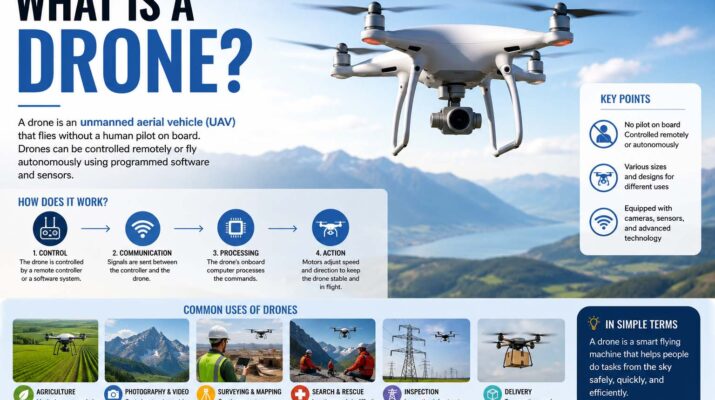
What is a drone? A drone is an aircraft that can fly without a person physically sitting inside it. Most drones are controlled remotely or can follow programmed flight paths using onboard computers, sensors, and navigation systems. Depending on the design, drones may be used for photography, mapping, inspections, agriculture, surveying, delivery, recreation, and other applications. Consumer drones often include cameras and features such as GPS positioning, obstacle detection, and automated flight modes, while larger professional drones can carry specialized equipment for specific tasks.
Modern drones are used in many industries including photography, agriculture, construction, security, delivery services, filmmaking, and emergency response. Some drones are small enough to fit in a backpack, while others are large military aircraft designed for surveillance and defense missions.
How Does a Drone Work?
Understanding how drones work helps beginners use them more effectively. A drone uses motors and propellers to create lift and movement.
The flight controller acts like the drone’s brain. It receives commands from the remote controller and adjusts the motors to stabilize the aircraft during flight.
Most drones include:
Flight Controller
This system manages balance, direction, and altitude.
GPS Technology
GPS helps drones maintain position, return home automatically, and follow pre-planned routes.
Battery System
Rechargeable lithium batteries power the drone and determine flight time.
Camera and Sensors
Many drones include HD or 4K cameras along with sensors that detect obstacles and improve stability.
Remote Controller or Mobile App
Pilots control drones through a controller or smartphone application.
Together, these technologies allow drones to fly safely and capture aerial footage from unique angles. Many advanced drone systems also rely on what is telemetry technology to transmit flight data between the aircraft and the pilot.
Types of Drones Available Today
There are several categories of drones designed for different purposes.
Consumer Drones
These are popular for photography, travel videos, and beginner flying. Brands like DJI and Autel dominate this category.
Racing Drones
Racing drones are lightweight and extremely fast. They are built for competitive flying and FPV racing experiences.
Commercial Drones
Businesses use commercial drones for inspections, mapping, surveying, and agriculture.
Military Drones
Governments use advanced drones for surveillance, reconnaissance, and defense operations.
Toy Drones
These affordable drones are designed for kids and beginners learning basic controls.
What Is a Drone Used for in Warfare?
One common question people ask is: what is a drone used for in warfare?
Military drones are used for surveillance, reconnaissance, target tracking, and tactical operations. They allow armed forces to gather information without risking pilots inside aircraft.
Some military drones monitor enemy movements using advanced cameras and thermal sensors. Others can support search missions, border security, and intelligence collection.
Modern warfare drones often use artificial intelligence, satellite communication, and long-range flight systems. Countries around the world continue investing heavily in military drone technology because it improves operational efficiency and situational awareness.
What Is the Purpose of a Weaponized Drone?
Weaponized drones can support military operations by reaching dangerous areas without exposing soldiers directly to combat zones. They may carry guided systems, surveillance tools, or electronic warfare equipment.
These drones are controversial because they raise ethical and legal discussions about autonomous technology and modern warfare. However, supporters argue they reduce risks for military personnel and improve precision during operations.
What Is Headless Mode on a Drone?
Many beginners ask: what is headless mode on a drone?
Headless mode is a beginner-friendly drone setting that simplifies flight controls. Normally, drone movement depends on the direction the drone is facing. In headless mode, the controls stay relative to the pilot instead.
For example, pressing forward on the controller always moves the drone away from the user, regardless of its orientation.
This feature helps beginners avoid confusion while learning basic flight controls. It is especially useful when the drone is far away and difficult to see clearly.
Although headless mode is helpful for training, experienced pilots often disable it for more precise control.
Modern training platforms sometimes combine drone simulations with augmented reality applications to help new pilots practice navigation safely.
What Is a Fiber Optic Drone?
A fiber optic drone uses fiber optic communication technology instead of traditional radio signals. These drones are connected using ultra-thin fiber optic cables that transmit control signals and data.
Unlike traditional wireless drones, fiber optic drones are less vulnerable to electronic jamming or signal disruption. This makes them useful in specialized environments where communication reliability matters.
Benefits of Using Drones
Drones offer many advantages across different industries and everyday activities.
Better Aerial Photography
Drones capture cinematic footage from angles that were once only possible using helicopters.
Faster Inspections
Companies inspect buildings, bridges, towers, and pipelines safely without sending workers into dangerous areas.
Improved Agriculture
Farmers use drones to monitor crops, irrigation systems, and plant health.
Emergency Response
Rescue teams use drones during floods, earthquakes, and search operations to locate people quickly.
Delivery Services
Some businesses are testing drone delivery systems for packages, medicine, and food transportation.
How to Fly a Drone Safely
Learning how to fly safely is important for every beginner.
Step 1: Read the User Manual
Every drone model has different controls and safety recommendations.
Step 2: Charge the Battery Fully
Low battery levels can reduce flight stability and safety.
Step 3: Start in an Open Area
Practice in large open spaces away from trees, buildings, and power lines.
Step 4: Use Beginner Mode
Many drones include beginner settings that limit speed and altitude.
Step 5: Learn Basic Controls
Practice hovering, turning, ascending, and landing before attempting advanced maneuvers.
Step 6: Follow Local Drone Laws
Always check local drone regulations and no-fly zones before flying.
Some advanced controllers also provide what are haptics features through vibration feedback to alert pilots about warnings or flight conditions.
Drone Troubleshooting Tips
Even modern drones can experience technical problems. Here are common drone issues and solutions.
Drone Won’t Connect to Controller
Restart both devices and ensure firmware is updated.
Weak GPS Signal
Move to an open area away from tall buildings and heavy interference.
Drone Drifts During Hovering
Calibrate the compass and gyroscope settings.
Short Battery Life
Avoid flying in strong wind and replace old batteries if performance drops.
Camera Feed Lag
Reduce transmission distance and check Wi-Fi interference.
Proper maintenance and regular software updates help improve drone performance and reliability. Many drone components, including motors and control mechanisms, work together with what is an actuator technology to produce accurate movement.
Drone Comparison: Beginner vs Professional Drones
Beginner drones are usually affordable, lightweight, and easy to control. They focus on simple flying experiences and safety features.
Professional drones offer advanced cameras, longer flight times, obstacle sensors, and intelligent flight modes. These drones are ideal for filmmakers, surveyors, and commercial operators.
If you are just learning, starting with a beginner drone is usually the best choice before upgrading to advanced models.
Future of Drone Technology
Drone technology continues evolving rapidly. Artificial intelligence, automation, and smart navigation systems are shaping the future of UAVs. Modern design also draws on principles of what is mechatronics?, combining mechanical, electronic, and software systems into a single platform.
In the coming years, drones may become common for delivery services, traffic monitoring, farming automation, and infrastructure management.
Some companies are also developing passenger drones and flying taxi concepts for urban transportation. As battery technology improves, drones will likely achieve longer flight times and better safety systems.
FAQ About Drones
Are drones legal to fly?
Drone laws vary by country. Many regions require pilots to follow altitude limits and restricted airspace rules.
Can beginners fly drones easily?
Yes. Most modern drones include beginner modes, GPS stabilization, and automated controls.
How far can drones fly?
Consumer drones usually fly between a few hundred meters and several kilometers depending on the model.
Do drones need internet access?
Most drones do not require internet during flight, but apps and maps may need connectivity for updates.
What is the average drone flight time?
Most consumer drones fly between 20 and 45 minutes on a single battery charge.
Conclusion
Understanding what is a drone helps people see how important drone technology has become in modern life. From photography and agriculture to delivery systems and military operations, drones continue transforming industries around the world.