
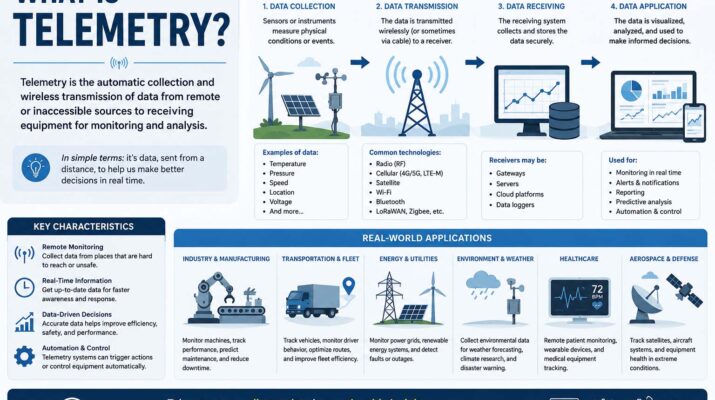
Telemetry is the process of collecting data from a device, machine, vehicle, or system and sending it somewhere else for monitoring and analysis. For example, it can gather details about temperature, speed, performance, or system activity and send them in real time. So, understanding what is telemetry shows how organizations watch their systems, spot problems, and make better decisions with remote data.
Many people ask about it because they see the term in software tools, hospitals, or engineering work. In short, it lets devices collect, send, and analyze data from far away on their own.
What Is Telemetry?
Telemetry is the automatic process of collecting measurements from a remote source. Then, it sends that information to another place for monitoring, analysis, and decisions.
The word comes from Greek roots that mean “remote measurement.” In simple terms, it helps people see what is happening inside a system without being there in person.
For example, it is common in software monitoring, healthcare, and space exploration. In addition, factories, phone networks, transport companies, and Internet of Things (IoT) devices rely on it.
As a result, it gives valuable insights that improve performance, reliability, and efficiency.
How Does Telemetry Work?
The process is quite simple. First, sensors or software collect information from a device, app, or system.
Next, the data travels through a network, such as the internet, Wi-Fi, mobile networks, or satellites. Then, monitoring tools or dashboards store and analyze it.
Finally, the system creates reports, alerts, or charts that help users understand performance.
Usually, this happens nonstop and in real time. Therefore, keeping what is continuity during data transfer helps monitoring run without breaks.
What Is Telemetry Data?
One of the most common related questions is what is telemetry data. Simply put, it is the information a monitored source collects and sends.
For example, it can include temperature readings, heart rate, GPS locations, and app performance numbers. Similarly, it can cover network traffic, machine conditions, and fuel use.
Organizations use this information to catch problems early, improve performance, and make better decisions. In fact, it forms the base of many modern monitoring and analytics tools.
Why Is Telemetry Important?
This technology gives businesses and organizations several advantages.
Real-Time Monitoring
First, users can watch equipment, apps, or devices as events happen.
Faster Problem Detection
In addition, it helps teams find issues before they turn into major failures.
Improved Efficiency
Moreover, constant monitoring helps companies run their operations better.
Better Decision-Making
Also, organizations gain useful insights from data-driven analysis.
Reduced Downtime
Finally, early alerts help prevent costly outages.
For these reasons, remote monitoring has become critical across many industries.
Common Applications of Telemetry
Many different industries use it every day.
Software Development
Developers use monitoring data to track app performance, errors, and user behavior. Also, understanding basic coding concepts helps developers read this data and fix software faster.
Healthcare
Similarly, doctors and nurses use remote monitoring systems to follow patient health from a distance.
Transportation
Likewise, fleet managers track vehicle locations, fuel use, and repair needs.
Manufacturing
Factories watch machine performance and production lines. In addition, these systems often work with what is instrumentation tools to measure and control key operating conditions.
Aerospace
Above all, space missions rely heavily on remote monitoring to watch spacecraft systems from Earth.
Clearly, these uses show how flexible this technology is.
What Is Telemetry Nursing?
Healthcare is one of the most important fields that uses remote monitoring. In fact, many people search for what is telemetry nursing after a hospital visit or during nursing school.
Simply put, it means caring for patients whose vital signs are tracked nonstop by electronic equipment. For example, these machines track heart rate, blood pressure, breathing rate, and oxygen levels.
Nurses watch this data and act quickly when readings look abnormal. As a result, this monitoring improves patient safety and supports fast medical care.
What Is a Telemetry Nurse?
A related question is what is a telemetry nurse. In short, this is a registered nurse who specializes in watching patients through electronic equipment.
Usually, they care for patients with heart conditions or those recovering from heart problems. In addition, they look after patients with breathing issues and other high-risk conditions.
Therefore, these nurses must understand both patient care and monitoring technology. For example, they read electronic data, respond to alerts, and help plan treatment.
Although this is a healthcare role, it relies heavily on advanced monitoring systems.
What Is OpenTelemetry?
A fast-growing topic in software is what is OpenTelemetry. Basically, it is a free, open-source toolkit that makes it easier to collect monitoring data from apps and cloud systems in one standard way.
For example, developers use it to gather logs, metrics, and traces. As a result, engineering teams can track app performance and find technical problems.
Moreover, it works with any vendor, improves visibility, and makes monitoring and troubleshooting simpler. The official OpenTelemetry documentation explains how to set it up.
As cloud computing grows, OpenTelemetry has become a key tool for modern software teams. Similarly, low-level software such as what is a bootloader creates diagnostic information that engineers can monitor while hardware starts up.
Telemetry vs Traditional Monitoring
Although the two are closely related, they are not exactly the same.
| Feature | Telemetry | Traditional Monitoring |
|---|---|---|
| Data Collection | Automated | Often limited |
| Real-Time Data | Yes | Sometimes |
| Remote Access | Yes | Varies |
| Analytics | Advanced | Basic |
| Scalability | High | Moderate |
| Automation | Extensive | Limited |
Overall, remote data monitoring offers a more complete and automated way to collect, send, and analyze information.
How Businesses Use Telemetry for Growth
More and more companies rely on this technology to perform better and stay competitive. For example, they use it to watch customer experiences and make apps more reliable. In addition, it helps them cut costs, predict machine failures, and use resources wisely.
For instance, an online store can spot website slowdowns before customers notice.
Similarly, factories can watch their machines and plan repairs before breakdowns happen. Also, many automated production lines use what is an actuator to take physical actions based on this data and sensor feedback.
As a result, organizations run more efficiently and serve customers better.
Troubleshooting Telemetry Systems
Like any technology, monitoring systems can run into problems.
Missing Data
First, check the sensors, network connections, and data collection settings.
Delayed Reporting
Next, remember that network traffic or setup errors can delay data.
Inaccurate Measurements
Also, calibration problems or faulty sensors can give wrong readings.
Storage Issues
In addition, too little storage space can stop the system from keeping data.
Security Concerns
Finally, use encryption and access controls to protect sensitive information.
In the end, regular maintenance and steady monitoring keep the system reliable.
Future Trends in Telemetry
This field keeps changing quickly. For example, new trends include artificial intelligence, predictive analytics, and edge computing. In addition, smart IoT devices, cloud monitoring platforms, and advanced automation are growing.
As a result, these ideas will allow even more powerful monitoring and decision-making.
As technology becomes more connected, remote monitoring will play a bigger role in healthcare, transport, factories, aerospace, and software.
Frequently Asked Questions
What is telemetry?
It is the automatic collection and sending of data from remote devices or systems. As a result, people can monitor and analyze them from afar.
What is telemetry data?
It is the information these systems gather and send. For example, it includes performance numbers, sensor readings, and operating measurements.
What is telemetry nursing?
It means caring for patients through electronic systems that track vital signs nonstop. In addition, nurses follow other health information on screen.
What is a telemetry nurse?
It is a nurse who specializes in watching patients with monitoring equipment. Also, they read and act on the collected data.
What is OpenTelemetry?
OpenTelemetry is an open-source toolkit that helps developers collect logs, metrics, and traces from apps. Therefore, teams can monitor and understand their software better.
Conclusion
Understanding what is telemetry matters more than ever in a world full of connected devices, cloud platforms, and real-time data. After all, it helps organizations collect, send, and analyze information, which improves performance, reliability, and decisions.
As industries keep adopting smart technology and automation, remote monitoring will remain one of the most valuable tools for running systems well.