
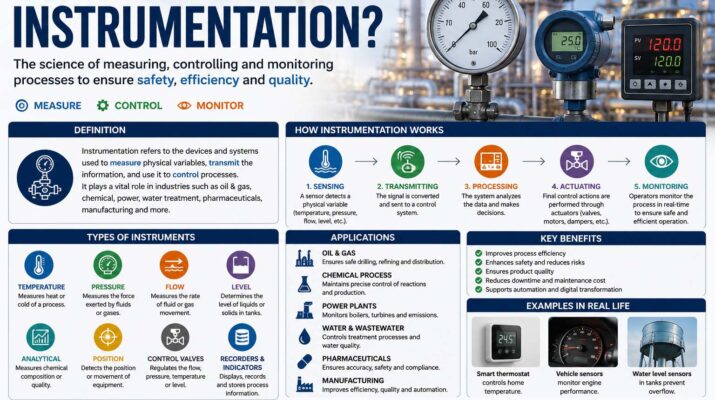
What is instrumentation? It is the use of instruments, sensors, transmitters, controllers, and related devices to measure, monitor, and help control physical processes. From factory equipment to power plants and water treatment systems, these technologies provide the information needed for safe and efficient operation.
Instrumentation supports accurate measurement, data collection, system monitoring, and process control. Therefore, it plays an important role in manufacturing, energy, healthcare, transportation, research, utilities, and industrial automation.
Without reliable measurement systems, modern factories, chemical facilities, laboratories, and power plants would struggle to maintain consistent operating conditions. In addition, engineers would have difficulty identifying problems before they affect equipment or production.
This guide explains how these systems work, their main components and types, and why they matter in modern engineering.
Quick Overview of Instrumentation
| Feature | Description |
|---|---|
| Purpose | Measure, monitor, record, and help control processes |
| Common devices | Sensors, transmitters, gauges, controllers, and analyzers |
| Common variables | Temperature, pressure, flow, level, speed, voltage, and current |
| Industries | Manufacturing, oil and gas, healthcare, power generation, and water treatment |
| Main goal | Improve accuracy, safety, reliability, and efficiency |
| Related field | Instrumentation and control engineering |
What Is Instrumentation?
Instrumentation refers to the equipment and techniques engineers use to measure, monitor, and help control physical variables and processes.
In engineering, it can range from a simple temperature gauge to a complex industrial system connected to programmable logic controllers (PLCs), control valves, SCADA software, and automated equipment.
Common variables include:
- Temperature
- Pressure
- Flow
- Level
- Speed
- Voltage
- Current
- Humidity
- Position
- Vibration
- pH
These measurements help operators and automated systems understand current process conditions.
For example, a chemical plant may continuously measure temperature, pressure, flow, and liquid level. If a reading moves outside its acceptable range, the system can alert an operator or initiate a corrective action.
Similarly, remote monitoring uses related measurement principles. Our guide explaining what is telemetry explores how equipment sends measurement data to another location for monitoring and analysis.
What Does Instrumentation Mean in Engineering?
In engineering, instrumentation means the devices and methods used to obtain reliable information about a system’s condition or behavior.
In other words, it connects measurement technology with monitoring, automation, and process control.
For example, a basic pressure gauge displays a measured value. However, an advanced pressure transmitter can send the same information to a controller.
The controller may then use that measurement to adjust a valve or trigger an alarm.
As a result, engineers can monitor operating conditions more effectively and respond to changes when necessary.
How Does an Instrumentation System Work?
Most measurement and control systems follow a basic sequence:
Measurement → Signal transmission → Processing → Display or control
Although individual systems differ, these stages explain how measurement information moves from equipment to an operator or controller.
Step 1: Measurement
First, a sensor detects a physical condition.
Common examples include:
- Temperature sensors
- Pressure sensors
- Flow meters
- Level sensors
- Humidity sensors
The physical quantity that the system measures is often called a process variable.
For example, a temperature sensor detects the temperature of a liquid flowing through a pipe.
Step 2: Signal Transmission
Next, the measuring device produces a signal that other equipment can interpret.
Depending on the system, the signal may be electrical, pneumatic, or digital.
A transmitter can then send the information to a controller, PLC, computer, or monitoring display.
For instance, an industrial pressure transmitter may send a standardized electrical signal to a control system.
Step 3: Signal Processing
After receiving the measurement, a controller or processing device evaluates the information.
For example, it may compare the current temperature with a desired operating value.
If the measurement falls outside the acceptable range, the system can generate an alarm.
In addition, a controller may calculate the adjustment needed to restore normal operating conditions.
Consequently, the equipment can respond more consistently to changing process conditions.
Step 4: Process Control
Finally, a control system may adjust equipment in response to the measurement.
Examples include:
- Valves
- Pumps
- Motors
- Heaters
- Cooling systems
- Actuators
For instance, a controller may reduce heating when a temperature sensor detects excessive heat.
As a result, the system can maintain more consistent operating conditions.
Main Components of Instrumentation Systems
Depending on the application, a measurement and control system may contain several interconnected components.
However, the exact equipment depends on the application and required level of automation.
Sensors
Sensors detect physical conditions or environmental changes.
Examples include:
- Temperature sensors
- Pressure sensors
- Proximity sensors
- Motion sensors
- Level sensors
- Vibration sensors
In most applications, sensors provide the initial measurement information.
For example, a level sensor can detect the amount of liquid inside a storage tank.
As a result, operators can monitor storage conditions and identify unexpected changes.
Transmitters
Transmitters convert, condition, or communicate measurement signals.
They are especially useful when sensors operate far from the main control room.
For example, a pressure transmitter can send process information to a centralized monitoring system.
Therefore, operators can monitor equipment without standing beside every measuring device.
Controllers
Controllers evaluate measurement information and determine whether corrective action is necessary.
Common examples include:
- Programmable Logic Controllers (PLCs)
- PID controllers
- Distributed Control Systems (DCS)
For instance, a PID controller can continuously adjust a control output to help maintain a desired process value.
Display and Monitoring Devices
Operators need interfaces that show current measurements and system conditions.
Common examples include:
- Digital displays
- Touchscreen panels
- Human-machine interfaces (HMIs)
- SCADA software
- Analog gauges
In addition, modern interfaces may display alarms, historical trends, and equipment status.
Final Control Elements
Final control elements physically influence a process after receiving commands from a control system.
Examples include:
- Control valves
- Electric motors
- Pumps
- Actuators
For example, a control valve can adjust liquid flow in response to a controller’s command.
Together, these components allow engineers to measure real-world conditions and respond appropriately.
Types of Instrumentation and Their Applications
Different industries require specialized measurement equipment.
Therefore, engineers often classify instrumentation according to its purpose and operating environment.
Process Instrumentation
Process instrumentation monitors variables such as temperature, pressure, flow, and level.
Industries that use these systems include:
- Oil and gas
- Chemical processing
- Food production
- Water treatment
- Power generation
- Pharmaceuticals
For example, a water treatment facility may monitor tank levels and flow rates to maintain consistent operations.
Electrical Instrumentation
Electrical instrumentation measures electrical quantities, including:
- Voltage
- Current
- Resistance
- Frequency
- Power
For instance, technicians use voltmeters and ammeters to evaluate electrical systems.
However, accurate testing also requires reliable wiring and electrical connections.
Understanding what is continuity can therefore help when checking circuits, cables, and electrical measuring equipment.
Medical Instrumentation
Medical instrumentation measures, monitors, or analyzes physiological information.
Examples include:
- ECG machines
- Blood pressure monitors
- MRI systems
- Ultrasound equipment
- Patient monitoring devices
These instruments support diagnosis, monitoring, treatment planning, and research.
For example, an ECG records electrical activity associated with the heart.
Similarly, blood pressure monitors provide information that healthcare professionals can use when assessing patients.
Scientific Instrumentation
For this reason, scientific laboratories use specialized instruments to obtain accurate and repeatable measurements.
Examples include:
- Spectrometers
- Microscopes
- Analytical balances
- Data acquisition equipment
- Laboratory sensors
Because experimental results depend on reliable observations, scientists must carefully select and maintain their measuring equipment.
Instrumentation Measurement: Common Variables
Instrumentation measurement involves determining a physical quantity through an instrument or measurement system.
The following table shows common variables and suitable devices.
| Process Variable | Example Instrument |
|---|---|
| Temperature | Thermocouple or RTD |
| Pressure | Pressure transmitter or gauge |
| Flow | Flow meter |
| Level | Level transmitter |
| Voltage | Voltmeter |
| Current | Ammeter |
| Humidity | Humidity sensor |
| Vibration | Accelerometer |
| pH | pH analyzer |
However, engineers cannot select an instrument based only on the variable they want to measure.
They must also consider accuracy, measurement range, operating temperature, environmental conditions, and maintenance requirements.
For example, a sensor suitable for an ordinary laboratory may not withstand the conditions inside a high-temperature industrial process.
Therefore, proper instrument selection is essential for reliable results.
Common Industrial Instruments
Although their production processes differ, many industrial facilities use similar measuring devices.
Common examples include:
- Pressure gauges
- Pressure transmitters
- Flow meters
- Temperature transmitters
- Thermocouples
- Resistance temperature detectors (RTDs)
- Level indicators
- Level transmitters
- pH analyzers
- Load cells
- Vibration sensors
- Control valves
For instance, manufacturers may use thermocouples to monitor equipment temperature and load cells to measure weight or force.
Meanwhile, water treatment facilities may rely on flow meters, level transmitters, and pH analyzers.
Therefore, engineers select each device according to the measurement task and operating requirements.
What Is Instrumentation Engineering?
Instrumentation engineering focuses on designing, selecting, installing, calibrating, maintaining, and improving measurement and control systems.
Instrumentation engineers work with equipment and technologies such as:
- Sensors
- Transmitters
- PLC programming
- Automation systems
- Process control
- Industrial communication
- Calibration equipment
- SCADA systems
- Safety systems
- Control valves
For example, an instrumentation engineer may design a measurement system for an industrial production line.
After installation, the engineer may also help test, calibrate, and maintain the equipment.
Industries That Employ Instrumentation Engineers
Common industries include:
- Manufacturing
- Oil and gas
- Pharmaceuticals
- Power generation
- Aerospace
- Chemical processing
- Renewable energy
- Water treatment
Because modern control systems combine hardware and software, instrumentation engineers often need knowledge of electronics, programming, and communication networks.
Students exploring related technology careers may also find our computer engineering vs computer science comparison useful.
Why Is Instrumentation Important?
Instrumentation provides the information engineers need to understand equipment behavior and maintain reliable processes.
Without accurate measurements, operators may struggle to identify abnormal conditions or determine when corrective action is necessary.
Improved Measurement Accuracy
Instruments provide quantitative information that can reduce dependence on manual observation.
For example, a calibrated pressure transmitter can continuously report changes in pipeline pressure.
As a result, operators can monitor conditions more consistently.
Better Operational Safety
Continuous monitoring can help identify abnormal operating conditions.
For instance, a temperature alarm may warn operators when equipment becomes excessively hot.
However, measurement equipment alone does not guarantee safety.
Instead, reliable protection also requires proper system design, maintenance, and operating procedures.
Higher Process Efficiency
Measurement systems help operators identify unnecessary process variation.
In addition, automated controllers can adjust equipment to maintain desired operating conditions.
Therefore, organizations may improve efficiency while reducing avoidable energy use.
Lower Operating Costs
Reliable monitoring can help reduce equipment stress, process errors, and wasted materials.
For example, accurate flow measurement may help a facility identify unnecessary resource consumption.
As a result, better information can support more efficient operations.
Better Product Quality
Consistent measurements help manufacturers maintain production conditions that influence product quality.
For instance, food processing equipment may monitor temperature during heating or cooling.
As a result, operators can identify unwanted variations and make appropriate adjustments.
Therefore, accurate measurement supports more consistent production.
Better Process Information
Modern systems can also record historical operating data.
Engineers can then analyze this information when investigating faults or improving equipment performance.
For example, vibration trends may help maintenance teams identify developing machinery problems.
Challenges and Limitations of Instrumentation
Although measurement technology offers many advantages, it also introduces practical challenges.
Common issues include:
- Equipment costs
- Calibration requirements
- Sensor drift
- Sensor wear
- Electrical interference
- Wiring problems
- Communication failures
- Maintenance expenses
- Incorrect installation
For example, a sensor may produce inaccurate readings if its calibration changes over time.
Similarly, poor wiring or electrical interference may affect signal quality.
In addition, harsh operating conditions can shorten the service life of certain instruments.
Therefore, reliable operation depends on proper installation, maintenance, calibration, and system design.
Industries That Use Instrumentation
Measurement and control systems support many different industries.
Manufacturing
Manufacturing facilities use sensors to monitor machinery, production conditions, and product quality.
For example, automated production lines may measure temperature, position, speed, and pressure.
Meanwhile, monitoring systems can record measurements for later analysis.
As a result, operators can identify problems and maintain consistent production.
Oil and Gas
Oil and gas facilities monitor pressure, temperature, flow, and liquid level.
For example, pressure transmitters can help operators track pipeline conditions.
In addition, monitoring systems can alert operators when measurements exceed operating limits.
Power Generation
Power plants rely on measuring equipment to monitor turbines, boilers, generators, and cooling systems.
For instance, temperature and vibration sensors can provide information about equipment condition.
Consequently, maintenance teams can use this information when investigating developing problems.
Food Processing
Food manufacturers use instruments to monitor temperature, pressure, flow, and production timing.
Because processing conditions can affect product quality, reliable measurements are especially valuable.
Pharmaceuticals
Pharmaceutical manufacturing requires carefully controlled processes.
Therefore, measurement systems help operators monitor conditions and maintain consistent production.
Water Treatment
Water treatment facilities monitor flow, pressure, tank level, pH, and other relevant variables.
For example, level sensors can help operators track storage tank conditions.
Transportation and Aerospace
Vehicles and aircraft use sensors to monitor engines, electrical systems, temperature, pressure, speed, and position.
For example, engine sensors provide information about operating conditions.
In addition, monitoring systems support maintenance and operational decisions.
Why Calibration Matters in Instrumentation
Calibration helps determine whether an instrument provides measurements that meet the requirements of its intended application.
The process compares an instrument’s response with an appropriate reference or standard.
For example, a technician may compare a pressure gauge with a suitable reference instrument.
If the readings differ, the technician can evaluate the error and determine whether adjustment or other corrective action is necessary.
In addition, calibration records can help maintenance teams monitor instrument performance over time.
However, calibration doesn’t automatically guarantee that every future reading will remain accurate.
Environmental conditions, equipment wear, and improper handling can still affect performance.
For authoritative information about measurement science, consult the National Institute of Standards and Technology (NIST) metrology resources.
NIST provides information about measurement standards, calibration, and metrological traceability.
Therefore, understanding calibration is an important part of maintaining reliable measurement systems.
Instrumentation vs Automation: Key Differences
Instrumentation and automation are closely connected, but they perform different functions.
| Instrumentation | Automation |
|---|---|
| Measures and monitors processes | Performs operations automatically |
| Uses sensors and measuring devices | Uses controllers, software, and control logic |
| Produces process information | Uses information to make or execute decisions |
| Can operate without full automation | Often relies on measurement feedback |
| Helps identify operating conditions | Helps maintain or change operating conditions |
A simple explanation is:
Instrumentation tells a system what is happening. Automation uses information to determine or execute what happens next.
For example, a temperature sensor measures the temperature inside a tank.
Next, a controller receives the measurement and compares it with the desired temperature.
If necessary, the controller adjusts a heater or cooling valve.
As a result, instrumentation and automation work together to maintain process conditions.
Modern automated systems also rely on embedded software.
For example, understanding what is a bootloader can help explain how controllers and embedded devices initialize before running their main programs.
Instrumentation Standards and Identification
Industrial measurement systems often use standardized symbols and identification methods.
As a result, engineers, technicians, and operators can interpret process diagrams more consistently.
For example, a piping and instrumentation diagram (P&ID) may show sensors, control valves, transmitters, and other equipment.
The International Society of Automation maintains ISA-5.1, a standard covering instrumentation and control symbols and identification.
Therefore, standardized drawings can improve communication during design, installation, operation, and maintenance.
What Is Windows Management Instrumentation?
Windows Management Instrumentation (WMI) is different from industrial measurement technology.
WMI is a Microsoft Windows management technology that allows administrators, scripts, and software tools to access information about Windows computers.
It can provide information about:
- Computer hardware
- Installed software
- System performance
- Running services
- Network configuration
For example, an IT administrator may use WMI to collect system information or troubleshoot a computer.
However, WMI belongs to computer system management rather than industrial process measurement.
Therefore, the meaning of instrumentation depends partly on the technical context.
Best Practices for Instrumentation Systems
Proper maintenance helps measurement and control equipment remain reliable.
Recommended practices include:
- Inspect sensors regularly.
- Perform calibration when required.
- Check wiring and connections.
- Replace damaged components.
- Keep control and monitoring software updated.
- Document maintenance activities.
- Check grounding and shielding.
- Train operators and technicians.
- Investigate unusual measurement changes.
For example, technicians should investigate a sensor that suddenly reports unexpected readings.
However, replacing the sensor immediately may not solve the problem if the actual cause is damaged wiring.
Instead, maintenance teams should examine the complete measurement system.
These responsibilities also relate to what do engineers do, particularly when engineers maintain and improve industrial equipment.
Common Instrumentation Problems and Troubleshooting
Measurement systems can develop faults because of sensor problems, wiring failures, environmental conditions, or incorrect configuration.
The following table summarizes common issues.
| Problem | Possible Cause | Possible Solution |
|---|---|---|
| Incorrect readings | Sensor drift | Inspect and recalibrate the instrument |
| No signal | Broken wiring or power loss | Check cables, connections, and power |
| Fluctuating values | Electrical noise | Check shielding and grounding |
| Slow response | Dirty or damaged sensor | Inspect, clean, or replace the sensor |
| Communication errors | Network or configuration fault | Check communication settings and connections |
Troubleshooting should follow a systematic process.
First, identify the affected measurement and confirm the reported problem.
Next, inspect the instrument and its power supply.
Then, check wiring, connections, and signal quality.
If the problem continues, review configuration and communication settings.
Finally, verify the instrument’s performance after completing any corrective work.
However, technicians should follow appropriate electrical and industrial safety procedures before inspecting equipment.
Future of Instrumentation Technology
Instrumentation continues to develop as industrial systems become more connected.
Important technologies include:
- Smart sensors
- Wireless measurement systems
- Industrial Internet of Things (IIoT)
- Remote monitoring
- Cloud-connected systems
- Advanced data analytics
- Artificial intelligence
- Predictive maintenance
- Edge computing
For example, some smart sensors can report diagnostic information alongside ordinary measurements.
As a result, maintenance teams may identify developing problems before equipment fails.
In addition, wireless systems can make monitoring more practical in certain locations.
However, engineers must still consider reliability, cybersecurity, communication quality, and maintenance requirements.
Despite these changes, the main purpose remains unchanged: obtaining useful information about real-world conditions.
Frequently Asked Questions About Instrumentation
What Is Instrumentation in Simple Words?
Instrumentation means using devices to measure, monitor, and sometimes help control physical conditions.
For example, instruments can measure temperature, pressure, flow, level, voltage, and speed.
What Is the Definition of Instrumentation?
In engineering, instrumentation refers to the instruments and associated systems used for measurement, monitoring, recording, and control.
These systems may include sensors, transmitters, displays, controllers, and communication equipment.
What Is the Main Purpose of Instrumentation?
Its main purpose is to provide reliable information about equipment or processes.
For example, operators can use measurements to identify abnormal conditions or evaluate system performance.
In addition, automated controllers can use measurement information to adjust equipment.
What Is an Instrumentation System?
An instrumentation system consists of interconnected devices that measure and process information about physical variables.
For instance, a system may contain a sensor, transmitter, controller, display, and final control element.
However, simpler systems may require only a measuring device and display.
What Are the Four Main Functions of Instrumentation?
Four broad functions are measurement, monitoring, recording or transmission, and control.
However, not every instrument performs all four functions.
For example, a basic pressure gauge measures and displays pressure without automatically controlling the process.
What Is Instrumentation Measurement?
Instrumentation measurement involves using an instrument or measurement system to determine a physical quantity.
For example, a flow meter measures fluid flow, while a voltmeter measures electrical voltage.
What Is Instrumentation Engineering?
Instrumentation engineering focuses on designing, installing, calibrating, maintaining, and improving measurement and control systems.
In addition, the field includes industrial automation, electronics, communication, and process control.
Is Instrumentation the Same as Automation?
No. Instrumentation primarily provides measurement information, while automation uses control logic and equipment to perform operations automatically.
However, the two technologies frequently work together.
What Industries Use Instrumentation?
Manufacturing, oil and gas, healthcare, power generation, chemical processing, pharmaceuticals, aerospace, research, transportation, and water treatment all use measurement systems.
For example, power plants monitor equipment conditions, while laboratories rely on precise scientific instruments.
What Skills Are Useful for Instrumentation Engineers?
Useful skills include electronics, sensors, PLCs, industrial communication, calibration, mathematics, troubleshooting, and process control.
In addition, engineers benefit from understanding electrical systems, mechanical equipment, and software.
Key Takeaways: Understanding Instrumentation
Understanding what is instrumentation helps explain how modern engineering systems measure and control physical processes.
Instrumentation includes sensors, transmitters, controllers, displays, and related devices that provide information about variables such as temperature, pressure, flow, level, speed, and voltage.
First, measuring devices detect physical conditions. Next, the system transmits or processes the information. Finally, an operator or controller can use that information to monitor or adjust equipment.
As a result, measurement technology supports accuracy, safety, efficiency, and reliable operation across many industries.
In addition, calibration and preventive maintenance help ensure that instruments continue to provide useful information.
As smart sensors, connected equipment, and industrial automation continue to develop, reliable measurement will remain a fundamental part of modern engineering.