
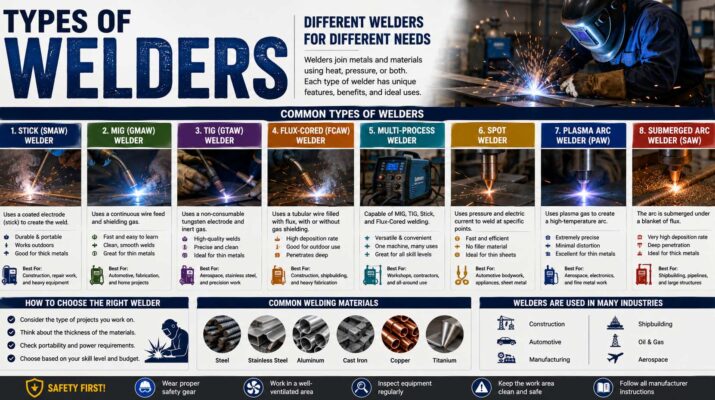
Walk into a fabrication shop and you may see several welding machines that look similar but work very differently. The main types of welders include MIG, TIG, stick, and flux-core machines, while specialized processes such as submerged arc and plasma arc welding serve more specific industrial needs. Each process controls heat, electrodes, filler metal, and shielding in a different way, so choosing the right welder depends on the material, thickness, working environment, and quality you need.
For beginners, MIG welding is often one of the easiest places to start. Meanwhile, TIG gives experienced operators excellent control over clean, precise welds. Stick welding remains useful for outdoor and heavy-duty work, whereas flux-core equipment offers high productivity and good portability.
Understanding these differences helps you choose equipment more confidently and also gives you a clearer picture of welding as a trade.
What Is a Welder and How Does It Work?
A welder is a machine or power source used to create the heat needed to join metals. In common arc-welding processes, an electrical arc generates intense heat between an electrode and the workpiece. As a result, the base metal melts and forms a joint as it cools.
However, the exact process varies. Some systems continuously feed wire, while others use a separate tungsten electrode or a coated consumable rod.
Shielding is another major difference. Molten weld metal can react with gases in the surrounding air, so welding processes use shielding gas, flux, or both to protect the weld pool.
Because metals respond differently to heat, the right machine also depends on what you plan to join. For example, someone researching what is damascus steel will encounter layered steel construction that requires considerably different skills from simply joining mild-steel plates in a fabrication shop.
Main Types of Welders Compared
If you are wondering what types of welders are there, four processes cover many common workshop, repair, fabrication, automotive, and construction jobs.
| Welder Type | Electrode/Filler | Shielding | Best Suited For | Learning Curve |
|---|---|---|---|---|
| MIG | Continuous wire | External gas | General fabrication, auto work | Beginner-friendly |
| TIG | Tungsten + optional filler rod | External gas | Precision and clean welds | Higher |
| Stick | Coated electrode | Flux coating | Outdoor and heavy repair | Moderate |
| Flux-Core | Tubular wire | Flux, sometimes gas | Fabrication and outdoor work | Beginner to moderate |
These categories overlap in their applications. Therefore, you should select a process based on the actual job rather than assuming one machine can handle every welding situation equally well.
MIG Welders
MIG welding is commonly associated with Gas Metal Arc Welding, or GMAW. The machine continuously feeds a consumable wire electrode through a welding gun.
At the same time, shielding gas normally flows around the weld area. Because wire feeding happens automatically, the operator can concentrate on gun position, travel speed, and maintaining the weld pool.
Why MIG Is Popular With Beginners
MIG equipment is relatively straightforward to learn compared with processes that require the operator to coordinate a separate filler rod.
It is also fast. Therefore, MIG works well for production environments, general metal fabrication, automotive projects, repairs, and hobby workshops.
However, conventional gas-shielded MIG is sensitive to wind because moving air can disturb the shielding gas. For that reason, outdoor conditions may call for another process.
Material thickness also matters. Although modern machines cover broad operating ranges, you still need a welder with suitable output and wire for the metal you plan to join.
TIG Welders
TIG stands for Tungsten Inert Gas welding and is commonly known technically as Gas Tungsten Arc Welding, or GTAW.
Unlike MIG, TIG uses a non-consumable tungsten electrode to create the arc. When filler material is required, the welder typically introduces a separate filler rod by hand.
This arrangement gives the operator excellent control.
Consequently, TIG is widely used when weld appearance, precision, or control over heat input matters. Depending on the equipment and procedure, it can weld materials such as steel, stainless steel, and aluminum.
When people ask what is the strongest metal, they may expect one material to outperform every alternative. In practice, though, successful welding depends on the specific alloy, joint design, filler material, heat control, and welding procedure rather than a simple strength ranking.
Advantages and Limitations of TIG
TIG can produce clean, precise welds with excellent visual quality. Therefore, it suits detailed fabrication, thin materials, stainless-steel work, and applications where finish quality matters.
However, TIG usually requires more coordination and practice than MIG.
It can also be slower because the operator controls several variables at once. As a result, TIG may not be the most productive choice when speed is the main priority.
Stick Welders
Stick welding, technically Shielded Metal Arc Welding or SMAW, uses a consumable electrode covered with flux.
As the electrode burns, the coating helps create shielding around the molten metal and forms slag over the weld.
Unlike conventional MIG and TIG processes, stick welding does not depend on a separate shielding-gas cylinder. Therefore, it works particularly well for field repairs and outdoor projects.
Stick machines are widely used in construction, maintenance, structural work, farm repairs, and heavy equipment applications.
However, the process produces slag that must normally be removed after welding. It also takes practice to maintain a suitable arc length and avoid sticking the electrode to the workpiece.
Flux-Core Welders
Flux-Cored Arc Welding, or FCAW, shares some similarities with MIG because both commonly use continuously fed wire.
The major difference lies inside the wire.
Flux-core wire contains flux ingredients that help protect the weld. Self-shielded flux-core wire can operate without an external shielding-gas cylinder, making it convenient for outdoor work.
Other flux-cored processes use external shielding gas as well.
Flux-core welding can offer good deposition rates, so it is useful in fabrication and construction. However, it generally creates more smoke and spatter than typical gas-shielded MIG welding, and slag may need removal.
When joining fabricated assemblies, welding is only one fastening option. Depending on the design, types of rivets may provide a mechanical joining solution where permanent welded joints are not preferred.
Other Types of Welders Used in Industry
MIG, TIG, stick, and flux-core machines receive most of the attention, yet industrial manufacturing uses several other welding technologies.
Submerged Arc Welding
Submerged Arc Welding, or SAW, creates an arc beneath a layer of granular flux.
Because the arc remains covered, the process can achieve high deposition rates and works well with automation.
As a result, SAW is common in heavy fabrication involving long weld seams and thicker steel components. However, it is far less suitable for casual home projects because the equipment and applications are more specialized.
Plasma Arc Welding
Plasma arc welding uses a constricted arc to produce a concentrated heat source.
The process shares some concepts with TIG but controls the arc differently. Consequently, it can offer excellent precision in specialized manufacturing.
However, equipment tends to be more complex and expensive than common hobby-level welding machines.
Resistance Welding
Resistance welding joins materials using electrical resistance and pressure.
Spot welding is a familiar example. It is widely associated with sheet-metal manufacturing, particularly high-volume production.
Instead of manually running a bead along a joint, resistance spot welding creates individual weld points between overlapping pieces.
Oxy-Fuel Welding
Oxy-fuel welding is different from arc welding because it uses a fuel-gas flame rather than an electrical arc.
An oxygen-fuel mixture creates enough heat to melt the workpiece and filler material.
Although electrical welding processes have replaced oxy-fuel welding for many production tasks, gas equipment remains useful for certain repair, heating, brazing, and cutting jobs.
Different Types of Welders for Common Materials
Material should strongly influence your equipment choice.
Mild Steel
Mild steel is relatively versatile from a welding perspective. MIG, TIG, stick, and flux-core processes can all work well when the machine, electrode or wire, settings, joint preparation, and technique match the project.
For basic fabrication, MIG is often convenient because it combines speed with a manageable learning curve.
Stainless Steel
Stainless steel requires careful process and consumable selection because excessive heat and contamination can affect the finished joint.
TIG is popular for precise stainless work, especially where appearance matters. Meanwhile, suitable MIG processes can provide greater production speed.
Anyone comparing stainless steel vs carbon steel should also consider corrosion resistance, alloy composition, fabrication requirements, and the environment in which the finished part will operate.
Aluminum
Aluminum conducts heat quickly and has characteristics that make welding technique and equipment selection especially significant.
TIG is commonly chosen for controlled, high-quality aluminum welding. Meanwhile, MIG can be effective for faster fabrication when paired with suitable wire-feeding equipment and procedures.
For example, some MIG setups use a spool gun or specialized feeding system to handle soft aluminum wire more reliably.
Cast Iron
Cast iron can be challenging because its composition and thermal behavior increase the risk of cracking when unsuitable procedures are used.
Therefore, successful repairs may require careful joint preparation, appropriate filler material, temperature control, and slow cooling.
If you regularly work with ferrous components, understanding wrought iron vs cast iron can also clarify why metals that look somewhat similar may behave very differently during fabrication and repair.
Types of Welders Jobs and Career Paths
The phrase types of welders jobs usually refers to welding careers rather than welding machines.
In practice, welders can specialize in very different environments.
Fabrication welders build metal products and assemblies in workshops or factories. Structural welders, meanwhile, work on steel frameworks and other construction projects.
Pipe welders focus on joining piping systems, where joint quality and process control can be demanding. Automotive welders may repair or fabricate vehicle components, while manufacturing welders often work in production environments.
There are also specialized roles involving shipbuilding, aerospace, industrial maintenance, and automated welding systems.
Therefore, the different types of welders jobs require different combinations of training, certification, process knowledge, and practical experience.
How to Choose the Right Type of Welder
Start with the metal you expect to weld most often.
Next, consider its typical thickness. A small machine intended for light sheet metal may not provide enough output for heavy structural components.
Then think about location.
If most work happens outdoors, a process that relies heavily on external shielding gas can become inconvenient in windy conditions. Stick or self-shielded flux-core welding may be more practical.
Power availability matters too. Before buying equipment, check the machine’s required input voltage, output range, duty cycle, and circuit requirements.
Also consider the other ways your projects will be assembled. For example, removable equipment panels and mechanical assemblies often rely on types of bolts rather than permanent welding because technicians may need to disassemble the parts later.
Finally, look beyond the welder itself. Your budget may also need to cover a suitable helmet, gloves, protective clothing, consumables, gas equipment where required, clamps, preparation tools, and ventilation or fume-control equipment.
Common Mistakes When Choosing a Welder
Buying purely on maximum amperage is a common mistake. Higher output does not automatically make a machine better for your actual work.
Likewise, beginners sometimes choose TIG because they like the appearance of finished TIG welds without considering its steeper learning curve.
Another mistake is overlooking duty cycle. A machine may provide a certain maximum output but cannot necessarily weld continuously at that level.
Consumable availability matters as well. Before buying a machine, check whether compatible wire, electrodes, replacement torch components, and other supplies are readily available in your area.
Finally, avoid choosing equipment before checking electrical requirements. A welder that cannot operate properly from your available electrical supply may create extra installation costs.
Welding Safety Basics
Welding produces intense light, heat, sparks, hot metal, fumes, and electrical hazards. Therefore, suitable protective equipment and a safe work area are essential.
Use an appropriate welding helmet and protective clothing. Gloves should suit welding work, while footwear and clothing should help protect against sparks and hot material.
Ventilation and fume control also matter. Welding fumes vary according to the process, base metal, coatings, consumables, and workplace conditions.
Keep combustible materials away from sparks and hot work areas. Also inspect leads, torches, electrode holders, gas equipment, and connections before use.
Because specific workplaces and materials create different hazards, follow the machine manufacturer’s instructions and applicable workplace safety requirements rather than relying on general advice alone.
FAQs About Types of Welders
What are the four main types of welders?
MIG, TIG, stick, and flux-core are four of the most common welding processes and machine categories. Each has different advantages depending on the material, environment, and required finish.
Which welder is easiest for beginners?
MIG is often considered beginner-friendly because the machine feeds wire automatically. However, flux-core equipment can also be approachable, especially when users want to avoid an external shielding-gas setup.
Which welder is best for outdoor work?
Stick and self-shielded flux-core welding are commonly suited to outdoor work because they do not depend on an external shielding-gas cloud in the same way as conventional gas-shielded MIG or TIG.
Is TIG better than MIG?
Neither process is universally better. TIG provides excellent control and clean results, while MIG generally offers easier operation and faster production. Your material, thickness, desired finish, and skill level should guide the choice.
Can one welding machine perform several processes?
Yes. Multi-process welders can support combinations such as MIG, flux-core, stick, and sometimes TIG. However, capabilities vary by model, so check exactly which processes and features a machine supports before buying.
Picking the Best Welder for Your Work
The different types of welders exist because welding jobs vary enormously. MIG makes sense for many beginners and general fabrication tasks, TIG offers fine control, stick remains valuable for rugged field work, and flux-core combines continuous wire feeding with useful outdoor capabilities.
Instead of searching for one machine that is simply “best,” match the process to your metal, thickness, work environment, electrical supply, and skill level. Then check consumable costs, duty cycle, accessories, and safety requirements before buying.
That approach makes it much easier to choose welding equipment that fits the work you actually plan to do.