
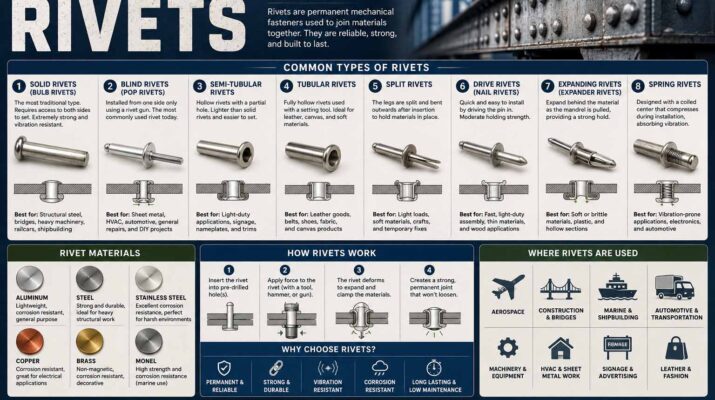
Rivets may look like simple pieces of hardware, yet their design has a big effect on the strength and reliability of an assembly. The types of rivets available today range from traditional solid fasteners used in structural work to pop rivets that can be installed when only one side of a panel is accessible.
Unlike screws and bolts, most rivets create a permanent or semi-permanent mechanical joint. Once installed, they normally have to be drilled, cut, or otherwise destroyed for removal. As a result, they work especially well in products and structures where vibration resistance and long-term fastening matter.
What Is a Rivet?
A rivet is a mechanical fastener that joins two or more pieces of material. A basic rivet has a manufactured head on one end and a cylindrical shank that passes through aligned holes in the parts being joined.
During installation, the opposite end of the shank is deformed or expanded. This process creates a second head or enlarged section that prevents the rivet from pulling back through the hole.
Riveting appears in aircraft structures, sheet-metal products, vehicles, electronics enclosures, machinery, bridges, cookware, bags, belts, and many other products.
The process is also a useful example of how relatively simple components support complex types of machines, since manufacturing equipment often relies on permanent mechanical joints where welding or threaded fasteners are not ideal.
How Do Rivets Work?
Most rivets work by clamping materials between two enlarged ends.
First, a hole is drilled, punched, or manufactured through the materials. Next, the rivet shank passes through that hole. A tool then deforms part of the rivet so its diameter becomes larger than the hole.
As a result, the rivet becomes mechanically locked in position.
The exact installation method depends on the design. For example, a solid rivet may require access to both sides of the joint. A blind rivet, however, can usually be installed entirely from one side.
Riveted joints often handle shear loads very well because the rivet shank sits directly across the joined materials. However, joint strength still depends on factors such as rivet diameter, material, hole quality, spacing, grip length, and installation accuracy.
Main Types of Rivets and Their Uses
There are many specialized designs, but several categories account for most industrial, engineering, repair, and consumer applications.
1. Solid Rivets
Solid rivets have one of the simplest designs. They consist of a solid shank with a manufactured head at one end.
During installation, the rivet passes through the workpieces. A rivet gun, hammer, press, or similar tool then deforms the tail while the opposite side is supported.
Solid rivets can create extremely dependable joints when installed correctly. Consequently, they have a long history in structural engineering and remain common in aircraft construction and other applications that demand predictable mechanical performance.
However, installers normally need access to both sides of the joint. Therefore, solid rivets are less convenient for enclosed structures.
2. Blind or Pop Rivets
Blind rivets are among the most convenient options for sheet metal and general repair work. They are often called pop rivets, although “POP” originated as a brand name.
A typical blind rivet contains a hollow rivet body and an internal mandrel. The installer inserts the rivet into a prepared hole and uses a rivet tool to pull the mandrel. As the mandrel moves, it expands the rivet body behind the material and forms the blind-side head. The mandrel then breaks at a designed point.
This installation method explains why blind rivets are useful when the back of a panel cannot be reached.
There are also several types of pop rivets, including open-end, closed-end, multi-grip and structural blind rivets. Their load capacity, sealing ability, retained mandrel design, and grip range can vary, so they should not automatically be treated as interchangeable.
3. Tubular Rivets
A tubular rivet has a hollow section in its shank. Instead of deforming a completely solid tail, the installation tool rolls or flares the hollow end.
Because less force is required to form the tail, tubular rivets work well with materials that do not need the high structural capacity associated with heavy solid riveting.
Common applications include luggage, electronics, furniture, brakes, handles and light mechanical assemblies.
For anyone curious about what do engineers do when designing such joints, fastener selection is a good example: engineers compare loads, material thickness, manufacturing speed, cost, service conditions, and failure risks before specifying a fastening system.
4. Semi-Tubular Rivets
Semi-tubular rivets look similar to solid rivets, except the tail contains a partial axial hole.
That opening reduces the force needed to form the rivet during installation. At the same time, much of the shank remains solid, which can provide greater mechanical capability than a more deeply hollow tubular design.
Manufacturers use semi-tubular rivets in products such as hinges, ladders, brakes, casters and mechanical linkages.
They can also act as pivot points when the joint is designed to allow controlled movement rather than clamp every component rigidly together.
5. Drive Rivets
Drive rivets simplify installation by using a pin or mandrel that is driven into the rivet body.
After the rivet enters the prepared hole, the installer strikes or presses the center pin.
Because installation can be quick, drive rivets appear in identification plates, signs, panels and some light-duty assemblies.
However, they are not automatically suitable for high-load structural joints. The manufacturer’s specifications should always determine whether a particular drive rivet can handle the expected forces.
6. Flush Rivets
Flush rivets use a countersunk head that sits level, or nearly level, with the surrounding surface.
This shape matters when a protruding fastener head would interfere with airflow, moving components, surface clearance, or appearance.
Aircraft skins are a well-known application because a smooth exterior surface can help reduce aerodynamic drag. Flush rivets also appear in equipment and fabricated products where a low-profile finish is desirable.
Installation requires accurate countersinking or dimpling. Otherwise, the rivet may sit too high, too low, or incorrectly against the surrounding material.
7. Split Rivets
Split rivets have a shank divided into two legs. During installation, those legs spread apart and grip the material.
They generally suit softer materials rather than demanding structural applications. For example, split rivets may be used with leather, fiberboard and similar products.
Because the legs spread during installation, material thickness and toughness need careful consideration. Excessive force can damage softer workpieces.
Quick Comparison of Different Types of Rivet
| Rivet type | Typical installation access | Common applications | Main advantage |
|---|---|---|---|
| Solid | Both sides | Aircraft, structural assemblies | High, dependable joint strength |
| Blind/pop | One side | Sheet metal, enclosures, repairs | Easy installation with limited access |
| Tubular | Usually both sides | Furniture, electronics, light assemblies | Low forming force |
| Semi-tubular | Usually both sides | Hinges, brakes, moving joints | Efficient installation |
| Drive | Primarily one side | Signs, plates, panels | Fast installation |
| Flush | Depends on design | Aircraft, smooth panels | Low-profile surface |
| Split | Application dependent | Leather, fiberboard, soft materials | Works well with softer products |
Although this table offers a quick comparison, rivets within the same family can have very different strength ratings. Therefore, always check the fastener manufacturer’s technical data for load-critical applications.
Types of Rivets for Metal
Metal fabrication is one of the most common uses for riveted joints. However, the best rivet depends on the metals being joined and the environment around them.
Blind rivets are practical for thin sheet-metal enclosures, ducts, cabinets and repair panels. Meanwhile, solid rivets may be a better fit when high joint reliability is required and both sides remain accessible.
Material compatibility also deserves attention.
Aluminum rivets are lightweight and resist corrosion in many environments. Steel rivets generally offer greater strength, while stainless steel can provide strong corrosion resistance. Copper and other materials suit more specialized applications.
The surrounding metal matters too. For instance, placing dissimilar metals together in the presence of an electrolyte can increase the risk of galvanic corrosion. Protective coatings, compatible fastener materials, sealants, or isolation methods may be needed.
Material properties can vary dramatically between metal families. A comparison such as wrought iron vs cast iron shows why engineers cannot select a fastener based only on the fact that both workpieces are “metal.”
Types of Rivets for Leather
Rivets are not limited to engineering structures. They are also common in belts, bags, straps, wallets, footwear and other leather goods.
The types of rivets for leather generally prioritize easy installation, appearance and adequate holding strength rather than heavy structural performance.
Double-cap rivets are popular because they provide a finished appearance on both sides. Tubular rivets can handle thicker assemblies, while rapid rivets are commonly used for straightforward leathercraft projects.
Sizing is especially important.
A post that is too short may not form a secure connection. On the other hand, an excessively long post may bend or create a loose joint. Ideally, the post length should suit the combined thickness of the leather layers according to the rivet manufacturer’s guidance.
How to Choose the Right Type of Rivet
Selecting a rivet becomes easier when you evaluate the joint systematically.
Check Access First
Determine whether you can reach both sides of the workpiece. If only the front is accessible, a blind rivet is often the most practical starting point.
Match the Grip Range
Grip range refers to the total material thickness a rivet is designed to clamp.
If the assembly falls outside that range, the rivet may form incorrectly. Therefore, measure the combined thickness of all joined layers before choosing the rivet length.
Consider the Expected Load
Ask whether the joint will experience shear, tension, vibration, impact, or repeated movement.
A decorative leather rivet has very different requirements from a fastener holding an aircraft panel. Consequently, use rated structural fasteners whenever joint failure could create a safety risk.
Choose Compatible Materials
Rivet material affects strength, corrosion resistance, weight, electrical behavior and appearance.
For unusual alloys, material knowledge becomes even more relevant. Learning what is damascus steel, for example, illustrates how the term “steel” can cover materials with very different structures and manufacturing characteristics, although Damascus steel itself is not a typical basis for choosing everyday rivets.
Think About the Finished Surface
A standard protruding head is perfectly acceptable in many applications. However, a flush rivet may make more sense when clearance, aerodynamics, movement, or appearance requires a smoother surface.
Common Riveting Problems and How to Avoid Them
Even the correct rivet can fail when installation is poor.
An oversized hole may allow movement and reduce the quality of the joint. Conversely, an undersized or misaligned hole can damage the rivet during insertion.
Incorrect grip length is another common problem. A rivet that is too short may not form a sufficient blind-side head, while an unsuitable long rivet can form poorly or leave the joint loose.
Material damage can also occur when the fastener is too strong or installation pressure is excessive. This problem is especially relevant with plastics, thin sheet metal, composites and leather.
For reliable results, drill or punch the specified hole diameter, remove problematic burrs when required, keep components aligned, select the correct grip range, and use an installation tool intended for that rivet design.
Frequently Asked Questions About Types of Rivets
What are the most common types of rivets?
Common designs include solid, blind or pop, tubular, semi-tubular, drive, flush and split rivets. However, many specialized variants exist for structural, aerospace, automotive and manufacturing applications.
What is the difference between a pop rivet and a solid rivet?
A pop or blind rivet can usually be installed from one side by pulling a mandrel through the rivet body. In contrast, a conventional solid rivet generally requires access to both sides so its tail can be properly formed while the manufactured head is supported.
Which rivet is best for sheet metal?
Blind rivets are convenient for many sheet-metal jobs, particularly when only one side is accessible. However, the correct choice depends on sheet thickness, required strength, hole size, corrosion exposure and whether the joint needs to be sealed.
Are rivets stronger than screws?
Neither fastener is always stronger. A properly designed riveted joint can perform very well under shear and vibration, while screws offer easier removal and servicing. The better choice depends on the materials, load direction, fastener size and joint design.
Can rivets be removed?
Yes, but most rivets are not designed for normal reuse. Removal often involves drilling out the head or using another destructive method. As a result, screws or bolts may be more practical when equipment requires frequent disassembly.
Picking the Right Rivet for the Job
Understanding the types of rivets makes fastener selection far less confusing. Solid rivets provide dependable performance for demanding joints, while blind rivets solve the practical problem of one-sided access. Meanwhile, tubular and semi-tubular designs simplify many manufacturing operations, and flush, drive, split and leather rivets address more specialized needs.
Instead of choosing a rivet only by appearance or diameter, consider access, grip range, load, material compatibility, corrosion exposure and installation method together. For critical structures, always follow the relevant engineering specification and the rivet manufacturer’s rated limits. A small fastener may be inexpensive, but choosing and installing it correctly can determine the reliability of the entire joint.