
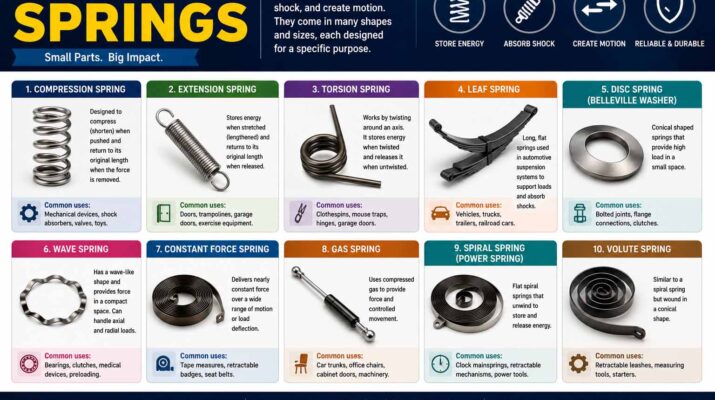
Springs are simple mechanical components, yet they perform essential jobs in everything from vehicles and industrial equipment to watches, switches, furniture, and garage doors. The many types of springs are designed to store mechanical energy, absorb shock, maintain force, control movement, or return a component to its original position. Although most people picture a coiled metal spring, engineers use several designs, each suited to a different kind of load and motion.
Understanding these designs makes it easier to see why one spring works well in a suspension system while another is better for a door hinge or electrical switch. The spring’s shape, material, load direction, and available space all influence that choice.
What Is a Spring?
A spring is an elastic mechanical component that changes shape when a force acts on it. As long as the load stays within its intended operating range, the spring stores energy during deformation and releases that energy when the force decreases or disappears.
For example, push down on a compression spring and it becomes shorter. Once you remove the load, the stored energy pushes the spring toward its original length.
This behavior is closely related to force, displacement, and stiffness. In many basic spring systems, force increases approximately in proportion to displacement. Engineers often describe this relationship using Hooke’s law.
However, real springs have operating limits. If a spring experiences too much force, it can deform permanently, lose stiffness, or fail. Therefore, designers consider the material, wire diameter, spring dimensions, operating cycles, temperature, and expected load.
Spring behavior also connects naturally with concepts shown in a free body diagram, since engineers need to identify the forces acting on a component before selecting a suitable spring.
How Do Springs Store and Release Energy?
When a spring bends, stretches, twists, or compresses, its material resists that deformation. As a result, mechanical energy becomes stored as elastic potential energy.
Then, when the external force changes, the spring can release that energy.
Consider a vehicle suspension. When a wheel travels over a bump, the suspension spring compresses. It then pushes back as the wheel moves beyond the obstacle. However, a spring alone would allow the vehicle to continue bouncing. Therefore, damping components help control that repeated motion.
This relationship also helps explain the difference between shocks and struts in automotive suspension systems, where springs support loads while damping components control unwanted oscillation.
Although the principle sounds simple, engineers can change spring geometry to produce very different mechanical behavior. Consequently, spring design varies widely between applications.
Main Types of Springs and Their Applications
There are many different types of springs, but most common designs fall into several recognizable categories. Each handles force in a particular way.
Compression Springs
Compression springs are among the most familiar designs. Usually, they consist of helically wound wire with space between the coils.
When force pushes inward from opposite ends, the spring becomes shorter and resists compression. After the force is removed, it expands toward its original length.
Compression springs appear in:
- Vehicle suspension components
- Push-button mechanisms
- Mechanical valves
- Industrial machinery
- Mattresses
- Pens
- Electronic equipment
Their simple construction makes them useful wherever a component needs to resist a pushing force.
However, compression springs need enough space to operate without excessive sideways bending. Long, narrow springs may buckle under compression, so designers often use guides or alter the spring dimensions.
Extension Springs
Instead of resisting compression, extension springs resist pulling forces.
Their coils normally sit close together when the spring is unloaded. As two connected components move apart, the spring stretches and creates a restoring force that pulls them back toward each other.
Common applications include garage doors, exercise equipment, agricultural machinery, automotive mechanisms, and industrial assemblies.
Hooks, loops, or other attachment features usually appear at the ends. Since these end connections carry significant loads, their design can strongly influence the spring’s service life.
Torsion Springs
Torsion springs work through twisting rather than straightforward compression or extension.
Usually, the coiled section sits around a shaft or pin, while arms extend outward from the spring. When one arm rotates relative to the other, the spring stores rotational energy.
You can find torsion springs in clothespins, door hinges, clips, vehicle components, switches, and various mechanical assemblies.
Their operation also provides a useful example of rotational force. If you are learning what is thrust, it helps to distinguish thrust as a generally axial force from the torque and rotational action associated with a torsion spring.
Constant-Force Springs
A constant-force spring is typically made from a tightly wound strip of spring material rather than round wire.
As the strip unrolls, it can provide a relatively consistent force across a substantial distance. Therefore, this design works well when a mechanism needs predictable tension through a long range of motion.
Unlike a conventional coil spring, its force does not necessarily increase sharply as displacement grows. As a result, it can provide smoother operation in certain mechanisms.
Spiral Springs
Spiral springs use a flat strip of material wound into a spiral. When the inner or outer end rotates, the strip stores energy.
Traditionally, mechanical watches and clocks have relied on related spring designs to store and release energy gradually. Spiral springs also appear in timers, measuring instruments, retracting mechanisms, and mechanical devices.
Because the spring operates through rotation, designers can use it where axial space is limited but rotational energy storage is needed.
Leaf Springs
Leaf springs look very different from conventional coils. They use one or more long, flexible strips, usually made from spring steel.
When loaded, the strips bend and store energy. Their shape allows them to support substantial loads while remaining relatively simple and durable.
Vehicle suspension systems are one of their best-known applications, particularly in trucks, trailers, and some commercial vehicles.
Leaf springs may use a single strip or several stacked leaves. Multi-leaf designs distribute loads across multiple layers and can handle demanding operating conditions.
Disc Springs
Disc springs, sometimes called Belleville washers, resemble slightly conical washers. When an axial force flattens the disc, it produces spring resistance.
Although each disc is compact, engineers can stack multiple units in different arrangements to modify force and deflection characteristics.
Therefore, disc springs work particularly well in:
- Valves
- Bolted assemblies
- Clutches
- Braking systems
- Industrial machinery
- High-load mechanisms
They are useful when a design needs considerable force within a small axial space.
Quick Comparison of Common Spring Designs
The right spring depends heavily on the direction and type of force involved.
| Spring Type | Main Motion | Typical Purpose | Common Example |
|---|---|---|---|
| Compression | Compressing | Resist pushing force | Vehicle suspension |
| Extension | Stretching | Resist pulling force | Garage door |
| Torsion | Twisting | Provide rotational force | Door hinge |
| Constant-force | Unrolling | Maintain steady force | Retractable mechanism |
| Spiral | Rotating | Store rotational energy | Mechanical timer |
| Leaf | Bending | Support heavy loads | Truck suspension |
| Disc | Flattening | Handle high axial loads | Industrial valve |
These categories also demonstrate why springs are common across many types of machines. A spring can support, return, tension, isolate, or control another mechanical component without requiring its own external power source.
Different Types of Garage Door Springs
Garage doors provide an easy real-world example of how spring selection changes with mechanical design. The two major types of garage door springs are torsion and extension springs.
Torsion Garage Door Springs
Torsion springs usually sit on a shaft above the garage door opening. As the door operates, the springs wind or unwind and help counterbalance the door’s weight.
Because the system applies torque through a shaft, it can provide controlled lifting force across the door’s movement.
Extension Garage Door Springs
Then, as the door opens, that stored energy helps lift the door.
When comparing the different types of garage door springs, torsion systems are often valued for controlled movement and compact placement above the opening, while extension systems use a simpler stretching action.
Garage door springs operate under substantial stored energy. Therefore, damaged or broken springs can be dangerous to adjust without suitable tools and experience.
What About Types of Box Springs?
The phrase types of box springs refers to something different from individual mechanical springs. A box spring is a mattress foundation designed to support a mattress and, depending on its construction, provide some flexibility.
Traditional models may contain actual metal springs within a wooden or metal frame. However, many modern mattress foundations use rigid slats or support structures rather than traditional spring assemblies.
Common foundation styles include traditional coil box springs, low-profile foundations, split foundations, and rigid mattress foundations.
Therefore, when shopping for a bed, it helps to check the mattress manufacturer’s support requirements rather than assuming every mattress needs a conventional box spring.
Materials Used to Manufacture Springs
Spring performance depends on more than shape. Material selection affects strength, corrosion resistance, fatigue life, temperature tolerance, and cost.
Spring steel is widely used because it combines strength with elasticity. Stainless steel works well when corrosion resistance matters, while specialized alloys may be necessary in high-temperature or chemically demanding environments.
Some lightweight applications also use nonmetallic or composite springs.
Material selection becomes especially significant when a spring must operate for thousands or millions of cycles. Repeated loading can eventually produce fatigue even when each individual load seems relatively small.
Choosing the Right Type of Spring
First, identify how the load acts. That question quickly narrows the available designs.
Next, determine the required force and travel. A spring must provide enough force without reaching its mechanical limit during normal operation.
Space matters as well. For instance, a disc spring can produce substantial axial force in a compact area, while a long compression spring may require more installation space.
Then consider the environment. Moisture, chemicals, heat, vibration, and repeated cycling can all affect material choice and expected lifespan.
In automated systems, spring action may also work alongside what is an actuator concepts because actuators create controlled movement while springs can provide return force, preload, energy storage, or fail-safe positioning.
Finally, designers should consider fatigue life and safety margin rather than selecting a spring solely because it physically fits.
Common Reasons Springs Fail
Springs are durable, but they do not last forever.
Fatigue is one of the most common problems. Repeated loading creates microscopic damage that can eventually develop into a crack.
Corrosion presents another concern. Rust or chemical attack can reduce the effective cross-section of the material and create weak points.
Meanwhile, excessive heat can change material properties, while poor alignment can create uneven loading. For that reason, proper installation matters almost as much as choosing the correct spring.
Visible cracking, unusual deformation, corrosion, reduced force, uneven movement, or unexpected noise can all indicate that a spring needs inspection or replacement.
Practical Takeaway
The many types of springs exist because mechanical systems place loads on components in very different ways. Compression springs resist pushing forces, extension springs resist pulling, torsion springs manage rotational loads, and leaf springs support heavy bending loads. Meanwhile, disc, spiral, and constant-force designs solve more specialized engineering problems.
Choosing the correct spring starts with understanding the direction of force, required movement, available space, operating environment, and expected service life. Once those factors are clear, the wide variety of spring designs becomes much easier to understand—and much easier to match to the job.