
If you’re shopping for a motorcycle, dirt bike, lawn equipment, chainsaw, or boat motor, understanding 2 stroke vs 4 stroke engines can help you make the right choice. Although both designs burn fuel to produce power, they differ in how they complete a combustion cycle, manage lubrication, and deliver performance.
A 2-stroke engine generally offers a lighter design, fewer mechanical components, and strong power relative to its size. In contrast, a 4-stroke engine typically provides better fuel economy, quieter operation, and lower hydrocarbon emissions. However, the best option depends on the machine, your budget, and how you plan to use it.
Understanding what is RPM also helps explain why these engine designs behave differently. RPM measures how many revolutions an engine’s crankshaft completes each minute. Once you understand engine speed and the operating cycle, choosing the right engine becomes much easier.
Quick Comparison: 2-Stroke vs. 4-Stroke Engines
| Feature | 2-Stroke Engine | 4-Stroke Engine |
|---|---|---|
| Power delivery | Often strong for its size | Generally smoother |
| Fuel economy | Usually lower | Usually better |
| Weight | Lighter | Heavier |
| Mechanical design | Simpler | More complex |
| Maintenance | May require frequent internal servicing | Requires scheduled oil and valve maintenance |
| Noise | Often louder | Often quieter |
| Lubrication | Oil injection or fuel-oil mixing on many models | Usually has a separate engine oil system |
| Emissions | Traditional designs often produce more hydrocarbons | Generally produces fewer hydrocarbons |
| Service life | Depends on use and maintenance | Often longer in comparable applications |
| Purchase price | Often lower | Often higher |
These are general differences rather than guarantees. Modern engine technology, operating conditions, and maintenance can affect the results.
What Is a 2-Stroke Engine?
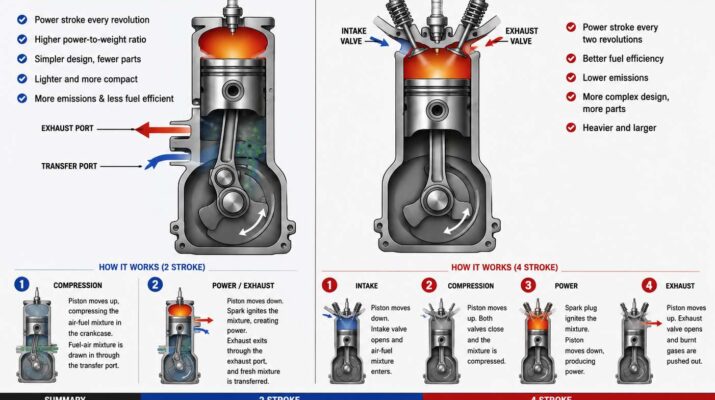
A 2-stroke engine completes its operating cycle in two piston strokes, or one crankshaft revolution. During this cycle, the engine combines several processes to produce power within a compact design.
Unlike a conventional 4-stroke engine, a traditional 2-stroke design uses ports in the cylinder wall to control the movement of fresh mixture and exhaust gases.
Because the engine produces a power stroke during every crankshaft revolution, it can deliver quick acceleration and a high power-to-weight ratio. As a result, manufacturers use these engines in equipment where low weight and responsive performance matter.
Common applications include:
- Dirt bikes and some competition motorcycles
- Chainsaws and leaf blowers
- Weed trimmers and other portable garden tools
- Snowmobiles
- Some scooters and personal watercraft
- Certain marine engines
However, many traditional 2-stroke engines require special oil mixed with gasoline or supplied through an oil-injection system. Always follow the manufacturer’s instructions to maintain proper lubrication.
What Is a 4-Stroke Engine?
A 4-stroke engine completes one operating cycle in four piston strokes, requiring two crankshaft revolutions. Each stroke performs a distinct function, allowing the engine to manage intake, compression, combustion, and exhaust separately.
The four stages are:
- Intake: The engine draws air and usually fuel into the cylinder.
- Compression: The piston compresses the air-fuel mixture in a gasoline engine.
- Power: The spark plug ignites the compressed mixture, pushing the piston downward.
- Exhaust: The piston pushes burned gases out through the exhaust valve.
Because the engine separates these processes, it can control combustion and exhaust flow more effectively than many traditional 2-stroke designs.
Most conventional passenger cars, along with many motorcycles, ATVs, generators, lawn mowers, and modern outboard motors, use 4-stroke engines.
These engines also typically have a separate lubrication system. Consequently, owners can change the engine oil without mixing it into the gasoline.
How Each Engine Works
Understanding the operating cycle makes the main differences easier to remember.
How a 2-Stroke Engine Works
A conventional 2-stroke engine combines several functions during its two piston movements.
First, the piston moves upward. The engine compresses the mixture inside the cylinder while drawing a fresh charge into the crankcase in many conventional designs.
Next, combustion occurs. The spark plug ignites the compressed mixture, forcing the piston downward and transferring energy to the crankshaft.
Meanwhile, the downward movement opens the appropriate ports. Exhaust gases leave the cylinder as fresh mixture enters, preparing the engine for another cycle.
Therefore, the engine produces a power stroke every crankshaft revolution. This arrangement helps explain its responsive acceleration and compact construction.
How a 4-Stroke Engine Works
A 4-stroke engine separates the cycle into four distinct movements.
During the intake stroke, the intake valve opens and the piston draws the charge into the cylinder. Next, the valves close for compression, allowing the piston to compress the mixture.
Then, the spark plug ignites the mixture and combustion pushes the piston downward. Finally, the exhaust valve opens and the piston expels the burned gases.
Because the engine produces a power stroke every two crankshaft revolutions, its power delivery differs from that of a comparable 2-stroke engine.
However, power output also depends on displacement, RPM, tuning, and other design factors. Engine output can be measured in kilowatts (kW) or horsepower. Therefore, compare the actual specifications of two machines rather than assuming one engine type always produces more power.
Key Differences Between 2-Stroke and 4-Stroke Engines
Power and Acceleration
A major difference is how frequently each engine produces a power stroke. A 2-stroke engine delivers one power stroke per crankshaft revolution, which can provide rapid throttle response and strong power relative to engine weight.
A 4-stroke engine produces one power stroke every two crankshaft revolutions. Nevertheless, its power delivery often feels smoother and more predictable, especially in machines designed for everyday use.
Engine performance can also depend on forced induction. For example, understanding how does a turbo work can help explain how a turbocharger uses exhaust energy to compress incoming air and potentially increase an engine’s power output. However, turbocharging is a separate design consideration and does not determine whether an engine uses a two-stroke or four-stroke cycle.
Fuel Consumption
Fuel economy generally favors 4-stroke engines. Their operating cycle allows many designs to burn fuel more efficiently, while traditional 2-stroke engines can lose some unburned fuel through the exhaust during the gas-exchange process.
As a result, a 4-stroke engine often costs less to operate over long periods. However, fuel consumption varies with engine size, load, tuning, and operating habits.
Also, remember that 2-stroke engines may require additional oil for lubrication. Include that expense when comparing the total operating costs of similar machines.
Maintenance Requirements
Both engine types need regular servicing, but their maintenance schedules differ.
Typical 2-stroke maintenance includes:
- Mixing fuel and oil when the manufacturer requires it.
- Checking the oil-injection system on applicable models.
- Inspecting spark plugs and cleaning or replacing them when needed.
- Monitoring piston, cylinder, and ring wear.
- Checking exhaust ports and servicing components as required.
Typical 4-stroke maintenance includes:
- Changing engine oil at the recommended intervals.
- Replacing oil and air filters when required.
- Checking valve clearances according to the service schedule.
- Inspecting spark plugs and cooling components.
- Servicing timing components when specified by the manufacturer.
Although a 2-stroke engine has fewer mechanical parts, high-performance models may need frequent internal servicing. Conversely, a 4-stroke engine has more components, but routine maintenance can be less frequent in some applications.
Always follow the equipment’s service manual rather than relying on engine type alone.
Weight and Handling
A traditional 2-stroke engine generally weighs less because it does not require the same valve train as a conventional 4-stroke engine.
Consequently, lightweight engines can make dirt bikes and portable equipment easier to maneuver. Riders may also appreciate the quick response during technical riding.
A 4-stroke engine usually weighs more because it needs additional valve-train components and a separate engine lubrication system. Even so, modern designs have reduced the weight difference in some applications.
Noise and Emissions
Traditional 2-stroke engines often produce a sharper exhaust sound and more visible smoke, particularly when the engine burns lubricating oil with its fuel. They can also release more unburned hydrocarbons than comparable conventional 4-stroke engines.
By comparison, 4-stroke engines typically operate more quietly and produce fewer hydrocarbon emissions. However, actual emissions depend on engine design, tuning, and emissions-control equipment.
For further information, consult the U.S. Environmental Protection Agency’s overview of nonroad engine emissions standards. This resource explains how regulations address pollution from small engines and related equipment.
Advantages of a 2-Stroke Engine
A 2-stroke engine remains a practical choice when performance and low weight matter more than fuel economy.
Its main advantages include:
- Lightweight construction: Makes portable equipment and some performance machines easier to handle.
- High power-to-weight ratio: Delivers substantial output relative to engine size in many designs.
- Simple mechanical layout: Uses fewer major moving components than a conventional 4-stroke engine.
- Responsive acceleration: Produces a power stroke during every crankshaft revolution.
- Potentially lower purchase cost: Some 2-stroke machines cost less than comparable 4-stroke alternatives.
- Straightforward rebuilding: Many models have relatively simple engine designs that experienced mechanics can service efficiently.
For these reasons, 2-stroke engines remain popular in selected off-road, racing, and portable-equipment applications.
Advantages of a 4-Stroke Engine
A 4-stroke engine often makes more sense for everyday transportation, recreational boating, and regular equipment use.
Its benefits include:
- Better fuel economy: Many models consume less fuel during comparable operating conditions.
- Lower hydrocarbon emissions: Conventional designs generally release fewer unburned hydrocarbons.
- Quieter operation: Often provides a more comfortable experience for riders, operators, and nearby people.
- Smooth power delivery: Helps drivers and riders manage acceleration.
- Separate engine lubrication: Usually eliminates the need to mix oil with gasoline.
- Potentially longer service life: Properly maintained engines often last longer in comparable applications.
Furthermore, many buyers appreciate the predictable maintenance routines of 4-stroke engines. However, their extra components can increase repair complexity and servicing costs.
Drawbacks of Each Engine
Disadvantages of 2-Stroke Engines
Despite their performance benefits, traditional 2-stroke engines have several limitations.
- Higher fuel consumption in many applications.
- Greater hydrocarbon emissions in conventional designs.
- Frequent internal servicing on some high-performance models.
- Louder exhaust in many machines.
- Oil-mixing requirements on models without separate oil injection.
- Potentially shorter service life under demanding operating conditions.
Modern technologies can reduce some of these disadvantages, so check the specific model before making a decision.
Disadvantages of 4-Stroke Engines
A 4-stroke engine also has trade-offs.
- Greater weight in many comparable applications.
- More mechanical components.
- Potentially higher purchase prices.
- More complex internal repairs.
- Additional oil and filter servicing requirements.
- Less immediate power delivery in some comparable engine designs.
Nevertheless, these disadvantages may matter less if fuel savings, comfort, and long-term ownership are your priorities.
Which Engine Lasts Longer?
When comparing engine durability, a properly maintained 4-stroke engine often has a longer service life than a comparable conventional 2-stroke engine. However, the result depends on design quality, workload, lubrication, operating temperature, and maintenance.
A 4-stroke engine benefits from a dedicated lubrication system that circulates oil through internal components. In addition, its combustion and operating characteristics can reduce wear under suitable conditions.
Meanwhile, a 2-stroke engine may experience faster wear when operated at high RPM or under heavy loads without adequate lubrication. Some performance models also require more frequent piston and cylinder servicing.
Therefore, don’t judge lifespan by engine type alone. Follow the maintenance schedule, use the correct oil and fuel, keep cooling systems clean, and avoid running the engine beyond its intended operating limits.
2-Stroke vs. 4-Stroke Dirt Bikes
The best dirt bike engine depends on your riding style, skill level, and preferred terrain.
Choose a 2-Stroke Dirt Bike If You Want
- Lightweight handling.
- Quick acceleration.
- A strong power-to-weight ratio.
- A relatively simple engine design.
- Potentially lower rebuilding costs on suitable models.
These characteristics make 2-stroke dirt bikes appealing for motocross, technical trails, and riders who enjoy an energetic riding style.
Choose a 4-Stroke Dirt Bike If You Want
- Smooth, predictable power delivery.
- Good traction and controlled acceleration.
- Comfortable trail riding.
- Strong performance across a useful RPM range.
- Good fuel economy during comparable riding conditions.
Many beginners prefer 4-stroke models because their power delivery can feel easier to manage. However, engine size, throttle response, seat height, and overall bike weight are equally important when selecting a beginner motorcycle.
2-Stroke vs. 4-Stroke Outboard Motors
Boat owners should consider weight, fuel consumption, maintenance, and boating distance before selecting an outboard engine.
Benefits of a 2-Stroke Outboard
A suitable 2-stroke outboard can offer low weight, quick acceleration, and a strong power-to-weight ratio. These qualities can benefit smaller boats and applications where portability matters.
However, traditional designs may consume more fuel and produce more exhaust smoke. Oil requirements also vary between conventional premix engines and models with oil injection.
Benefits of a 4-Stroke Outboard
A modern 4-stroke outboard typically offers better fuel economy, quieter operation, and lower hydrocarbon emissions than a comparable traditional 2-stroke model.
Therefore, it often suits recreational boating, fishing, and longer journeys. On the other hand, its greater weight and potentially higher purchase price may affect boat balance and the initial budget.
Before buying, check the boat manufacturer’s recommended engine capacity, the motor’s weight, service requirements, and local regulations.
Which Engine Is Easier for Beginners?
For many first-time owners, a 4-stroke engine is easier to live with because it usually offers smoother power delivery, quieter operation, and straightforward fuel handling.
In addition, most conventional 4-stroke models do not require owners to mix oil into gasoline. This removes one routine task and helps avoid incorrect fuel-to-oil ratios.
However, a 2-stroke engine can still be an excellent choice for someone who values low weight and responsive performance. The key is understanding the manufacturer’s maintenance instructions and choosing equipment that matches your experience.
For either engine type, read the owner’s manual before operating the machine. Proper fuel, lubrication, and maintenance matter more than broad generalizations.
Tips for Keeping Either Engine Running Well
Regular maintenance helps protect performance and reduce repair costs. Follow these practical steps regardless of which design you choose.
- Use the correct fuel and oil. Check the manufacturer’s specifications, including the required fuel grade and oil type.
- Follow the service schedule. Complete oil changes, filter replacements, and inspections at the recommended intervals.
- Maintain the air filter. A clean filter helps prevent dirt from entering the engine.
- Inspect the spark plug. Replace it when wear or the maintenance schedule calls for it.
- Monitor the cooling system. Check coolant levels or water flow, depending on the engine design.
- Inspect fuel lines. Look for cracks, leaks, and restrictions.
- Store equipment correctly. Follow the manufacturer’s recommendations for fuel treatment and storage during extended periods of inactivity.
Finally, investigate unusual noise, overheating, smoke, or power loss promptly. Early attention can prevent a minor issue from becoming an expensive repair.
Common Engine Problems and Troubleshooting
| Problem | Possible Cause | Recommended Action |
|---|---|---|
| Hard starting | Old fuel or a faulty spark plug | Check fuel condition and inspect the plug |
| Poor performance | Dirty air filter | Clean or replace the filter |
| Excessive smoke | Incorrect oil mixture or an engine fault | Check the manual and inspect the lubrication system |
| Engine overheating | Cooling-system problem | Check coolant or water flow as applicable |
| Rough idle | Dirty spark plug or fuel-system issue | Inspect the plug and fuel system |
| Loss of power | Restricted fuel supply or internal wear | Inspect fuel lines and seek servicing if needed |
These checks provide a starting point rather than a complete diagnosis. If the engine continues to run poorly, consult a qualified mechanic or authorized service center.
Which Engine Should You Buy?
Your ideal engine depends on how you plan to use it and which compromises you can accept.
Choose a 2-stroke engine if you prioritize:
- Low weight.
- Quick acceleration.
- Strong power relative to engine size.
- Certain racing and motocross applications.
- A relatively simple mechanical design.
Choose a 4-stroke engine if you prioritize:
- Better fuel economy.
- Quieter operation.
- Smooth power delivery.
- Lower hydrocarbon emissions in comparable designs.
- Convenient everyday ownership.
- Potentially longer service life.
Before purchasing, compare the complete machine rather than focusing exclusively on its engine. Consider the purchase price, fuel costs, maintenance schedule, replacement parts, intended workload, and availability of local servicing.
There is no universally superior design. A lightweight 2-stroke may be ideal for one task, while a fuel-efficient 4-stroke may be the better investment for another. When analyzing acceleration or towing forces, a free body diagram can also help illustrate how forces act on a vehicle or machine.
Frequently Asked Questions
Is a 2-stroke engine faster than a 4-stroke?
Not always. A 2-stroke engine can provide strong acceleration because it produces a power stroke every crankshaft revolution. However, top speed depends on engine output, displacement, gearing, vehicle weight, and overall design.
Which engine lasts longer?
A properly maintained 4-stroke engine often lasts longer than a comparable conventional 2-stroke engine. Nevertheless, operating conditions, lubrication, servicing, and manufacturing quality all influence engine life.
Why do 2-stroke engines need oil mixed with fuel?
Many traditional 2-stroke engines use oil delivered with the incoming fuel mixture to lubricate internal components. Some models instead use an automatic oil-injection system, so always follow the manufacturer’s instructions.
Are 4-stroke engines better for beginners?
They often suit beginners because they typically provide smooth power delivery, good fuel economy, and straightforward fuel handling. Still, the best choice depends on the machine, engine size, and user’s experience.
Which engine is better for dirt bikes?
A 2-stroke often appeals to riders who want lightweight handling and responsive performance. A 4-stroke may suit riders who prefer predictable power and comfortable trail riding.
Are 2-stroke engines still used today?
Yes. Manufacturers still use them in selected dirt bikes, chainsaws, leaf blowers, snowmobiles, personal watercraft, and other specialized equipment. Their suitability depends on performance needs, emissions requirements, and the particular application.
Final Thoughts
When comparing 2-stroke and 4-stroke engines, focus on how you intend to use the machine. A 2-stroke design offers low weight, quick acceleration, and simple construction, making it useful for selected performance and portable-equipment applications.
A 4-stroke engine, meanwhile, typically provides better fuel economy, quieter operation, and smoother power delivery. It can be an excellent choice for everyday transportation, recreational boating, and regular equipment use.
Ultimately, the right engine balances performance, weight, maintenance, fuel costs, and durability. Compare the specifications of the actual models you are considering, and follow the manufacturer’s service recommendations to get reliable performance over time.