
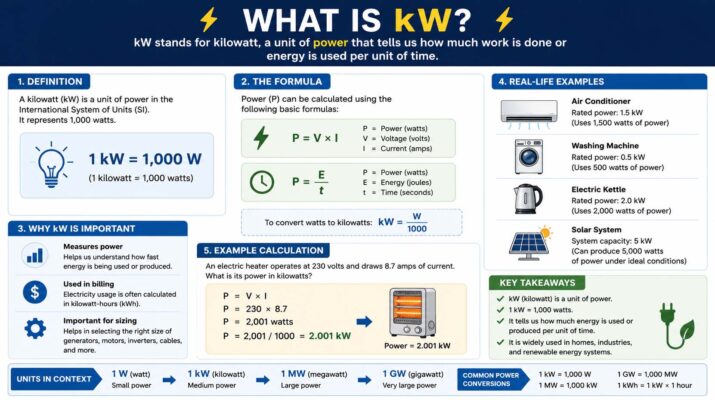
What is KW? The term can have different meanings depending on whether you are studying electricity, engineering, or chemistry. In electrical technology, kW stands for kilowatt, a unit of power equal to 1,000 watts. In chemistry, represents the ion-product constant of water, which helps explain the relationship between hydrogen and hydroxide ions.
Although these terms look similar, they describe completely different scientific concepts. Therefore, understanding the context is essential when reading technical documents, appliance labels, or chemistry textbooks.
For example, kilowatts help people compare electrical equipment and estimate energy consumption. Meanwhile, the ion-product constant helps students understand acids, bases, and pH calculations.
This guide explains both meanings using simple definitions, practical examples, formulas, and comparisons.
What Is KW in Technology?
In electrical technology, kW means kilowatt, a standard unit used to measure power.
One kilowatt equals 1,000 watts. Therefore, a device rated at 2 has a power rating equivalent to 2,000 W.
Electrical power describes the rate at which a device uses or transfers energy. As a result, kilowatt ratings help people understand how much power different systems require.
You will commonly encounter kW measurements in:
- Electrical appliances
- Heating and cooling equipment
- Electric vehicle chargers
- Generators and motors
- Solar power systems
- Industrial machinery
- Commercial electrical installations
For example, an electric heater may have a rated power of 2 kW. This means it uses energy at a rate of 2,000 watts while operating at its rated output.
However, a power rating alone does not tell you the total energy consumed. You must also consider how long the device operates.
How Kilowatts Work
The basic conversion is:
1 kilowatt (kW) = 1,000 watts (W)
A watt measures the rate of energy transfer, while a kilowatt represents 1,000 watts.
For example:
- 500 W = 0.5 kW
- 1,000 W = 1 kW
- 1,500 W = 1.5 kW
- 2,000 W = 2 kW
- 5,000 W = 5 kW
To convert watts into kilowatts, divide the watt value by 1,000.
Kilowatts = Watts ÷ 1,000
Conversely, multiply kilowatts by 1,000 to convert them into watts.
Watts = Kilowatts × 1,000
These conversions are useful when comparing appliances, estimating electrical loads, or reviewing equipment specifications.
In industrial environments, technicians also use what is instrumentation concepts to understand how instruments measure electrical and operating conditions.
Power Versus Energy
Power and energy are related, but they are not interchangeable.
Kilowatts measure power at a particular rate. Kilowatt-hours, however, measure the amount of energy consumed or supplied over time.
For example, a 2 heater running for one hour consumes 2 kWh of electrical energy.
This distinction is particularly important when calculating electricity costs.
Common Examples of Kilowatt Usage
Kilowatt ratings appear on many devices and systems. However, the actual power drawn can vary with operating conditions, settings, and equipment design.
Home Appliances
Electric ovens, heaters, air conditioners, and washing machines may display power ratings in watts or kilowatts.
For instance, an electric heater rated at 1.5 kW has a power rating of 1,500 watts.
However, appliances with thermostats or variable-speed motors may not draw their maximum rated power continuously.
Therefore, the nameplate rating and actual energy consumption can differ.
Electric Vehicles
Electric vehicle charging equipment commonly uses to describe charging power.
For example, a charger delivering 7 kW transfers energy faster than one delivering 3.5 kW under otherwise comparable conditions.
However, actual charging speed also depends on the vehicle’s charging limits, battery condition, and temperature.
Solar Panels
Solar power systems use kilowatt ratings to describe their nominal power capacity.
For example, a residential solar installation might have a rated capacity of 5 kW.
Nevertheless, its actual output changes with sunlight, temperature, shading, and system efficiency.
Industrial Equipment
Factories use kilowatt ratings to describe the power of motors, pumps, compressors, and other machinery.
These measurements help engineers plan electrical installations and evaluate equipment requirements.
Furthermore, modern facilities may use what is telemetry systems to transmit operating data for remote monitoring.
What Is KW in Chemistry?
In chemistry, Kw is the ion-product constant of water, also called the water ionization constant.
Unlike kilowatts, this symbol does not describe electrical power. Instead, it represents an equilibrium relationship involving hydrogen and hydroxide ions in water.
Water undergoes a small amount of self-ionization.
A simplified representation is:
H₂O ⇌ H⁺ + OH⁻
A more chemically detailed representation is:
2H₂O ⇌ H₃O⁺ + OH⁻
Here:
- H₃O⁺ represents the hydronium ion.
- OH⁻ represents the hydroxide ion.
- Kw describes the equilibrium relationship between these ions.
In introductory chemistry, the ion-product constant is commonly expressed as:
Kw = [H₃O⁺][OH⁻]
The brackets represent molar concentrations in the simplified calculation.
More rigorous thermodynamic treatments use ion activities rather than concentrations. However, the concentration-based expression is suitable for many introductory chemistry problems.
Why Water Ionization Matters
Even pure water contains small amounts of hydronium and hydroxide ions.
At 25°C, pure water has approximately equal concentrations of these ions.
Therefore, it is neutral at that temperature.
The ion-product relationship helps explain why increasing the concentration of one ion generally corresponds to a decrease in the other under the same temperature conditions.
What Is the KW Value in Chemistry?
At 25°C, the commonly used ion-product constant of water is:
Kw = 1.0 × 10⁻¹⁴
This approximate value is widely used in introductory acid-base calculations involving dilute aqueous solutions.
At the same temperature, neutral pure water has approximately:
[H₃O⁺] = 1.0 × 10⁻⁷ mol/L
[OH⁻] = 1.0 × 10⁻⁷ mol/L
Multiplying these concentrations gives:
Kw = (1.0 × 10⁻⁷) × (1.0 × 10⁻⁷)
Kw = 1.0 × 10⁻¹⁴
As a result, students can use the relationship to calculate an unknown ion concentration when the other is known.
Does Kw Change With Temperature?
Yes. The ion-product constant of water depends on temperature.
Consequently, the familiar value of 1.0 × 10⁻¹⁴ should not be treated as universal for every temperature.
The pH of neutral water also changes with temperature. Therefore, neutral water does not always have a pH of exactly 7.
However, neutrality still means that hydronium and hydroxide ion activities are equal.
How Kw Helps With pH Calculations
The ion-product relationship is especially useful when studying acids and bases.
For example, if the hydronium ion concentration is known, students can calculate the hydroxide ion concentration using:
[OH⁻] = Kw ÷ [H₃O⁺]
At 25°C, another familiar relationship is:
pH + pOH = 14
This equation is a useful approximation for typical introductory problems involving dilute aqueous solutions.
However, its numerical value changes with temperature because changes.
KW vs Watt vs Kilowatt-Hour
One of the most common mistakes is confusing electrical power with energy consumption.
Although these measurements are related, each describes something different.
| Measurement | Symbol | Meaning |
|---|---|---|
| Watt | W | Basic SI unit of power |
| Kilowatt | kW | 1,000 watts of power |
| Kilowatt-hour | kWh | Energy equal to using 1 kW for one hour |
| Megawatt | MW | 1,000 kilowatts of power |
For example, a heater rated at 2 kW has a power rating of 2,000 watts.
If it operates at that power for three hours, it consumes 6 kWh of energy.
Therefore, describes the rate of energy use, while kWh describes the total energy consumed.
The National Institute of Standards and Technology’s SI unit guidance explains standard measurement units and their correct symbols.
Why Correct Capitalization Matters
The standard symbol for kilowatt is kW, not KW or kw.
The lowercase k represents the SI prefix kilo, while the uppercase W represents watt.
Similarly, kilowatt-hour is written as kWh.
In chemistry, the water ion-product constant is commonly written as Kw, with the w formatted as a subscript when possible.
Although online searches frequently use uppercase KW, correct notation makes technical writing clearer.
How to Calculate Electricity Consumption
Calculating electricity consumption is straightforward when you know the device’s power and operating time.
The basic formula is:
Energy (kWh) = Power (kW) × Time (hours)
Step 1: Find the Power Rating
Check the appliance label or technical specifications.
For example, suppose an electric heater has a rated power of 2 kW.
Step 2: Determine Operating Time
Estimate how many hours the device operates.
In this example, assume the heater runs for five hours.
Step 3: Calculate Energy Use
Multiply the power rating by the operating time.
2 kW × 5 hours = 10 kWh
Therefore, the heater consumes 10 kWh if it operates continuously at its rated power for five hours.
Step 4: Estimate Electricity Cost
Multiply the energy consumed by your electricity rate.
For example, if the electricity rate is $0.20 per kWh:
10 kWh × $0.20 = $2.00
The estimated energy charge would be $2.00.
However, actual electricity bills may also include taxes, fixed charges, and different pricing tiers.
Additionally, thermostats and variable-power operation can reduce actual consumption compared with this simple example.
Why Kilowatts Matter in Modern Technology
Kilowatt measurements are important because they help consumers and engineers compare electrical equipment.
For example, understanding a device’s power rating can support decisions about installation requirements, operating costs, and energy efficiency.
Comparing Electrical Appliances
Power ratings can help estimate how much electricity appliances may use.
However, a lower kW rating does not automatically mean that one appliance is more efficient.
A more powerful device may complete a task faster. Therefore, total energy consumption and performance should also be considered.
Planning Electrical Installations
Engineers use power ratings when selecting electrical equipment and planning circuits.
For example, an installation must support the expected electrical loads safely.
Additionally, some automated systems use what is a solenoid components to control mechanical movement through electromagnetic action.
Monitoring Equipment Performance
Industrial facilities monitor electrical demand to identify unusual operating conditions and manage energy costs.
As a result, power measurements can support maintenance planning and equipment management.
However, accurate monitoring may require additional measurements, including voltage, current, power factor, and energy consumption.
KW in Renewable Energy Systems
Renewable energy technologies frequently use kilowatt ratings to describe power capacity.
However, rated capacity should not be confused with actual energy production.
Solar Energy Systems
A solar installation may have a nominal capacity of 5 kW.
Nevertheless, it will not necessarily generate 5 kW throughout the day.
Its output depends on sunlight, shading, temperature, equipment condition, and system losses.
Therefore, annual energy production is usually expressed in kWh rather than kW.
Wind Power
Small wind turbines may also have rated outputs measured in kilowatts.
However, actual production depends heavily on wind speed and turbine performance.
Consequently, two turbines with identical power ratings can produce different amounts of energy at different locations.
Battery Storage
Battery systems commonly display both power and energy specifications.
For example:
- kW describes how quickly a battery can deliver or receive power.
- kWh describes how much energy the battery can store.
Therefore, both measurements matter when evaluating battery performance.
Electrical installations may also use single phase vs three phase configurations depending on the application and power requirements.
Common Misunderstandings About KW
Because the same letters appear in different subjects, several misunderstandings are common.
Mistake 1: Confusing kW With kWh
Kilowatts measure power, while kilowatt-hours measure energy.
For example, a 1 kW appliance running for four hours consumes 4 kWh.
Therefore, the two measurements should not be used interchangeably.
Mistake 2: Assuming Higher Power Always Means Higher Efficiency
A higher power rating does not necessarily indicate better or worse efficiency.
Instead, efficiency depends on how effectively a device converts or uses energy for its intended purpose.
For example, two appliances with different power ratings may complete the same task in different amounts of time.
Mistake 3: Treating the Chemistry Constant as an Electrical Unit
The chemistry symbol is unrelated to the electrical unit kW.
While one describes water ionization equilibrium, the other measures power.
Therefore, always check the scientific context before interpreting the symbol.
Mistake 4: Assuming Solar Systems Produce Rated Power Continuously
A solar system’s rated capacity describes performance under specified test conditions.
However, real-world output varies throughout the day.
As a result, energy production estimates must account for local conditions and system performance.
Industrial automation also uses what is an actuator technology to convert energy into mechanical movement.
How to Identify the Correct Meaning of KW
If you encounter this abbreviation in a document, begin by examining the surrounding information.
In Electrical Technology
The term usually refers to kilowatts when the discussion involves:
- Power ratings
- Motors and generators
- Electric vehicle charging
- Solar installations
- Heating equipment
- Electrical demand
For example, a motor specification showing 5 kW refers to power.
In Chemistry
The symbol Kw refers to the ion-product constant when the discussion involves:
- Water ionization
- Hydronium ions
- Hydroxide ions
- Acids and bases
- pH and pOH
- Chemical equilibrium
For example, the expression Kw = 1.0 × 10⁻¹⁴ at 25°C refers to water ionization.
Therefore, identifying the subject area usually resolves the confusion immediately.
Why Students Learn About KW in Science
Students encounter these concepts in several educational subjects.
In physics, kilowatts help explain power, energy transfer, and electrical systems.
In engineering, power ratings support equipment selection and system design.
Meanwhile, chemistry students use Kw to understand aqueous equilibrium and acid-base behavior.
Environmental science also uses power and energy measurements when evaluating renewable energy systems.
As a result, understanding the distinction helps students interpret formulas and technical information more accurately.
Frequently Asked Questions About KW
What is KW?
KW can refer to different concepts depending on the context. In electricity, the correctly written symbol means kilowatt, a unit of power. In chemistry, represents the ion-product constant of water.
What is a KW in electricity?
A kilowatt equals 1,000 watts. It measures power rather than the total amount of energy consumed over time.
What is KW in chemistry?
In chemistry, Kw is the ion-product constant of water. It describes the equilibrium relationship between hydronium and hydroxide ions.
What is the value of Kw in chemistry?
At 25°C, the commonly used value is approximately 1.0 × 10⁻¹⁴. However, this value changes with temperature.
What is the difference between kW and kWh?
A kilowatt measures power, while a kilowatt-hour measures energy. For example, using 1 kW of power continuously for two hours consumes 2 kWh.
Is 1 kW equal to 1,000 watts?
Yes. One kilowatt is exactly equal to 1,000 watts.
Does a higher kW rating increase electricity bills?
Not necessarily. Electricity bills generally depend on energy consumption measured in kWh. Therefore, operating time and actual power use are also important.
Is KW the same in physics and chemistry?
No. In physics and electrical engineering, kW is a unit of power. In chemistry, Kw refers to the ion-product constant of water.
Conclusion
Understanding what is KW becomes easier when you consider the subject being discussed. In electricity and engineering, kW means kilowatt, a unit used to measure power. It helps explain appliance ratings, charging systems, electrical equipment, and energy consumption.
In chemistry, however, represents the ion-product constant of water. This relationship helps students understand water ionization, acid-base equilibrium, and pH calculations.
Although the symbols look similar, their meanings are different. Therefore, checking the context and using the correct notation will help you interpret technical information accurately.