
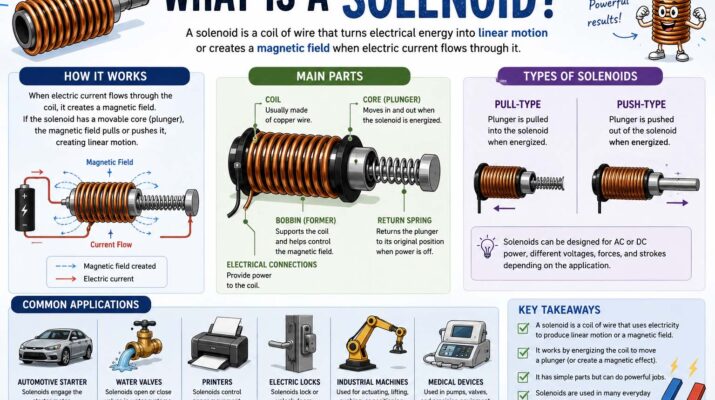
Many beginners ask, what is a solenoid? A solenoid is an electromagnetic device that uses a coil to create a magnetic field and produce controlled mechanical movement. Therefore, it provides a practical way to convert electrical energy into motion in many systems.
From cars and washing machines to smart locks and industrial equipment, solenoids play an important role in everyday technology. Although the term may sound technical, the basic operating principle becomes easy to understand once you know how electromagnetism moves the internal plunger.
What Is a Solenoid?
A solenoid generally consists of a coil of wire that creates a magnetic field when electric current flows through it. In many practical devices, this magnetic field moves a metal plunger or armature to perform mechanical work.
In simple terms, a solenoid can turn electrical input into controlled physical movement. As a result, engineers often use it alongside what is an actuator technology in automated systems.
For example, solenoid-driven mechanisms can:
- Open or close valves
- Lock or unlock doors
- Engage starter systems
- Control fluid flow
- Activate switches
- Operate mechanical components
Because solenoids can respond quickly to electrical signals, they suit many switching and automation applications.
How Does a Solenoid Work?
A solenoid works through electromagnetism. When electric current passes through its wire coil, the current creates a magnetic field around the coil.
That magnetic field can attract or move a ferromagnetic plunger inside the assembly. Consequently, the plunger produces the linear push-or-pull action required by the connected mechanism.
When the electrical supply stops, the magnetic field collapses. Then, a spring or another restoring mechanism can return the plunger to its starting position.
For a broader explanation, you can read Encyclopaedia Britannica’s overview of the solenoid and its electromagnetic function.
Main Parts of a Solenoid
Understanding the main components makes the operating principle easier to follow. Although designs vary by application, many electromechanical solenoids contain several basic parts.
Coil
The coil consists of insulated wire wound into a cylindrical form. When current flows through it, the coil produces the magnetic field required for operation.
Plunger or Armature
The metal plunger moves in response to the magnetic field. As a result, it provides the mechanical action needed to operate another component.
Housing
The housing protects and supports the internal components. In addition, its design may help position the coil and moving parts correctly.
Spring
Many designs use a spring to return the plunger after electrical power stops. Therefore, the mechanism can reset before the next activation.
Together, these parts allow an electrical signal to create predictable mechanical movement.
What Is a Solenoid Valve?
A solenoid valve controls the flow of a liquid or gas with an electrically operated mechanism. In this application, the solenoid moves part of the valve so the system can open, close, or redirect flow.
For example, manufacturers use solenoid valves in:
- Water systems
- Air-conditioning equipment
- Industrial machinery
- Coffee machines
- Irrigation systems
- Fuel systems
In addition, automated plumbing and water-control systems can use these valves to manage flow without requiring someone to operate a manual valve.
The exact operating method varies between valve designs. However, the basic idea remains the same: an electrical signal controls a mechanical valve action.
Solenoids in Cars
Vehicles use several types of solenoids for different electrical and mechanical functions. Therefore, the meaning of a solenoid in a car depends on the specific system being discussed.
Common automotive applications include:
- Starter systems
- Automatic transmission controls
- Fuel-related systems
- Variable valve timing
- Electric door locks
If one of these components develops a fault, the symptoms depend on its purpose and the vehicle design.
Starter Solenoid
A starter solenoid helps control the electrical connection used to operate the starter motor. When the driver starts the vehicle, the starting circuit activates the solenoid.
A starter-system problem may produce symptoms such as:
- Clicking when attempting to start
- An engine that does not crank
- Intermittent starting problems
However, these symptoms do not prove that the solenoid itself has failed. Battery, wiring, connection, starter motor, and other electrical problems can produce similar symptoms.
What Is a VVT Solenoid?
VVT stands for Variable Valve Timing. In engines that use this technology, a VVT solenoid can regulate oil flow within the variable valve timing system.
As a result, the system can help control valve timing according to operating conditions. Depending on the engine design, variable valve timing can contribute to:
- Engine performance
- Fuel efficiency
- Acceleration characteristics
- Emissions management
A malfunctioning VVT system may cause symptoms such as rough operation, reduced performance, or a warning light. However, proper diagnosis matters because several engine problems can produce similar symptoms.
Common Uses of Solenoids
Solenoids appear in many consumer, automotive, and industrial systems. Their specific design changes according to the required force, movement, voltage, and operating environment.
Smart Door Locks
Some electronic locks use a solenoid mechanism to move a locking component. Therefore, an electrical control system can lock or unlock the mechanism automatically.
Washing Machines
Washing machines commonly use electrically controlled valves to manage incoming water. As a result, the appliance can control water flow during different stages of a wash cycle.
Printers
Some printer mechanisms use solenoid-based actuators for rapid mechanical actions. However, the exact design depends on the printer model and technology.
Industrial Automation
Factories use solenoids in valves, actuators, and control mechanisms. In addition, these systems can operate alongside what is instrumentation equipment for measurement and process control.
Robotics
Certain robotic systems use solenoids when they need fast, relatively simple linear motion. Meanwhile, motors and other actuator technologies handle applications that require different movement characteristics.
Solenoid vs Motor Comparison
People sometimes confuse solenoids with electric motors because both convert electrical energy into mechanical action. However, their typical movement and applications differ.
| Feature | Solenoid | Electric Motor |
|---|---|---|
| Typical function | Short linear action | Rotational motion |
| Motion type | Push or pull | Rotation |
| Operation | Often intermittent | Can provide continuous rotation |
| Common use | Valves, locks, switches | Fans, pumps, wheels |
| Basic principle | Electromagnetic actuation | Electromagnetic rotation |
Therefore, a solenoid often works well when a system needs a short push-or-pull movement. On the other hand, an electric motor usually suits applications that require sustained rotation.
How to Check a Solenoid Safely
Basic inspection can help identify obvious problems. However, electrical and automotive systems can involve hazardous voltage, current, heat, or moving components. Always follow the equipment manufacturer’s service information and appropriate safety procedures.
Step 1: Disconnect Power
First, isolate electrical power before physically inspecting a component when the manufacturer’s procedure requires it. This reduces the risk of accidental activation.
Step 2: Check the Wiring
Next, inspect accessible connectors and wiring for loose connections, corrosion, or visible damage. A wiring problem can prevent a working solenoid from receiving the correct electrical supply.
Step 3: Check for Normal Operation
Some solenoids make an audible click when they operate. However, a click alone does not confirm that the entire mechanism works correctly.
Step 4: Test the Coil Correctly
A technician may use a multimeter to test coil resistance according to the manufacturer’s specifications. Therefore, compare any measurement with the correct specification rather than assuming one resistance value applies to every solenoid.
Step 5: Inspect for Visible Damage
Finally, look for signs such as damaged connectors, corrosion, overheating, or mechanical obstruction. If the device belongs to a safety-critical system, professional diagnosis may be the safer option.
Common Solenoid Problems
Solenoids can develop faults because of electrical, mechanical, or environmental conditions. For example, heat, contamination, corrosion, and damaged wiring may interfere with normal operation.
Overheating
Excessive heat can damage insulation or other internal components. Therefore, the cause of overheating should also be investigated rather than simply replacing the damaged part.
Dirt and Debris
Contamination can restrict moving components in some designs. As a result, the plunger or connected valve may not move freely.
Electrical Failure
A damaged coil, poor connection, incorrect supply, or wiring fault can prevent normal activation. Consequently, electrical testing may be necessary to locate the actual problem.
Worn Mechanical Parts
Springs and other moving components can wear over time. Therefore, an older mechanism may fail to return or operate correctly.
Troubleshooting a Faulty Solenoid
The correct troubleshooting method depends on the application. Nevertheless, several symptoms can provide useful starting points for diagnosis.
Solenoid Not Clicking
If a normally audible solenoid does not activate, check the power supply, wiring, connector, control signal, and coil according to the appropriate service procedure.
Mechanism Stuck Open or Closed
Dirt, corrosion, mechanical damage, or another obstruction may prevent movement. However, the exact cause depends on the device.
Weak Mechanical Action
Incorrect voltage, excessive resistance, mechanical friction, or an internal fault may reduce performance. Therefore, testing both the electrical supply and the mechanism can help narrow down the cause.
Car Starting Issues
A starter solenoid problem can interrupt normal starter operation. However, a weak battery, damaged cable, poor electrical connection, faulty starter, or another problem may cause similar symptoms.
Why Solenoids Matter in Modern Technology
Engineers use solenoids because they can provide fast electrical control of mechanical systems. In addition, manufacturers can design them in many sizes and configurations for specific applications.
Common advantages include:
- Fast actuation
- Compact designs
- Simple electrical control
- Integration with automated systems
- Availability for many applications
Industrial environments may also combine electromagnetic actuators with what is telemetry systems to monitor equipment remotely.
As a result, solenoids remain useful wherever a control system needs to trigger a straightforward mechanical action.
Solenoids in Smart Home Technology
Home automation systems can use solenoid-based components in several applications. For example, an electrically controlled water valve can respond to a smart controller or leak-detection system.
Other potential applications include:
- Smart locks
- Water-control systems
- HVAC equipment
- Irrigation
- Security mechanisms
However, not every smart device uses a solenoid. Manufacturers may choose motors, relays, electronic switches, or other actuator technologies depending on the application.
Solenoid Technology in 2026
Automation continues to create applications for compact electromechanical components. Therefore, engineers continue to optimize actuator systems for factors such as size, power consumption, response, durability, and control.
Solenoids can also operate as part of larger automated systems rather than as isolated components. For example, sensors and controllers can determine when an electrical signal should activate a valve or mechanical mechanism.
Many of these systems relate closely to what is mechatronics, which combines mechanical, electrical, electronic, and control engineering.
Meanwhile, industrial equipment may operate with single phase vs three phase electrical systems depending on the equipment and application.
FAQ About Solenoids
What is a solenoid?
A solenoid is a coil that produces a magnetic field when electric current flows through it. In many electromechanical devices, that field moves a plunger or armature to create mechanical action.
What is a solenoid valve?
A solenoid valve uses an electrically controlled solenoid mechanism to operate a valve. Therefore, a control signal can regulate the flow of liquid or gas.
What does a solenoid do in a car?
A vehicle can contain several solenoids with different functions. For example, manufacturers use them in starter circuits, transmissions, variable valve timing systems, and other electrically controlled mechanisms.
What is a VVT solenoid?
A VVT solenoid helps regulate oil flow in certain variable valve timing systems. As a result, the engine control system can adjust valve timing according to operating conditions.
Can a faulty solenoid be repaired?
It depends on the design and the type of failure. For instance, contamination or an external connection problem may sometimes be corrected, while a damaged sealed coil assembly may require replacement.
Why do solenoids fail?
Heat, contamination, corrosion, mechanical wear, wiring problems, or coil damage can cause failure. Therefore, proper diagnosis should identify the cause before replacing a component.
Conclusion
Understanding the basic function of a solenoid makes it easier to see how electrical systems can create mechanical movement. These electromagnetic components appear in vehicles, valves, appliances, locks, industrial equipment, and many automated systems.
In particular, their ability to respond to electrical control signals makes them useful for straightforward push, pull, switching, and valve operations. As automation develops, solenoids will continue working alongside sensors, controllers, motors, and other actuator technologies in modern electrical and mechanical systems.